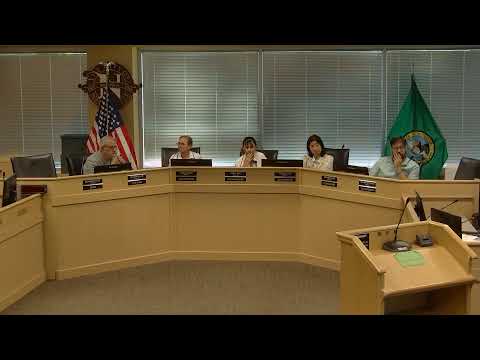
Attorney outlines draft small wireless facilities code, commissioners press on coverage and aesthetics
Summary
An attorney for Ogden Murphy Wallace presented a draft small wireless facilities code to the Newcastle Planning Commission, describing franchise, permitting, and design standards while commissioners questioned coverage, height rules and community input on aesthetics.
Daniel Kenny, an attorney with Ogden Murphy Wallace, presented the commission with the first draft of a small wireless facilities code and framed it as a way to allow modern wireless deployment while preserving local aesthetics and complying with FCC parameters. "I'm an attorney with Ogden Murphy Wallace, and I'm here tonight to talk to you about your small wireless facilities code update," Kenny said. He explained the code would make small wireless facilities a permitted use across the city, require franchises for right-of-way access, and use a quick administrative (Type 1) review to meet federal review timelines.
Commissioners pressed staff and the presenter on practical impacts: whether the code would resolve localized dead zones, how height limits are measured (the draft compares pole height to existing surrounding structures, not potentially permitted future buildings), and how long applicants could expect review. Kenny said the FCC sets many of the technical constraints — for example, antennas are limited to 3 cubic feet and equipment to 28 cubic feet — and noted collocations on existing poles would face shorter review timelines. He also described siting and design choices, including a preference for corner placements over mid-block installations and options to conceal equipment in poles or street furniture to reduce visual clutter.
The draft also includes a requirement that applicants provide an affidavit from an RF engineer confirming the proposed installation complies with FCC health and human-safety standards; Kenny emphasized the city is preempted from regulating health impacts directly. Commissioners asked about batching contiguous-site applications to speed reviews and how design-zone language would operate in historic downtown areas; staff recommended leaving flexible design-zone language in the code as a placeholder to be assigned geographies later. Next procedural steps discussed included additional public input and follow-up meetings on macro and micro wireless updates.
AI generated
The text on this page is AI generated. Summaries, highlights, analysis, and video transcripts are all produced from the original source material.
AI can make mistakes, so if you spot one, and we will fix it for everyone.
Note: the source content is unaltered by us. Any content source we link to, be it a video, an audio recording, or a document, is presented exactly as its publisher released it. That publisher is usually a government body, sometimes an individual official or another organisation.