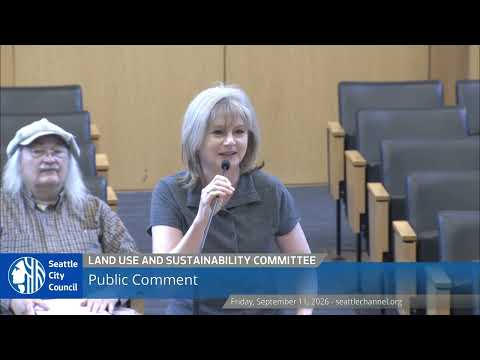
Public commenters urge restoring setbacks and equity analysis as tree rules are debated
Summary
Speakers from TriAction Seattle, Tree Action Seattle and others thanked the committee for stronger parking-lot tree rules but urged restoring a 10-foot institutional setback, protections for heritage trees, and a racial equity toolkit analysis because affected institutions are concentrated in communities of color.
Multiple public commenters told the committee that the proposed changes to parking-lot landscaping are a positive step but that setbacks and equity analyses need attention. Sarah Lapis of TriAction Seattle told the committee she was "thrilled" about the parking-lot amendment but asked the committee to "look at setbacks" and to "restore the 10 foot setback for institutions" so trees and canopy are preserved.
Sandy Shetler of Tree Action Seattle said parking lots are "a critical heat sink" and urged stronger protections in dense multifamily zones where setbacks are oftentimes the only place trees can be planted. She cited staff or bill figures that "this bill would affect 180 small institutions" and said roughly "62% of them are in the Central District, Beacon Hill and Rainier Valley," neighborhoods where canopy loss and racial equity concerns are concentrated. June Blue Spruce, speaking remotely, said a racial equity toolkit analysis should be performed, adding that "green factor does not equal trees" and that tree planting and stormwater benefits are materially different from general green-factor compliance.
Speakers also raised preservation of older and street trees and the potential for developer pressure on small institutions. Fritz Wallet, a retired assistant city attorney, warned of possible solicitations to purchase properties and asked the council to consider protections for small institutions and churches. The public comments framed trees as a public-health, environmental-justice and neighborhood character issue the committee should consider as it refines the proposal.
AI generated
The text on this page is AI generated. Summaries, highlights, analysis, and video transcripts are all produced from the original source material.
AI can make mistakes, so if you spot one, and we will fix it for everyone.
Note: the source content is unaltered by us. Any content source we link to, be it a video, an audio recording, or a document, is presented exactly as its publisher released it. That publisher is usually a government body, sometimes an individual official or another organisation.