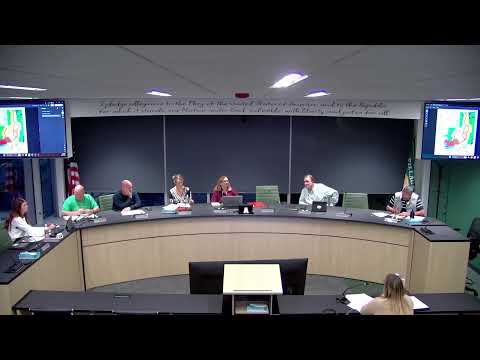
Plan Commission reviews comprehensive plan amendment proposing mixed‑use district and 161‑unit senior housing
Summary
The Kewaskum Plan Commission reviewed a draft comprehensive plan amendment that would reassign multiple parcels in the TID 6 area for medium‑, medium‑high and high‑density uses, add about 5 acres of planned mixed‑use, and allow a proposed 161‑unit senior housing building; staff asked for feedback before scheduling a 30‑day public hearing.
On Sept. 16, 2026, the Kewaskum Plan Commission held a discussion‑only review of a proposed comprehensive plan amendment that would update the village’s future land‑use map for several parcels tied to TID 6 development. Hannah, the county senior municipal planner leading the presentation, said the package is intended to give the village options for future redevelopment rather than immediate zoning changes.
Hannah summarized the primary changes: approximately 46.6 acres would remain designated medium density; the proposal would add a planned mixed‑use district of roughly 5 acres; the plan includes medium‑to‑high density areas with twin‑home (fee‑simple) units and reduces a minimum lot size in one category from about 7,200 to 6,000 square feet. "Approximately 46.6 acres is proposed to remain as medium density," Hannah said, describing the distribution of proposed land‑use categories. She also described a high‑density residential area proposed for a senior housing facility: "...a 161 units to be proposed" on just under 4 acres, which would raise the village average density from about 21.8 dwelling units per acre to roughly 42 DU/acre.
The proposal would reclassify about 6 acres of primary environmental corridor at the corridor fringe to medium density; Hannah outlined conditions staff would treat as necessary for such conversions, including compact disturbance, edge‑only impacts, protections for corridor integrity and no significant adverse water‑quality impacts. Hannah said deed restrictions or conservation easements could be imposed later in the development agreement stage.
Commissioners asked technical and code questions. Trustee Jim Wright asked whether the village’s current single‑ and two‑family zoning accommodates zero‑lot‑line/twin‑home arrangements; staff said code amendments could be required if the village wants to permit fee‑simple twin homes. Commissioners also discussed whether to retain a planned mixed‑use designation or change the central parcel to high‑density residential. "This district would allow the village to carefully plan for future development while maintaining the village's predominantly single family character," Hannah said when describing the planned mixed‑use option.
Staff recommended consulting the Southeastern Wisconsin Regional Planning Commission to determine whether a sanitary sewer service area amendment is required because the development would increase the number of dwelling units beyond previous assumptions; Hannah noted the last comprehensive plan was completed in 1988 with amendments through 2024. She closed by reminding commissioners that a formal comprehensive plan amendment would require a 30‑day class 1 public hearing notice under state law and subsequent resolution and ordinance actions if the village pursues adoption.
Next steps: staff will revise the draft using the commission’s feedback and, if the commission directs, will schedule the required 30‑day public hearing and prepare ordinance/resolution language for future action.
AI generated
The text on this page is AI generated. Summaries, highlights, analysis, and video transcripts are all produced from the original source material.
AI can make mistakes, so if you spot one, and we will fix it for everyone.
Note: the source content is unaltered by us. Any content source we link to, be it a video, an audio recording, or a document, is presented exactly as its publisher released it. That publisher is usually a government body, sometimes an individual official or another organisation.