Get email alerts on the Sustainability Plan topic
No spam. Unsubscribe anytime.
Wake Forest planners begin 16‑month sustainability plan process
Summary
Consultants from BlueStrike Environmental outlined a baseline assessment, greenhouse‑gas inventory, climate vulnerability review and broad community engagement as part of a sustainability plan expected to take about 16 months and to set a 5–10 year implementation horizon.
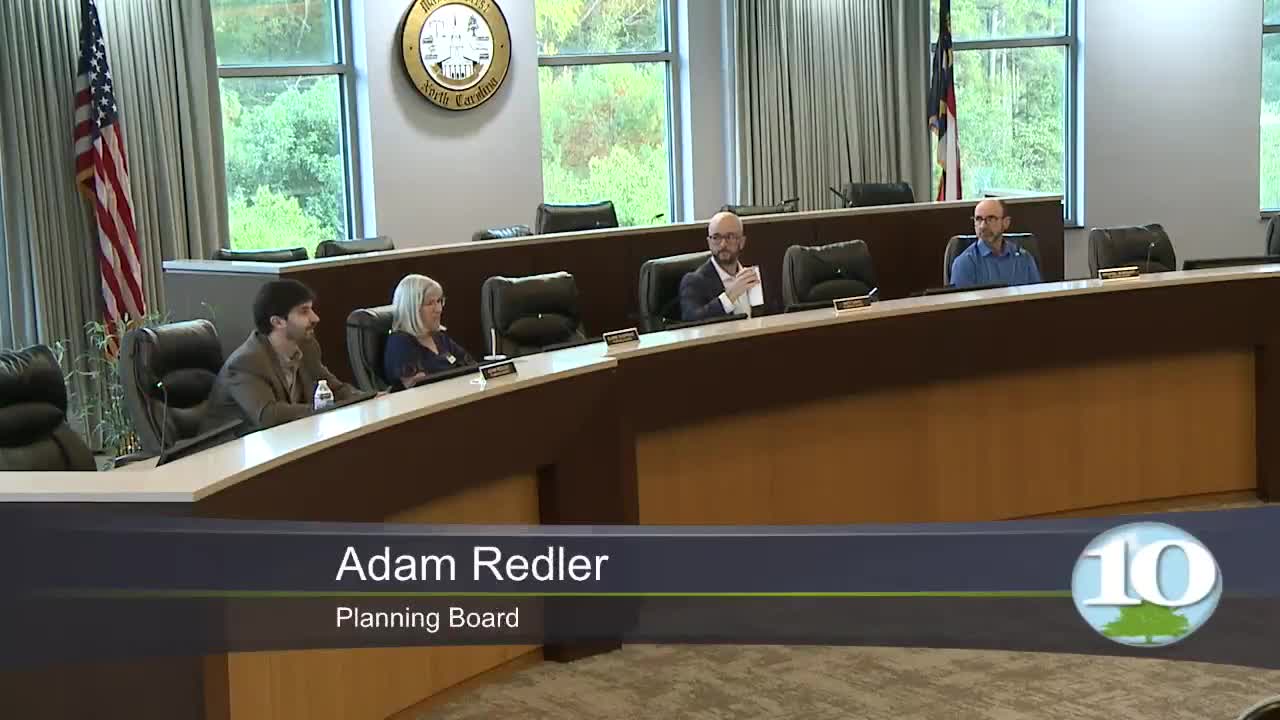
The Wake Forest Planning Board heard a kickoff presentation on a townwide sustainability plan at a special called work session, where consultants described a 16‑month development timeline and a plan intended to set 5–10 year implementation goals.
Carrie Grace, projects and programs manager with the planning department, introduced the presentation and said consultants would both provide an overview and solicit early feedback from board members.
“a sustainability plan ought to deliver something that moves you from where you are to where you want to go and provides the steps for how to get there,” said Rich Swanson, director of the energy and climate division at BlueStrike Environmental.
Cisco Temecino, a manager with BlueStrike, said the firm will produce an existing‑conditions assessment, a greenhouse‑gas inventory that separates town government operations from community emissions, a climate vulnerability and risk assessment, and a step‑by‑step implementation plan. “it'll take about 16 months,” Temecino said when asked about the timeline; the consultants described a planning time horizon of roughly five to ten years for implementation.
Consultants described a three‑phase approach: a baseline phase that compiles quantitative and policy data, an engagement phase that runs through the project, and a strategy phase to translate findings into goals, strategies and actions. BlueStrike said it is reviewing existing town policies and peer plans, and tailoring recommendations to improve alignment with county and state programs to support funding applications.
Board members and staff discussed likely priority areas that residents have raised so far, including resilience and natural habitat protection, the town tree canopy, traffic impacts and building energy efficiency for new multifamily and townhouse developments. Board members suggested practical measures such as syncing traffic signals, roundabouts, bicycle and pedestrian improvements, and encouraging “solar‑ready” wiring in new construction.
BlueStrike said the engagement schedule includes focus groups, meetings with the board of commissioners and town staff, a steering committee, open houses planned for December 4, and a public survey open in December and January. The consultants also noted prior and ongoing projects in the region — including work with Orange County, Davidson and Durham County — as examples of similar effort and outputs.
No formal votes or policy actions were taken at the session. The presentation concluded with an invitation for the planning board to provide high‑level guidance and for staff and consultants to continue public outreach and baseline research.
Next steps the consultants outlined include completing the baseline assessment by the end of winter, continuing stakeholder engagement through spring, and drafting strategies for a plan wrap up late in 2026.
AI generated
The text on this page is AI generated. Summaries, highlights, analysis, and video transcripts are all produced from the original source material.
AI can make mistakes, so if you spot one, and we will fix it for everyone.
Note: the source content is unaltered by us. Any content source we link to, be it a video, an audio recording, or a document, is presented exactly as its publisher released it. That publisher is usually a government body, sometimes an individual official or another organisation.