Lifetime Citizen Portal Access — AI Briefings, Alerts & Unlimited Follows
Littleton board reviews South Metro waste-diversion timeline, hauler licensing and outreach plans
Loading...
Summary
The Littleton City Environmental Stewardship Board on Wednesday reviewed staff’s timeline for the South Metro Waste Diversion Plan and discussed next steps including community outreach, hauler licensing and regional coordination.
The Littleton City Environmental Stewardship Board on Wednesday reviewed staff’s timeline for the South Metro Waste Diversion Plan and discussed next steps including community outreach, hauler licensing and regional coordination.
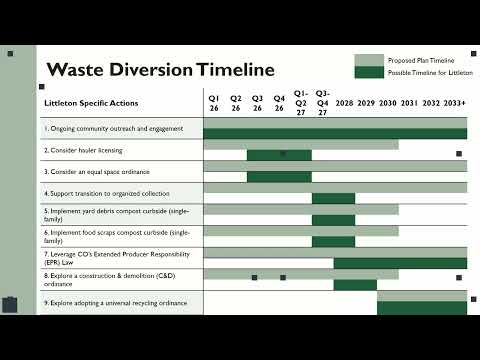
"I'm just gonna share with y'all now what I'm planning to present to council," staff member Laura said, describing a plan that staff will ask the City Council to adopt by resolution and then implement in stages. Laura said the near-term focus is community outreach and engagement in 2026, and that hauler licensing work would likely be “teeing it all up in 2026” with licensing actions beginning in 2027.
Nut graf: Board members spent the meeting weighing how the city should inform and involve residents and property owners about potential changes, including a licensing requirement for companies that operate as waste haulers in Littleton, and whether the board should help plan or only support outreach events. The licensing discussion covered technical and legal points staff must resolve before council considers an ordinance.
Laura told the board licensing would be established under the city's business-license authority and include specific operational requirements and fees. "We would have very specific requirements. And if they cannot prove that they can meet said requirements and they don't pay," Laura said, describing a model other cities use that assesses per-truck fees to reflect pavement and infrastructure impacts.
Board members and staff flagged several legal and practical constraints. Laura cautioned that Colorado statutes allow homeowners associations and some commercial entities to opt out of organized-collection programs, meaning licensing or a citywide single-hauler contract would not automatically cover all multifamily or HOA properties. She also noted that the licensing approach would not itself require an RFP; by contrast, a city-contracted single- or limited-hauler model would require a competitive procurement process and take longer to implement.
Board members focused heavily on outreach strategy and timing. Several members urged a phased approach with broad education before any mandatory changes. "Not everyone has the opportunity or the free time to do so, but everyone has trash," Laura said, arguing outreach must reach people who do not follow municipal communications.
Members suggested practical, event-driven outreach ideas: neighborhood block parties augmented with e-waste drop-off points; a large annual regional recycling event that consolidates hard-to-recycle streams (paint, electronics, pharmaceuticals); and partnerships with nonprofits, churches and service organizations to amplify notices and operate volunteer-run collection points.
The board also discussed coordination with neighboring jurisdictions. Laura said she is talking with Sheridan, Englewood and Centennial about shared messaging and that regional planning could affect timing for infrastructure such as organics processing. She and other speakers referenced Colorado’s extended producer responsibility (EPR) efforts as a potential funding source; a board member noted EPR-related funding availability beginning January 1.
No formal motion or vote occurred at the meeting. Laura said the staff presentation will go to City Council for adoption of the South Metro Waste Diversion Plan; individual implementation steps such as an ordinance to establish hauler licensing would return to council later and require two public hearings.
Ending: Board members asked staff to bring drafts and data back to the board before formal council hearings and to coordinate messaging regionally. Several members offered to support outreach in limited roles such as tabling at events or helping identify nonprofit partners, while some emphasized the board’s primary advisory role to City Council rather than operational event planning.