Get Full Government Meeting Transcripts, Videos, & Alerts Forever!
Get email alerts on the Public Safety topic
No spam. Unsubscribe anytime.
Fire chief outlines draft 'Zone 0' rules, timelines; residents urge local advocacy and rebates
Summary
Glendale Fire Chief Jeff Brooks briefed the council on draft Zone 0 defensible‑space rules derived from AB3074 and SB504, explained key restrictions and the rulemaking timeline, and residents urged the city to take a stronger advocacy role and seek assistance for costly vegetation work.
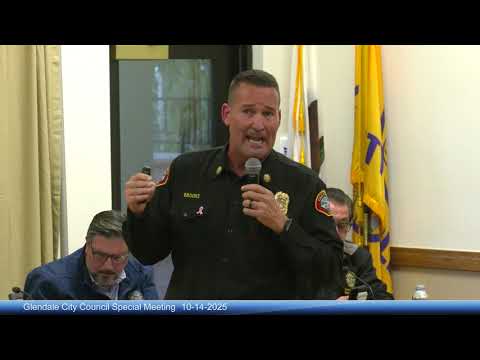
Glendale Fire Chief Jeff Brooks told a neighborhood meeting Oct. 14 that state bills AB3074 and SB504 have prompted draft regulations creating a new “Zone 0” defensible space inside the very‑high fire hazard severity area and that the city — as a local responsibility area — will be responsible for enforcement once the state issues a compliance guidance document.
“Zone 0 is really if you took this wall over here and you came out for the first 5 feet from that wall on the side of your house to that first 5 feet out is considered zone 0,” Chief Brooks said, using the meeting room to illustrate the area likely to be regulated. He described draft restrictions and exceptions now under discussion and said the Board of Forestry must complete an oversight committee’s work by Dec. 31, 2025, and publish formal guidance before any enforcement can begin.
What’s in the draft: Brooks summarized commonly discussed elements in the draft rule. Landscape materials likely to ignite from embers — such as mulch and wood chips — would not be allowed within Zone 0. Potted plants would be allowed if vegetation does not extend more than 18 inches above the pot rim. Trees could remain in Zone 0 but must be maintained so there are no dead or dying branches and lower branches are pruned to prevent fire climbing into the canopy. The draft specifies no tree branches should be within 5 feet of walls or roofs and 10 feet of chimneys; single‑specimen and protected trees have defined exceptions but must still meet protections that “provide the same level of protection,” Brooks said. Gates attached to structures in Zone 0 must be noncombustible and attached fences closest to structures must have a 5‑foot noncombustible span; new combustible fences would be prohibited.
Brooks emphasized local discretion in the draft: within a local responsibility area such as Glendale, the authority having jurisdiction may develop alternative practices for compliance that consider lot size, structure density, proximity to neighboring structures, plant ecology and local ordinances — but any alternative must be supported by a finding that it provides “substantially similar practical effects” to the state regulations.
Timeline and enforcement: Brooks said the oversight committee must finish by Dec. 31, 2025, and that the Board of Forestry will consider rule text and initiate a formal rulemaking process in November 2025 with public comment and revision through December; the board would complete rulemaking in January 2026. Crucially, Brooks said, “These regulations are not effective until a guidance document on compliance is published,” and that enforcement cannot begin until the state’s guidance describes homeowner expectations. He warned the full implementation timeline could extend well into 2026.
Local impact numbers presented by Brooks: updated 2025 fire hazard maps increased the city’s acreage in hazard zones (total hazard acreage changed from 12,242 to 14,968 in the presenter’s slide set; very‑high acreage rose from 11,378 to 13,328). The Glendale Fire Department currently conducts about 8,973 parcel inspections annually; the presenter said adding 7,420 parcels to the very‑high category would represent an 83% increase in mandated inspections and could affect roughly 16,000 residents.
Resident reaction and requests: callers and speakers urged the city to take a more proactive position at the state Board of Forestry and to press for financial help for homeowners who must alter landscapes. Anna Tabuena Reddy said removing vegetation within the first five feet of buildings can be costly and that well‑maintained native vegetation can serve as a wildfire buffer. “I think a one‑size‑fits‑all approach ends up being a one‑size‑fits‑none,” Reddy said, and she urged the city to advocate for rebates or programs to help residents prune and irrigate trees.
Beth Brooks echoed calls for stronger outreach and clearer cost information, urging the city to advertise the financial effects of compliance so residents can respond. Several commenters pointed to the need for the city to participate actively in state technical committees and to press for guidance that allows site‑specific alternatives in Glendale.
Discussion versus decision: the presentation was informational. No ordinance, formal motion or enforcement action was taken at the meeting; staff said the city continues to monitor Board of Forestry rulemaking and would consult the city attorney about local alternatives and findings if the state adopts final regulations.
Clarifying details from the presentation: key draft limits include a 5‑foot Zone 0 measured from the structure, prohibition of easily‑ignited landscaping materials in Zone 0, potted plant height limits (veg not to extend more than 18 inches above pot rim), pruning and clearance requirements for trees (no branches within 5 feet of walls/roofs, 10 feet of chimneys), noncombustible gates and a 5‑foot noncombustible span for attached fences, ADUs must comply but a neighbor’s ADU cannot trigger requirements on another property, and a legal test requiring alternative local practices to show “substantially similar practical effects.”
Next steps: city staff will continue to track the Board of Forestry meetings (noting additional public meetings Oct. 23 and Nov. 3) and will await the state’s compliance guidance before any enforcement. Residents asked the council to increase local outreach and to explore rebate or assistance programs for costly vegetation management work.