Get AI Briefings, Transcripts & Alerts on Local & National Government Meetings — Forever.
Athens council adopts zoning change to treat data centers as conditional use in heavy‑industrial zone
Loading...
Summary
After a public hearing with dozens of residents and experts, the Athens City Council voted 4–0 to amend its zoning code to list data centers as a defined, conditional use limited to the M2 (heavy industrial) district. Speakers pressed for enforceable limits on noise, water and utility impacts.
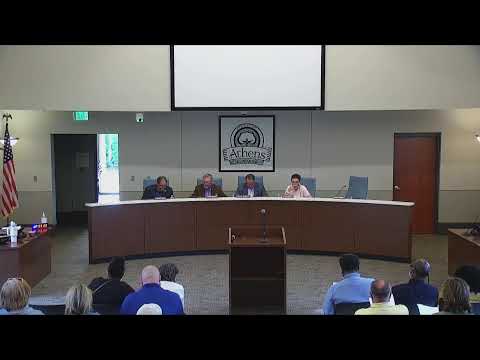
The Athens City Council on April 27 adopted an amendment to the city zoning ordinance that will list “data center” as its own use and make such facilities a conditional (not by‑right) use restricted to the M2 heavy industrial district.
City planner Aaron Tidwell told council the change is a narrow, preventive step: “We’re proposing to amend the zoning ordinance to clearly identify data centers as a defined use and clearly define that data centers are a conditional use in the heavy industrial district in Athens,” he said, explaining that best‑practice guidance from groups such as the American Planning Association and the National League of Cities recommends specific review for these facilities.
Tidwell said data centers are operationally distinct from warehouses and other industrial uses because of electricity and water demand, continuous noise and lighting, enhanced security needs and very low employment density. He told council the city’s current use table does not explicitly address data centers and that, without a distinct category, requests would be handled on an ad hoc basis.
Council members asked about available land. Tidwell said the city has roughly 74 noncontiguous acres zoned M2 on Wilkinson Street and that the largest undeveloped parcel there is about 34 acres — smaller than the 200–1,000 acres commonly cited for very large facilities. “That’s correct,” he said when asked whether a typical large data center would need far more acreage than Athens currently has available.
During public comment, speakers praised the council for acting preemptively but urged stronger, enforceable standards. Charles Miller, policy director at the Alabama Rivers Alliance, commended the council’s proactive step: “Acting proactively before somebody comes in . . . is definitely a very, very positive step.” Diane Steele of the Limestone County NAACP said she supported conditional‑use review but asked for plain‑language clarity about where M2 zoning exists and for protections for residents near industrial areas: “We want some type of assurance that our utility bills will not go through the roof because of a data center,” Steele said.
Other residents and consultants asked the council to require numeric limits for noise and to specify water and power‑use caps, a longer review timeline for technical proposals, and a plan for disposal of server equipment and lithium batteries. A former software engineer warned that a large center can “consume as much water as a city of 50,000 people,” urging the council to consider infrastructure capacity before approving a project.
City staff described the conditional‑use process the Planning Commission will follow: applicants must submit a conceptual site plan, pay a $100 application fee, and the commission has 60 days to approve or deny after required public notice. Tidwell said the commission may impose conditions tailored to the site to mitigate traffic, noise, lighting, water and other impacts; applicants denied by the commission may appeal to council within 15 working days.
After closing the public hearing, council suspended the rules and voted 4–0 to adopt the amendment. The roll call showed Creasy, Golden, Lucas and Seibert voting aye; Henry was recorded absent at roll call earlier in the meeting.
Votes at a glance: the council approved the zoning amendment regarding data centers (4–0); it also advanced a lengthy consent calendar and several contract approvals and change orders by unanimous votes, including acceptance of the low bid for civil grading at Swancutt Substation ($236,245), a $27,825 purchase of security fencing for that substation, a not‑to‑exceed $50,000 materials purchase for Sunrise Park and a $30,000 contract extension with Alta for Sunrise Park administration, a $22,144.60 change order on the US‑72/Hines Street pedestrian crosswalk, and a $184,303.24 change order to Rogers Group on the Mooresville Road/US‑72 improvements. All listed items passed on roll calls recorded as 4 yeas, 0 nays.
Why it matters: making data centers a distinct, conditional use creates a formal review path with public notice and the ability for the Planning Commission to attach enforceable conditions tailored to local threats to utilities, environment and neighboring residences. Residents at the hearing repeatedly asked the council to strengthen the ordinance with concrete limits on noise, water and electricity demand and to ensure oversight of long‑term environmental and utility impacts.
What’s next: the ordinance will guide how future data‑center proposals are reviewed; any developer seeking conditional‑use approval in M2 will face Planning Commission hearings and potential conditions. Several residents said they will submit written recommendations for specific numeric limits and mitigation language to the planning staff and commission.
Reporting note: direct quotations and attributions in this report come from the April 27 public hearing and the city planner’s presentation. If speakers provided written supplements, council staff said those would be taken under advisement in the continuing planning and ordinance drafting process.