Lifetime Citizen Portal Access — AI Briefings, Alerts & Unlimited Follows
Panama City details post‑Michael infrastructure prioritization, emphasizes SRF‑funded water and sewer work
Loading...
Summary
City staff outlined how service‑call data, pavement and sewer inspections, and funding restrictions shaped project areas after Hurricane Michael; the city is using State Revolving Fund loans, FEMA and other grants and aims to complete major work by 2027.
During an update to the Panama City Commission, a city staff member outlined why the city prioritized certain neighborhoods for infrastructure repairs after Hurricane Michael and described the funding sources and timelines that shaped those choices.
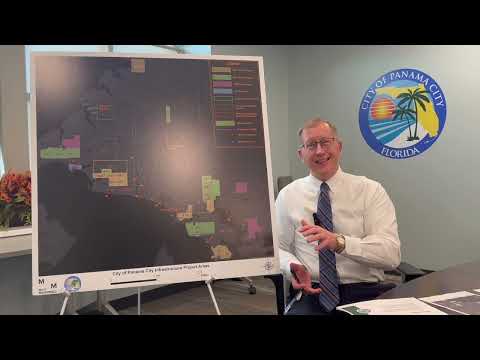
The staff member said the city relied on a decade of service‑request records, a pavement condition index survey, sewer‑line camera inspections and fire‑department water‑pressure data to create a “heat map” that guided where to focus water, sewer and stormwater investment.
The memo to the commission emphasized the State Revolving Fund (SRF), administered in Florida by the Department of Environmental Protection and originating with the U.S. Environmental Protection Agency, as the primary financing tool for many projects. The staff member said the city has been authorized for “around a $106,000,000” from SRF and is evaluating about $20,000,000 more to determine whether it can absorb that additional debt. According to the staff presentation, SRF loans delay the first payment until 2027, include an immediate 25 percent forgiveness of the total loan and carry 0 percent interest on the remaining balance for the life of the loan.
Staff emphasized that SRF projects must be tied to replacing or lining underground utilities. “The road condition did not drive or initiate that project,” the city staff member said, explaining that pavement resurfacing is permitted only where road disruption is needed to install or repair water, sewer or limited stormwater infrastructure. Other funding sources cited — including Community Development Block Grants (CDBG), Hazard Mitigation Grant Program (HMGP) funds and FEMA hazard mitigation appropriations — are restricted to particular uses or geographies, the presentation said.
The staff member described several programmatic efforts: moving Lift Station 45 on Beach Drive up to Garden Club Drive to remove it from Saint Andrew Bay; a Project Storm effort covering roughly 40 to 50 lift stations citywide; and permanent bypass pumps for about 30 to 40 identified lift stations. The presentation said permanent bypass pumps will have motors powered by diesel or natural gas to operate if commercial power from Florida Power & Light fails, keeping wastewater moving toward treatment plants in Saint Andrews or Millville. The city also plans communications upgrades for lift stations that currently lack remote monitoring.
Staff noted a state initiative and legislative appropriations to replace septic systems in coastal communities to reduce discharges to waters from Pensacola to Key West; city presenters thanked state and federal legislators for support. The staff said the city is not mandating immediate hook‑up to city water and sewer but explained the state could stop issuing septic permits in the future.
A separate funding stream supports sidewalks, the staff member said, noting a Department of Transportation program that targets sidewalks near schools; the presenter cited a state rule that limits busing for students who live within two miles of a school and said sidewalk funds cannot be used to repair subsurface water or sewer infrastructure.
Staff said many of the agency‑funded projects must be completed by 2027, which constrains sequencing and requires the city to pursue multiple projects and funding streams simultaneously. The staff member said public works will finish a pavement and repaving assessment and present it to the mayor and commission by the end of this calendar year or in early 2026.
“If you live in one of these areas, we understand how disruptive it is,” the staff member said, adding that the work is often “short term pain, but long term gain.” The presentation and staff remarks said project managers, contractors and design engineers coordinate communications with affected residents and that the city holds a monthly town hall on the first Saturday of each month to take citizen questions.
The update identified the narrow reasons projects were chosen — condition of underground utilities, history of service calls, water pressure data and specific grant restrictions — and repeatedly cautioned that surface pavement condition alone was not the primary criterion for selecting SRF project corridors.
No formal motions or votes were recorded in the provided transcript of this update.