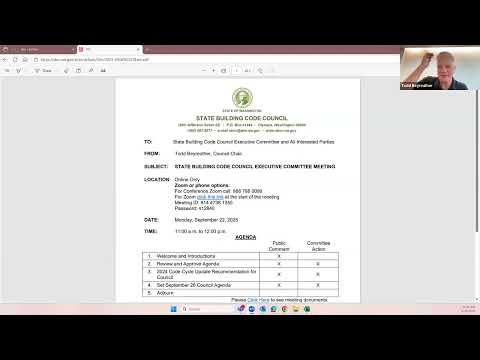
State Building Code Council executive committee weighs delaying 2026 code cycle, requests legislative pathway and extra contracting time
Summary
The State Building Code Council executive committee on Sept. 22 discussed options for completing the 2026 code adoption cycle after staff said the rule‑filing documents required for an Oct. 1 CR-102 submission were not ready.
The State Building Code Council executive committee on Sept. 22 discussed options for completing the 2026 code adoption cycle after staff said the rule‑filing documents required for an Oct. 1 CR-102 submission were not ready.
The committee’s managing director, Dustin (Managing Director, council staff), told members that most technical advisory work is complete but that staff had not finished the CR-102 filing documents — including the small-business economic‑impact statement and preliminary cost‑benefit analysis — and that coordination with the state rule‑drafting office and volume of work meant the October filing deadline would likely be missed. “The short story to sum it all up is that the CR-102 filing documents are not ready to go,” Dustin said.
That shortfall is compounded by a failed competitive procurement for third‑party analysis the council requires for energy‑code proposals. Dustin said the council had budgeted $200,000 for that contract; only one responsive bidder submitted a nonresponsive proposal for the residential energy code. He said staff plans to reissue the solicitation if the council’s timetable allows more time. “The time frame was the primary factor,” Dustin said; the available contract funding also constrained responses.
Why it matters: Washington law includes multiple timing constraints that affect adoption and implementation. Committee members and staff cited a December 1 decision deadline in RCW 19.27.074(5)(c) and a separate 30‑month deadline tied to publication of model codes; those statutory timelines overlap and sometimes conflict with publication dates set by the International Code Council (ICC). Council members warned the committee could be noncompliant with one RCW or the other depending on how dates fall.
Staff presented a staged approach to reduce statutory risk and give time for the energy‑code contract work. Dustin outlined one option that would: file and pursue final adoption for plumbing and mechanical codes first (targeted toward December), adopt building and fire codes in February, adopt the residential code in April and the energy code in June. He said that sequencing could move the proposed implementation date from Nov. 1, 2026, to May 1, 2027 — effectively a six‑month delay for implementation if the council follows that path. “Yes. And that’s just with getting all the per final adoption. And with all that, the proposed implementation date instead of being 11/01/2026… would be 05/01/2027,” Dustin said.
Members and affected industries urged clarity and a single implementation date. Patrick Hanks of the Building Industry Association of Washington told the committee his membership supports a six‑month delay if it is paired with a unified implementation date so designers, builders and code officials have consistent rules to plan for. “Our preference would be for all residential effects to go into effect at the same time,” Hanks said, adding that staggered implementation “would cause some headaches and problems.” Several private‑industry participants — including members of the design community — cautioned that splitting adoption or implementation dates across different codes would complicate design decisions and permitting.
Committee members discussed whether to seek legislative relief. Chair Todd (chair, executive committee) and other members said the committee could ask the legislature for authority or clarification to preserve an implementation date even if the council must “sit through” a legislative session after adoption. Jay Arnold and other committee members described plans to bring the issue to the House local government committee and recommended authorizing a legislative subgroup to pursue conversations; the chair said staff and legislative committee members had been invited to a working group meeting on Oct. 15.
Staff and members also identified process improvements: additional council or staff resources, better preloading of model‑code drafts and more lead time for third‑party contracts. Several members said additional staff or budget authority would ease bottlenecks but would not be a complete fix unless procurement windows and model‑code publication schedules were addressed.
The executive committee will summarize the discussion and present timeline options and proposed agenda items at a special full council meeting on Friday, Sept. 26, where public comment and any formal recommendations to the full council will be taken. Justin (staff) said he will bring visual schedules with specific filing dates for the Friday meeting.
Votes at a glance - Agenda approval: approved by voice vote (motion moved by Roger Haringa; second by Jay Arnold). - Temporary meeting extension (30 minutes): approved by voice vote (motion moved by Tom Handy; second by Jay Arnold).
AI generated
The text on this page is AI generated. Summaries, highlights, analysis, and video transcripts are all produced from the original source material.
AI can make mistakes, so if you spot one, and we will fix it for everyone.
Note: the source content is unaltered by us. Any content source we link to, be it a video, an audio recording, or a document, is presented exactly as its publisher released it. That publisher is usually a government body, sometimes an individual official or another organisation.