Lifetime Citizen Portal Access — AI Briefings, Alerts & Unlimited Follows
Clute council adopts 2025–26 budget and approves tax rate; debate centers on utility and drainage projects
Loading...
Summary
At a Sept. 25 public hearing, the Clute City Council approved the fiscal 2025–26 budget and adopted an ordinance setting the city's property tax rate; council and staff outlined a multi-year CIP focused on drainage, streets and sewer work and described a mix of grant and local funding for the plan.
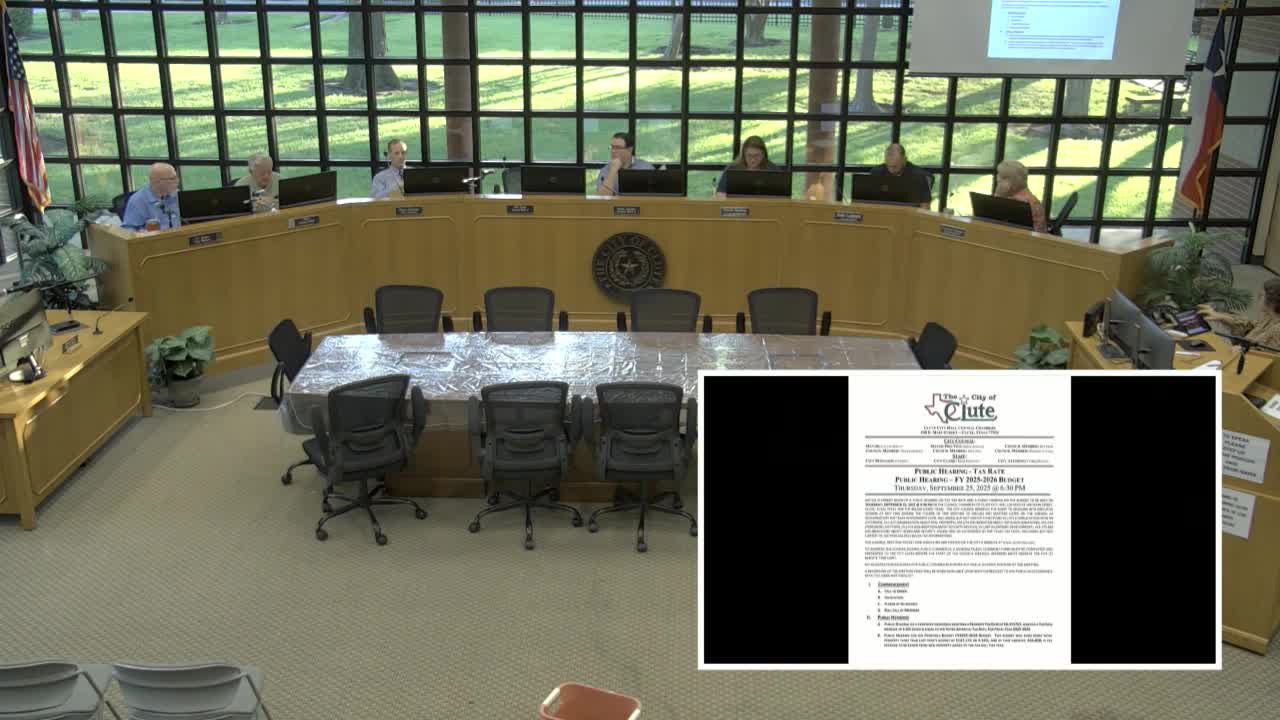
Clute, Texas — The Clute City Council voted Sept. 25 to adopt the city's annual budget for fiscal year Oct. 1, 2025'Sept. 30, 2026, and to set a property tax rate as stated in ordinance 25-018. The city manager and finance staff presented the budget and a 10-year capital improvement plan that emphasizes drainage, streets and sewer projects, and council members debated utility rate changes and project timing before recording the votes. The council's budget resolution (ordinance 25-017) and the tax ordinance (25-018) were acted on following the public hearing required under Texas Truth in Taxation statutes. City staff said the proposed budget includes an additional $187,174 in property-tax revenue (reported as a 4.16% increase in the required Truth in Taxation notice) and that $44,828 of that total is attributable to new property added to the tax roll this year. Why it matters: The adopted budget outlines spending and capital work the city expects to undertake in the coming year, including multi-million-dollar drainage improvements that depend in part on state grants; the tax ordinance sets the city's rate and thereby affects homeowners and other property owners in Clute. City staff summarized the budget figures and the capital program during the hearing. Staff said the general fund revenue in the proposed budget is about $14.8 million and projected general fund expenditures about $15.0 million. The Sidewalks, Streets and Drainage (SDS/CIP) fund and related grant awards were a focal point: staff described two major drainage projects (Flag Lake and Penn Money/Pen Money phases) and said the city has been notified of a $9.0 million award for Penn Money drainage improvements and an additional $1.2 million for inline detention tied to that system; staff said the $1.2 million had not been incorporated into the draft budget because the contract had not been received. The capital plan presented shows roughly $10.4 million of first-year CIP work. Specific year-1 projects described in the hearing include: - Old Angleton relayer and paving to a 35-foot profile (about $1.5 million). - Kyle Road West paving with sidewalk and curb and gutter (about $900,000). - Flag Lake ditch and Pen Money ditch (GLO-funded) improvements; staff described concrete-lined ditch work and installation of box culverts where necessary. Staff said those GLO projects total nearly $7.7 million in construction in the first year but noted that the inline detention phase (about $1.2 million) was not yet included in the draft budget. - Roof and ADA door work at City Hall (about $925,000) and interior remediation (about $100,000). Staff told the council the enterprise fund will fund wastewater projects including lift-station improvements and force main work (examples: Bumpy Road lift station; Dorset/Bumpy Road force main; Emerald subdivision mains), and that a possible meter-system replacement had a placeholder of $1.5 million in year 1 if needed. On utilities and fees, staff said the budget implements a tiered utility-rate structure and overall increases on the average utility bill of roughly 16% driven by a combination of base-rate adjustments and tiered surcharges (staff described an average monthly increase of about 10% for water and 10% for sewer on the typical residential bill). Solid-waste rates were discussed separately: staff said the solid-waste fee would increase (an cited figure was 34.92 in the presentation) and that the city plans an ordinance at a later meeting to impose a specific heavy-trash fee; staff also said the city has applied for a grant to buy a shredder to help manage bulky-item disposal. Funding sources: Staff described a blended funding picture that includes property tax revenue, a 2-cent sales tax allocation (40% to SDS/CIP, about 44% to the Economic Development Corporation, remainder to the general fund), grant awards (including FEMA reimbursements for prior events and upcoming GLO awards), EDC transfers (the EDC prepaid a Kroger mortgage buy-down which improved current-year fund balance), and debt service. Staff said FEMA PDM and public-assistance reimbursements were expected in the next 4–6 months and that those receipts were included as grant revenue in the draft. Formal actions and votes: At the meeting's action portion the council moved and seconded the ordinances. The council adopted the annual budget (ordinance 25-017) by recorded vote; the roll call read during the meeting shows affirmative votes recorded for Councilman Chris, Councilman Eric Aguilar, Councilman (Burton) Adams and Councilman Lopez (as stated on the record). The council then approved ordinance 25-018 fixing the tax rate; in the recorded vote on the tax rate Councilman Chris and multiple other members voted "Aye," and Councilman Eric Aguilar recorded a "No" vote as shown on the meeting record. (The meeting transcript contains overlapping and partially unclear roll-call lines; the ordinance numbers and the presence of recorded roll-call votes are on the public meeting record.) Staff and council discussion flagged two points of caution: first, appraisal values recently rose after a state-mandated audit of the appraisal district, and staff told the council that protests and resulting court adjustments had previously reduced collected ad valorem revenue in a prior year by roughly $250,000; second, staff said the city deliberately budgeted conservatively for sales-tax revenue and for grant timing because project drawings, environmental clearances and contract awards can delay spending and receipts. During the hearing Council members expressed concerns about accounts payable oversight and year-to-year operational spending. One council member asked for closer review of payables and said rising costs made stewardship of the budget more urgent. Council members also asked staff to report back on heavy-trash collection options, and staff said an ordinance establishing a heavy-trash fee will be brought to a future meeting and that interim third-party contractors have been used to collect bulky items. What's next: The ordinances adopted at the Sept. 25 meeting set the legal budget and the property-tax levy for fiscal 2025'26. Some capital projects described in the presentation require final contracts or grant agreements; staff told the council one or more grant awards were pending contract execution and therefore not yet included in the finalized spending lines. Council members directed staff to bring a separate ordinance on heavy-trash fees at a future meeting and asked for continued monitoring of accounts payable and revenue collection. Ending: The meeting record shows the public hearings closed, the ordinances adopted by recorded votes, and the meeting adjourned following the action items.