Get email alerts on the Regional Planning topic
No spam. Unsubscribe anytime.
Cape Cod Commission previews draft 2025 regional policy plan; public comment open through Sept. 24
Summary
The Cape Cod Commission presented a preview of its draft 2025 Regional Policy Plan to Barnstable County commissioners, highlighting updated goals, a renewed focus on water and climate resilience, and recommended regional actions. The plan is open for public comment through Sept. 24, 2025.
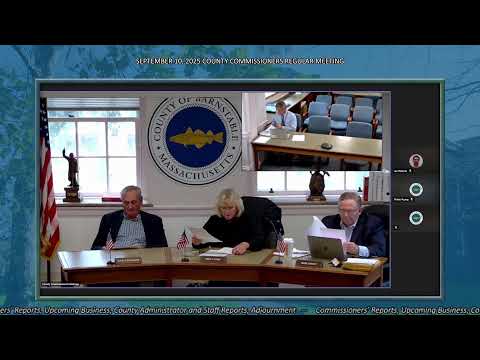
Christy (Cape Cod Commission staff) opened the Barnstable County Commissioners meeting with a preview of the draft 2025 Regional Policy Plan, saying, “Well, good morning and, thanks for the opportunity to be here today to present the draft 2025 regional policy plan.” The public comment period for the draft closes Sept. 24, 2025.
The draft updates the Commission’s goals and objectives across natural, built and community systems and refocuses several chapters on implementation. Chloe Schafer, chief planner, and Erin Perry, deputy director, walked commissioners through major changes including new language to recognize finite natural resources, expanded treatment of climate adaptation alongside mitigation, and targeted recommended actions for water quality, housing and infrastructure.
Why it matters: the plan establishes regional priorities that guide the Commission’s regulatory review and recommendations to towns. The draft frames top priorities — protecting open space, restoring coastal and freshwater quality, climate resilience, historic preservation, housing attainability, infrastructure planning and economic resilience — and pairs many of those priorities with recommended regional actions meant to be implemented over the next five years.
Most important changes and findings - Public engagement and survey: staff reported more than 1,200 resident survey responses; 91% said environmental quality was important or very important in deciding to live on Cape Cod. The top resident concerns identified for the next five years were affordable housing, coastal erosion, traffic congestion, sea-level rise and pond water quality. - Water resources and aquifers: the draft recommends developing an advanced, dynamic groundwater model (staff have discussed modeling with the U.S. Geological Survey) and advancing aquifer protection planning to better target risks to drinking water and coastal water quality. - Wetlands and pond buffers: the plan recommends developing model wetland bylaws for pond buffer protection to give towns a template for local adoption. - Climate change: the plan broadens the previous “climate mitigation” chapter to “climate change,” explicitly adding adaptation and resilience objectives (including wildfire, extreme heat and precipitation changes) while leaving shoreline and flood issues primarily to the coastal resiliency section. - Growth policy and place types: the draft reiterates a growth policy that focuses development in centers supported by infrastructure and directs growth away from ecologically sensitive areas, and it continues to use place types (from 2018) to guide context-sensitive review.
Recommended regional actions (selected highlights) - Natural systems: develop a regional open-space plan; advance groundwater modeling and aquifer protection planning; promote model pond-buffer wetlands bylaws; support Massachusetts Farmland Action Plan implementation; review the state ocean management plan updates. - Built systems: advance coastal resiliency tools and model resiliency bylaws; support local climate action planning and post-disaster planning; pursue a regional capital plan to coordinate infrastructure priorities; continue collaborative work on waste diversion; support replacement planning for the Bourne and Sagamore bridges. - Community systems: expand inventories of underrepresented historic resources; maintain the region’s comprehensive economic development strategy (2024) to retain federal Economic Development Administration eligibility; support local zoning changes to expand housing opportunities; implement elements of the state Affordable Homes Act for seasonal communities; convene a funding/financing working group for housing initiatives.
Questions and next steps Commissioners and staff discussed potential Commission support for municipal bylaws addressing pesticides and fertilizers and the Commission’s capacity to assist towns with more stringent local regulations. Commissioner Forrest asked whether the Commission would support local pesticide and fertilizer bylaws; Christy said the Commission has drafted fertilizer bylaw language previously and can be a resource for towns pursuing such rules.
Staff emphasized the plan is a draft and that an ordinance and a “what’s new” section will accompany the formal submission to the Assembly of Delegates. The public comment period remains open through Sept. 24, 2025; staff invited commissioners and residents to submit feedback through the Commission’s website.
Context and limitations The presentation summarized technical and policy changes; it did not itself adopt the plan. The Commission staff said further edits are expected before formal submittal. Specific costs or funding sources for recommended regional actions were not specified in the presentation.
Ending The Commission staff said they will return to the commissioners with the ordinance package and a summary of changes after the public comment period closes.
AI generated
The text on this page is AI generated. Summaries, highlights, analysis, and video transcripts are all produced from the original source material.
AI can make mistakes, so if you spot one, and we will fix it for everyone.
Note: the source content is unaltered by us. Any content source we link to, be it a video, an audio recording, or a document, is presented exactly as its publisher released it. That publisher is usually a government body, sometimes an individual official or another organisation.