
Athens-Clarke County approves plan development amendment for 585 Vine Street after heated public comment
Get AI-powered insights, summaries, and transcripts
Subscribe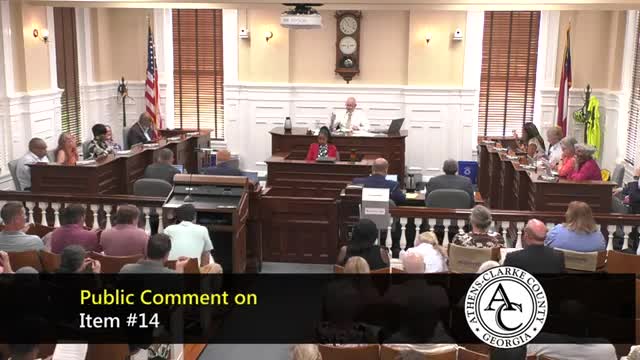
Summary
The Athens-Clarke County Commission approved a plan-development amendment for 585 Vine Street to reconfigure parking and add a community garden and teaching kitchen. The vote followed extensive public comment both for and against the project and a failed attempt to delay the decision.
The Athens-Clarke County Commission on Tuesday approved an amendment to the Commercial Neighborhood Plan Development (585 Vine Street) to allow reconfiguration of a parking area and creation of a community garden and teaching kitchen at 585 Vine Street.
The vote followed more than an hour of public comment in which neighborhood residents, community leaders and nonprofit representatives described decades-long distrust over development in Inner East Athens. Supporters said the amendment secures a binding plan to create green space, tree plantings and a teaching kitchen; opponents said the change risked displacement and represented a backdoor to larger development.
The amendment’s supporters included Rashi Malcolm, the property owner and executive director of Farm to Neighborhood, who described the project as a community-driven effort to increase access to nutritious food, expand youth and adult culinary programming and improve walkability. “This proposal is simple. We are proposing a community garden reconfiguration of the existing parking areas and a teaching kitchen. Nothing more, nothing less,” Malcolm said during the public-comment period.
Opponents, including multiple longtime East Athens residents and neighborhood association leaders, urged the commission to deny or delay the amendment. Dr. Shanice Allen, president of the Inner East Athens Neighborhood Association, told commissioners the amendment appeared to be a “backdoor for something much larger” and urged a 30-day suspension for transparency and truth. “This amendment presents harm disguised as help,” Allen said.
Commissioner Taylor moved to approve the amendment, with Commissioner Wright seconding. Commissioner Thornton offered a substitute motion to hold the item for one 30-day cycle; that motion received votes but did not carry as the commission ultimately returned to consider the original motion. On the final roll call the amendment passed 7–3.
Planning staff and W&A Engineering representatives said the amendment is binding and does not change the underlying zoning or permit residential redevelopment. Planning Director Bruce Loney told the commission the amendment removes three parking spaces and expands an on-site green space to a larger footprint than the 1996 plan had shown; because no new structures or changes in allowed uses were proposed, staff processed the request as a Type 2 amendment under the zoning code.
Supporters noted Farm to Neighborhood had secured a 25-year lease on the parcel and that the nonprofit administered a state grant intended for the site; a W&A representative said the nonprofit received $965,000 from the state Office of Planning and Budget for the project and that W&A has provided in-kind grant administration and planning services.
Commissioners asked for clarity about whether the amendment could be a precursor to higher-density development; Loney said any change to underlying zoning or an increase in residential density would require a separate, more extensive process and public hearings.
The commission’s approval is limited to the binding plan amendment as described in the application. Commissioners said they expect continued community engagement as design and implementation proceed.
The commission recessed after the vote and continued other agenda items later in the meeting.