Get AI Briefings, Transcripts & Alerts on Local & National Government Meetings — Forever.
Commissioner Morath details TEA process for educator-misconduct complaints, do-not-hire registry and limits on action for uncertified staff
Loading...
Summary
Commissioner Morath briefed the State Board on how the Texas Education Agency (TEA) and the State Board for Educator Certification (SBEC) handle complaints, criminal-history hits, investigations and the do-not-hire registry. He stressed legal limits on state action for non‑certified employees and described intake, review and enforcement steps.
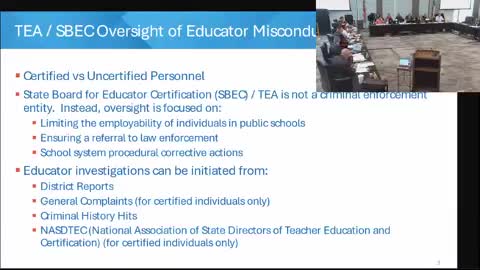
Commissioner Morath told the board that TEA receives thousands of reports and criminal-history “hits” concerning public-school employees and that the agency’s role is regulatory — to decide whether a person should be allowed to work in Texas public schools. He said TEA has received an elevated volume of inbound information from districts, DPS criminal-data feeds and public complaints and has a new parent-complaint navigator on its website to help people route concerns to the right place.
Morath, speaking during the committee of the full board, emphasized a legal bifurcation that matters for how allegations are handled: certified educators fall under the State Board for Educator Certification (SBEC) and TEA enforcement processes; non‑certified employees (including many bus drivers, custodial staff and an increasing share of first‑year classroom hires) are not subject to SBEC’s full disciplinary authority. “There’s SBEC that oversees all certified personnel in the state of Texas and then there’s non‑certified employees who are not under the oversight of SBEC,” Morath said. He described the practical consequence: non‑certified employees are not automatically removable from statewide employment lists unless narrow statutory triggers are met (for example, convictions that fall within specific “do‑not‑employ” criteria).
Morath gave the board a data snapshot for recent years: TEA logged tens of thousands of criminal‑history “hits” on education staff through law‑enforcement data feeds, thousands of misconduct reports from districts, and large counts of other complaint categories (special‑education complaints, data anomalies and academic‑integrity cases). He said TEA uses a two‑stage process: a preliminary review that typically takes about two weeks to determine whether the item warrants a formal investigation, and — if warranted — a formal investigation that triggers a public investigative notice on a certified educator’s record. He said investigative targets remain publicly noted while checks with law enforcement are under way.
On the do‑not‑hire registry, Morath said roughly 4,000 people are listed permanently in Texas. Entries result from a range of enforcement outcomes — from voluntary certificate surrenders to formal revocations and some cases where regulatory evidence supported barring employment even in the absence of a criminal conviction. “Most but not all of these are also people who have been criminally convicted,” he said, adding that the administrative standard for employment‑bar decisions is lower than the criminal standard.
Board members pressed Morath on specific procedural points: whether districts must check criminal histories for non‑certified hires (Morath said districts are required to fingerprint and check criminal histories and search the do‑not‑hire list), whether TEA notifies local boards or only superintendents (Morath said TEA collects superintendent contact information and suggested the agency could build a process to notify school‑board members but currently lacks a centralized board‑contact database), and the agency’s target investigation timelines (David Rodriguez, Executive Director of Investigations, said TEA aims for 90–120 days for many investigations but that targets have slipped and the agency has requested legislative resources to expand staffing).
Several members asked about notification to parents and trustees when CPS or law enforcement interviews students; Morath said notification timing is governed by statute and that he would follow up with more detail. Board members also raised concerns about mobility of employees under investigation: Morath said an “investigative warning” that appears on a TEA search portal is visible to districts, but absent statutory changes there is not a blanket prohibition preventing a person who has resigned or moved from being hired elsewhere while under investigation.
Why it matters: the board and TEA are responding to constituent pressure about student safety, transparency and how credentialing interacts with criminal and personnel processes. Morath framed TEA’s role narrowly: the agency’s legal question is whether an individual should be allowed to be employed in public education, not whether the person should be criminally prosecuted. He also flagged statutory gaps the agency has raised with the legislature — especially the limits on TEA action for non‑certified employees and the restriction that public (parent) complaints cannot alone be used to initiate regulatory action for uncertified staff.
What’s next: Morath said TEA will continue refining the parent navigator tool and will pursue additional staffing authority in the legislature for investigations. He agreed to provide the board follow‑up information on trustee notification requirements, the statute governing parent/CPS notice when students are interviewed, and a more detailed explanation of which dual‑credit/AP/TEKS provisions the agency uses when it evaluates transfer or non‑TEKS courses for science credit.
"The thing to think about as TEA's oversight of educator misconduct is really about answering that one question: should you be allowed to be employed by a public school in the state of Texas?" Commissioner Morath said. "That's very different than should you be in jail."