Lifetime Citizen Portal Access — AI Briefings, Alerts & Unlimited Follows
Electric-readiness rule divides builders and engineers at SBCC listening session
Loading...
Summary
Proponents argued an electric-readiness requirement for new residential construction would lower future retrofit costs and support state decarbonization; opponents said the measure provides no immediate energy savings and is outside the scope of the energy code.
The State Building Code Council heard contested views on residential proposal 018 (electric readiness). Johnny Coacher of RMI, the proponent, told the council electric readiness prepares buildings for future electrification, can reduce retrofit costs (proponents cited research indicating future wiring/panel upgrades are cheaper when installed during initial construction), and aligns with Washington’s 2021 State Energy Strategy that favors electrification as a least-cost decarbonization pathway.
Opponents, including Anne Anderson (structural engineer and residential tag alternate), argued electric-readiness language does not directly regulate energy use and therefore “doesn't belong in the code.” Anderson said the International Code Council (ICC) had previously removed similar requirements from the base 2024 model code and placed them in an appendix after appeals, and she urged the SBCC not to adopt an electric-readiness provision that lacks demonstrable immediate energy benefits.
Council members and stakeholders discussed how to evaluate costs and benefits for a measure whose benefits may accrue only when a fuel switch eventually occurs. Participants suggested the council should present both immediate energy impacts (often zero) and projected future savings with clearly stated time horizons (for example, the typical appliance replacement cycle identified in testimony as roughly 18–20 years). Witnesses asked that the economic-impact analysis bracket first costs and later benefits, and several speakers urged clearer, prescriptive definitions of what “electric readiness” entails (conduit only, pre-run wiring, panel sizing, etc.) to make cost estimates consistent and defensible.
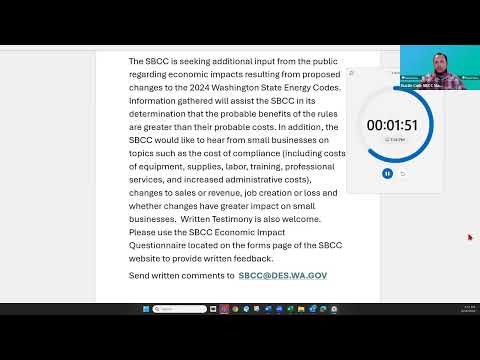
No formal action was taken. Staff and council members asked for written follow-up and clarified that the economic-impact work group would meet again to discuss the CR-102 filing and how to incorporate third-party analysis and public comment into the small-business economic impact statements.