Get Full Government Meeting Transcripts, Videos, & Alerts Forever!
Get email alerts on the Wildlife Conservation topic
No spam. Unsubscribe anytime.
Local Delta Waterfowl chapter reports increased nesting-box success at sanctuary
Summary
A Sunrise Side chapter of Delta Waterfowl told the council the chapter’s hen-house and wood-duck-box program at the sanctuary has produced 9 successful hen-house nests and 4 successful wood-duck boxes this year; the council received and filed the presentation.
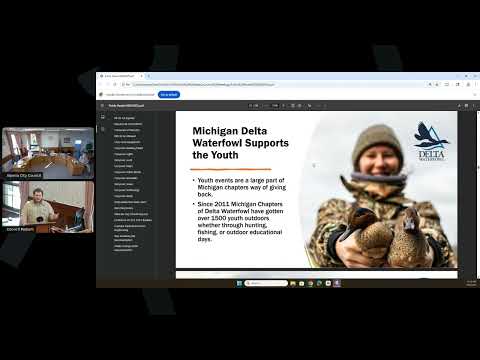
Kyle Greer, representing the Sunrise Side chapter of Delta Waterfowl, presented research results and a local update on a nesting-box program at the Alpena wildlife sanctuary and the council voted to receive and file the report.
Greer said the local chapter began placing hen houses in the sanctuary in April 2014. He said the project has expanded to 25 hen houses (13 original, 12 added this spring) plus nine wood duck boxes; of the 25 hen houses, nine were productive this year and of the nine wood duck boxes four showed evidence of hatched chicks. Greer said hen houses increase nesting success and that, “with a hen house, we’re basically 60% more likely that that nest is gonna hatch in that hen house versus on the ground.”
Greer clarified that other predator-management methods discussed by Delta Waterfowl at larger scales — live trapping and euthanasia of nest predators — are not being done in Alpena. He said trapping and larger-scale predator removal occur in other regions such as North Dakota and Manitoba, but locally the chapter’s activities are limited to hen houses, wood-duck boxes and habitat work.
The chapter reported volunteer capacity of roughly six to eight active volunteers for maintenance work and said hen houses typically take three to five years to reach maximum utilization. Greer said the chapter is exploring expansion to other lakes subject to Michigan Department of Natural Resources approvals and emphasized the program’s education and recruitment activities for new and young hunters.
Council member motioned to receive and file the presentation; the motion was seconded and carried by recorded vote. Greer told the council he would return next year with an update if invited.
Why it matters: the presentation documents a localized conservation practice in public wetlands, notes volunteer capacity limits, and flags potential expansion that would require DNR permitting.