
MassDEP outlines $5 million GAP 4 grants for water systems, food nonprofits and small food businesses
Get AI-powered insights, summaries, and transcripts
Subscribe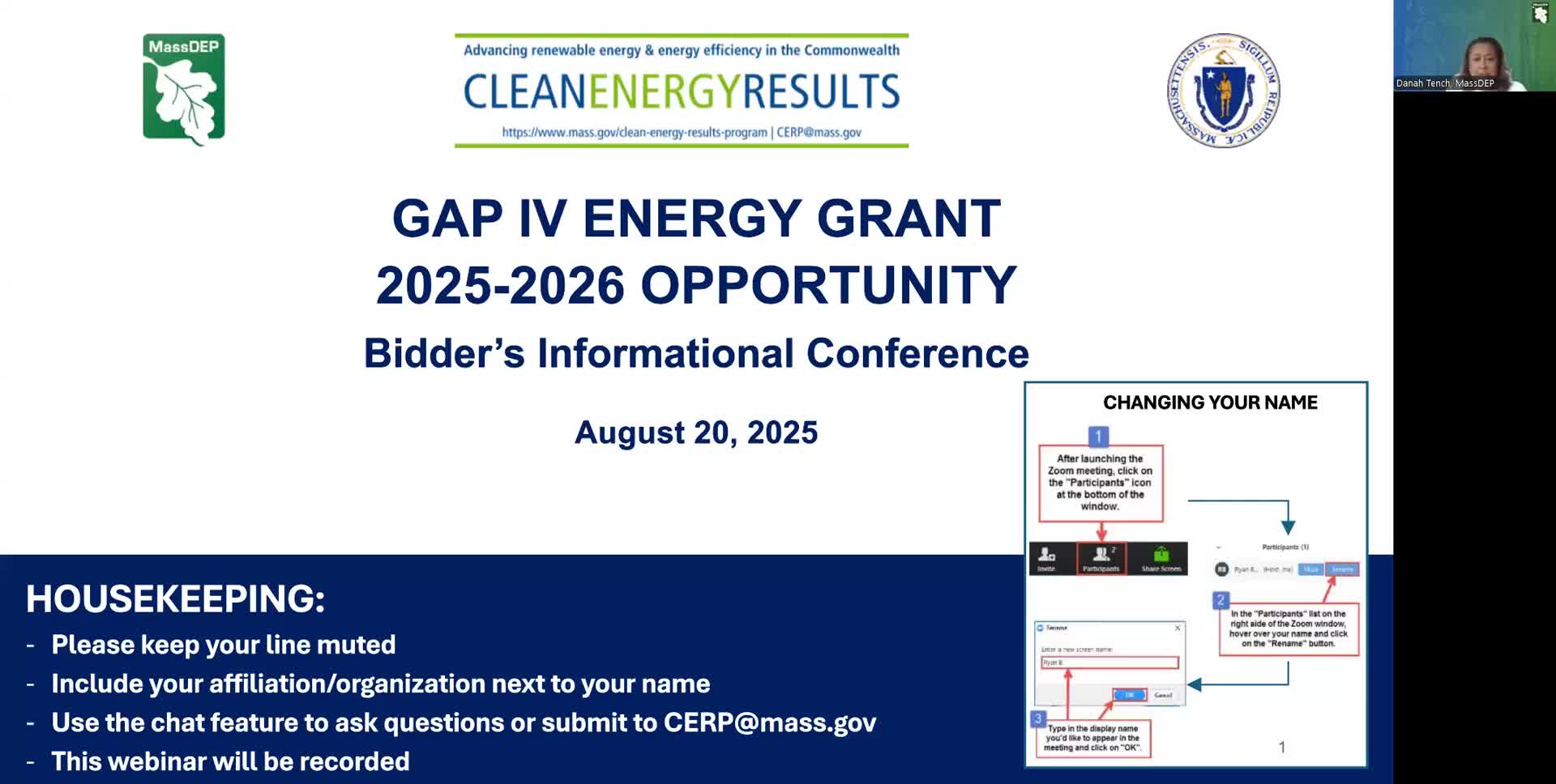
Summary
Massachusetts Department of Environmental Protection officials used a recorded webinar to describe GAP 4, a $5,000,000 competitive grant round that funds energy-efficiency and clean-energy projects at publicly owned water and wastewater facilities, nonprofit food and agricultural entities, and small food businesses engaged in distribution and processing.
Massachusetts Department of Environmental Protection officials used a recorded webinar to describe GAP 4, a $5,000,000 competitive grant round within the Clean Energy Results Program that funds energy-efficiency and clean-energy projects at publicly owned water and wastewater facilities, nonprofit food and agricultural entities, and small food businesses engaged in food distribution and processing.
The program, led by MassDEP in partnership with the Department of Energy Resources and the Clean Energy Center, seeks projects that reduce energy use (kilowatt‑hours, therms, or fuel gallons) and greenhouse‑gas emissions. Michael DeBara, project manager at MassDEP, said, “This grant program provides technical assistance in financial resources with the goal of reducing energy consumption and costs and with those saved dollars being reinvested back into the facilities and communities they serve.”
Applicants must meet several requirements. Projects must be at facilities owned by the applicant (a facility‑ownership and authorization form is required), applicants must provide a minimum 10% cost share on the adjusted project cost, and a completed energy assessment or audit is a prerequisite to apply. DeBara said, “there is a prerequisite that you need to have a completed energy assessment or audit or technical evaluation,” which may come from utilities or external consultants. The application deadline given on the webinar was September 19 at 5:00 p.m.; MassDEP said slides, a second informational session on September 9 at 10:00 a.m., and written answers to submitted questions will be posted for applicants.
Evaluation and award structure The GAP 4 budget is $5,000,000. MassDEP grouped applications into two funding tracks defined by total estimated project cost: small projects (estimated cost $75,000–$200,000) and large projects (greater than $200,000). Presenters said the program’s maximum grant per grantee is larger than in prior rounds; a slide and later remarks set the maximum at $350,000 per grantee. Projects are evaluated for cost‑effectiveness (payback), estimated annual energy savings or renewable generation in kilowatt‑hours, geographic distribution and equity (to reach communities across the state), and other criteria. MassDEP said projects that combine solar or wind with battery storage receive an additional 10 points, and projects that participate in demand‑response pathways receive a 5‑point adder in scoring.
Eligible applicants and projects MassDEP listed three eligible applicant groups: (1) publicly owned drinking water and wastewater facilities (including treatment plants, associated buildings, and pumping/lift stations; publicly owned facilities operated by private entities are eligible if ownership is public); (2) nonprofit food and agricultural entities such as food banks, pantries, commercial/shared kitchens, and food distribution organizations (applicants in this category must submit an attestation form); and (3) private small businesses engaged in food distribution and processing (a separate small‑business attestation is required). Eligible project types include energy‑efficiency measures (variable‑frequency drives, HVAC, controls, etc.), renewable generation (solar, wind, micro‑hydropower at pressure‑reducing stations), battery storage, geothermal and microgrid systems, and limited lighting assistance (MassDEP said lighting is eligible at up to 20% grant assistance and can be combined with other incentives). MassDEP noted that wastewater energy‑recovery projects are excluded from GAP 4 because a separate $5,000,000 wastewater energy recovery pilot procurement is being planned; applicants with wastewater energy recovery projects were directed to that future solicitation.
Application process and attachments Applications must be submitted online through the Mastercard/IMEI workspace customized for MassDEP; applicants are asked to preregister so they can access the GAP 4 application room. The online submission has six components including a project narrative (Word or PDF), Appendix A (applicant information and funding overview), Appendix B (signed certifications and financing attestations), Appendix C (an Excel grant table that lists each project and its cost and estimated savings), supporting documents (incentive letters, contracts, past studies), and the required energy assessment or audit. MassDEP provides an Excel version of Appendix C on its website to simplify calculations and asked applicants to follow the naming conventions supplied in the online guide. MassDEP said all grants will be reimbursed after projects are complete and operating, and typical contract performance windows are two years from execution; extensions can be requested in some circumstances.
Program history and leveraging Presenters summarized previous GAP rounds: rounds 1 and 2 awarded about $5.7 million and funded 67 drinking water and wastewater facilities (about 18% of the sector), leveraging more than $2.6 million in energy utility incentives and producing roughly 24,195 megawatt‑hours in annual energy savings. GAP 3 (2022) was larger (about $8 million) and extended eligibility to nonprofit food and agriculture entities.
Questions and clarifications During the Q&A presenters clarified that multifamily affordable housing is not eligible in this round, that repair or restoration of existing solar systems would need further review (MassDEP said it would respond in writing), and that required assessments can range from scoping‑level audits to detailed technical assessments as long as they identify specific energy conservation measures, estimated savings, and project costs for Appendix C. MassDEP also noted that applicants may combine GAP funding with other sources (Mass Save incentives, Green Communities grants, state revolving funds) and that leveraging additional funding can improve scoring.
Contact and next steps MassDEP asked attendees to submit written questions to serp@mass.gov, said slides and answers will be posted by mid‑late August (on the procurement schedule shown), and invited applicants to the September 9 information session. Prospective applicants should preregister in the IMEI portal, confirm they have an energy assessment that identifies measures and estimated savings, and prepare the Appendix C spreadsheet and required attestations.