Get email alerts on the Comprehensive Planning topic
No spam. Unsubscribe anytime.
Rangeley holds public hearing on updated comprehensive plan, state finds plan consistent
Summary
Rangeley select board held a public hearing on the town's draft 2025 comprehensive plan, reviewed major changes from the 2012 plan and discussed next steps after the state's consistency finding; voters will consider the plan at the Sept. 16 town meeting.
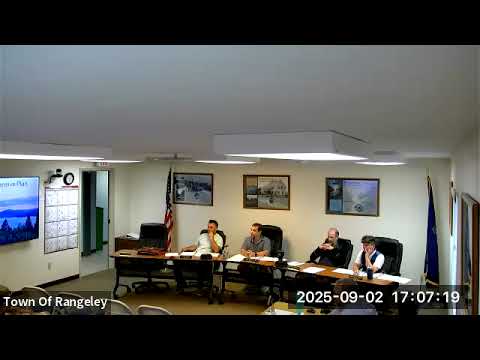
The Rangeley Board of Selectmen held a public hearing on the town's draft 2025 comprehensive plan and heard committee and public comments on proposed changes that the state has already found "consistent," town staff said. Voters will decide whether to adopt the plan at the town meeting on Sept. 16. The plan updates Rangeley's vision and reorganizes several topic areas, adding standalone chapters on climate change and health care, elevating housing and infrastructure priorities, and folding agriculture, forestry and outdoor recreation into a broader economy chapter, the town consultant said. The state's consistency letter was described as important for securing state grants tied to an approved plan. The discussion mattered because the consistency finding affects the town's eligibility for grant funding and directs which pieces of the long-range plan the town will prioritize. Committee members and residents focused on practical implementation steps, mapping, and how ordinance revisions will follow the plan. Town consultant Donna, a member of the comprehensive plan review committee and the committee chair discussed revisions and the process for implementation. She said the version available to voters is the state-approved, adjusted version and that further substantive changes cannot be placed on the Sept. 16 warrant because ballots are already being printed. "We have to see. The version that was out there is, the adjusted version which was approved by the state is out there, is what everyone is gonna be voting on on the sixteenth," she said. Committee members and residents outlined ten notable changes they saw between the 2012 and 2025 drafts and asked for clarifications. Ethel (identified in the hearing as a committee reviewer) summarized new and reorganized elements: a new standalone health care chapter, a separate climate chapter, greater emphasis on broadband- and remote-work-driven economic opportunities, and consolidation of outdoor recreation, agriculture and forestry under an economy chapter. She said the population narrative was updated to show a rise from 1,168 in 2012 to about 1,270, an older median age (56.5 versus 51.4 in 2010), and a seasonal peak population range of "5,300 to 10,000." The plan also proposes a future land use map that would allow higher-density residential development in some downtown and village areas where sewer and water exist. Donna noted the map's colors appeared differently in reduced-size handouts (black in the packet, red on the full-size map) and that the red map is what is being adopted. "The lines are the same...it's just the color the color code," she said. Selectmen agreed to add a blown-up appendix map to aid readability for residents who have difficulty viewing the 11-by-17 reduced maps. Board members and the committee discussed implementation mechanics rather than adopting ordinances immediately. Several speakers urged creating clear follow-up steps so the plan does not "sit on the shelf." A member who had previously worked on plan implementation elsewhere suggested an implementation committee and at least yearly reviews; others cautioned that implementation should be coordinated through existing boards such as the ordinance committee and the planning board. On housing and growth, committee members described an emphasis on measured infill and incentives for development in areas with existing sewer and water to reduce environmental impacts of dispersed development. Donna described clustering and a transfer-of-development-rights concept as tools to concentrate housing near services while preserving rural open space. She said clustering could allow lots as small as 20,000 square feet on septic when appropriate, and that transfer-of-development-rights programs require permanent restrictions on the rural parcels. Selectmen and committee members repeatedly distinguished the plan itself (a policy guide) from the ordinance changes that will be required to implement it, noting that ordinance work would proceed through the ordinance committee, planning board and selectmen after adoption. Several participants asked for a clear schedule for ordinance updates should voters approve the plan. The public hearing closed and the board moved on to other agenda items; the town meeting vote remains scheduled for Sept. 16.
AI generated
The text on this page is AI generated. Summaries, highlights, analysis, and video transcripts are all produced from the original source material.
AI can make mistakes, so if you spot one, and we will fix it for everyone.
Note: the source content is unaltered by us. Any content source we link to, be it a video, an audio recording, or a document, is presented exactly as its publisher released it. That publisher is usually a government body, sometimes an individual official or another organisation.