Get AI Briefings, Transcripts & Alerts on Local & National Government Meetings — Forever.
Council advances multiple bills to change real property tax thresholds and homeowner exemptions
Loading...
Summary
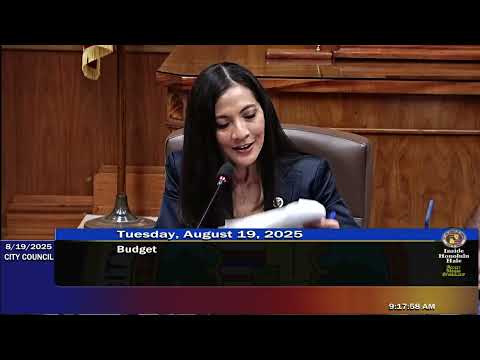
The Honolulu City Council budget committee advanced multiple measures to adjust residential tax thresholds and homeowner exemptions, including Bill 34 (CD1) to create new valuation tiers and Bills 49 and 50 to expand homeowner exemptions for older residents.
The Honolulu City Council Committee on Budget moved forward several measures that reshape real property taxation including tier thresholds for residential classifications and proposals to increase homeowner exemptions for older residents.
Bill 34 (CD1), introduced by Council Member Kia Aina, would create three valuation tiers for the Residential A classification and for transient vacation units (TVUs). Under the posted CD1, the residential A tiers would be: up to $1,300,000; $1,300,000 to $3,500,000; and above $3,500,000. For TVUs the CD1 sets tiers at up to $900,000; $900,000 to $2,000,000; and $3,000,000 and above. Council Member Kia Aina said the change aims to reduce instances in which owner-occupants are reclassified automatically to Residential A because of rising assessed values.
Director Andy Kawano, Department of Budget and Fiscal Services (BFS), said the department worked with council members to set the thresholds and that moving thresholds will change how many tax keys are classified in Residential A — from roughly 30,000 tax keys today to under 12,000 under the proposed thresholds. Kawano and RPAD staff noted classification mechanics can be complex: once a property crosses the threshold it is taxed at the Residential A rate on the whole assessed amount unless a homeowners exemption is filed. Steven Takara (RPAD administration) added that other variables used to define Residential A (units, underlying zoning) are under discussion and could affect outcomes.
Bills 49 and 50, both concerning the homeowner exemption for owners 65 and older, were reported out for third reading. Andy Kawano told the committee the department’s estimates indicate a combined reduction in property tax revenues if exemptions are expanded; he cited an estimated $5.6 million revenue reduction tied to one proposal. Chair Waters and several sponsors framed the measures as tax-relief tools to help kupuna on fixed incomes and to offset other cost pressures such as rising utility bills; Council Member Thoba noted reservations and recorded them in the committee’s actions.
Testimony included in-person and remote remarks from the Honolulu Board of Realtors (Suzanne Young), resident Donald Sakamoto and other community members who supported adjusting thresholds and expanding exemption outreach. Suzanne Young said the changes reflect market movements and would prevent the original Residential A classification — intended to target luxury homes — from ensnaring long-time owner-occupants whose homes have risen in value.
The committee amended Bill 34 to the posted CD1 and recommended it be reported out for second reading and a public hearing; Bills 49 and 50 were recommended for passage on third reading, with Council Member Thoba noting reservations. The record includes discussion about forming a permitted interaction group (PIG) or task force to look comprehensively at tax policy and homeowner-exemption outreach.