Get Full Government Meeting Transcripts, Videos, & Alerts Forever!
Get email alerts on the Personal Care Services topic
No spam. Unsubscribe anytime.
Senate committee advances bill to study personal care services workforce, reimbursement
Summary
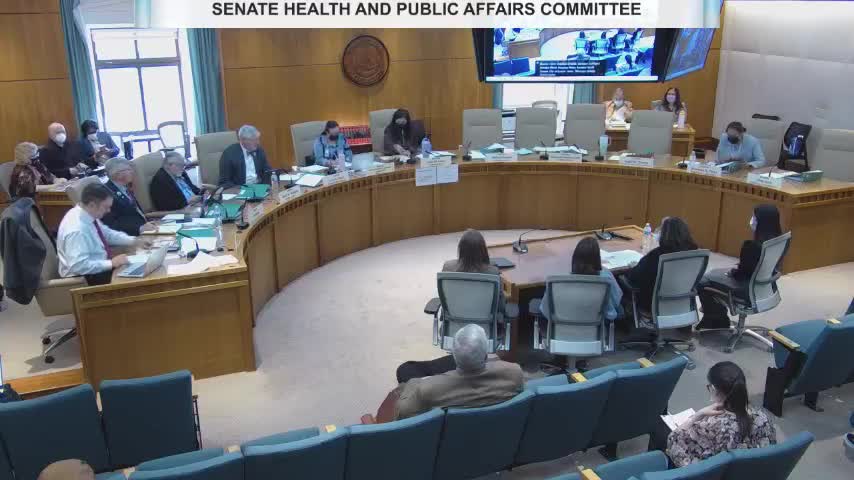
The Senate Health and Public Affairs Committee voted 7-3 to give a due-pass recommendation to a committee substitute for SB103, which would require managed care organizations and personal care providers to report workforce and pay data and direct the Health Care Authority to study payment adequacy and recommend Medicaid reimbursement rates.
The Senate Health and Public Affairs Committee voted 7-3 to give a due-pass recommendation to a committee substitute of Senate Bill 103, which would require managed care organizations, financial management agencies and personal care service providers to report workforce and wage data and direct the Health Care Authority to study payment adequacy and recommend Medicaid reimbursement rates.
Sponsor Senator Zedillo Lopez told the committee that personal care services allow people who have a nursing-facility level of care to remain in their homes: "personal care services is a person centered preferred care." She said the bill would require providers to submit data by March 1, 2026, and require the Health Care Authority to determine payment adequacy and recommend reimbursement rates by Jan. 30, 2030.
The bill’s study would examine workforce stability, vacancy reductions and the cost of a wage set at 150% of the state minimum wage, the sponsor said: "Payment adequacy shall address workforce stability, vacancy reductions, a wage at least 150% of the state minimum wage, and ensuring adequate access for eligible Medicaid recipients." She framed the measure as a transparency and planning tool to inform future Medicaid rate-setting.
Supporters from provider and advocacy groups told the committee that low wages and workforce shortages are limiting access to home-based care. Megan Lorino, executive director of the New Mexico Association for Home and Hospice Care, said personal care services are contracted through managed care organizations and that "the rates that they reimburse by are largely set by the state." Nurse Sharon Argenbright urged lawmakers to pass the bill, saying nurse turnover is a problem and data are needed: "Please pass senate bill 103." Other supporters included representatives of the New Mexico Caregivers Coalition, Disability Rights New Mexico, Community Home Care and the National Alliance on Mental Illness.
Committee members questioned how providers are authorized and contracted, what data would be collected and whether reports from both managed care organizations and financial management agencies would duplicate effort. Senator Scott and others pressed whether a study and transparency would necessarily lead to higher Medicaid rates; the sponsor and witnesses said the study is intended to provide the factual basis needed to justify rate changes.
The committee adopted a procedural motion to consider the committee substitute and then voted to recommend a do-pass at 7 to 3. Committee discussion included potential amendments to add education and certification fields to workforce reporting; senators indicated they would work with the sponsor and drafters before later committees.
The bill now proceeds with a due-pass recommendation to the next committee.