Get AI Briefings, Transcripts & Alerts on Local & National Government Meetings — Forever.
Committee hears hours of testimony on bill to raise state salaries, add parental leave and authorize remote work for state employees
Loading...
Summary
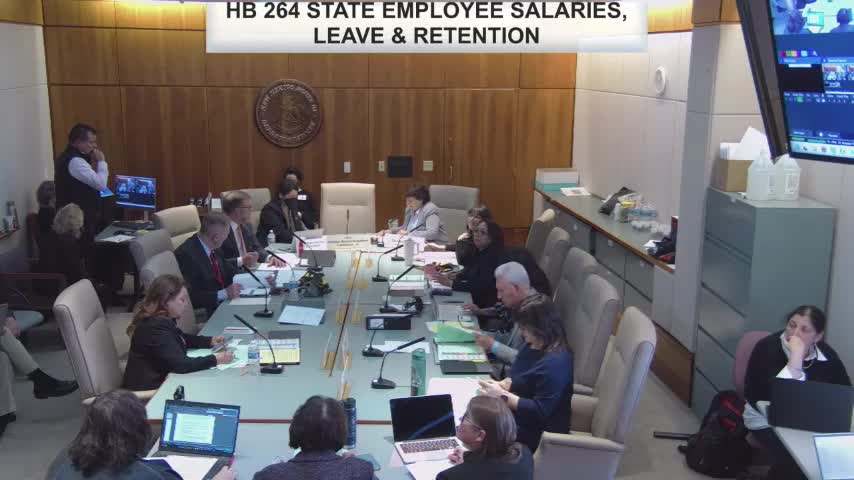
Lawmakers and dozens of state employees, union officials and business lobbyists spent a committee hearing on House Bill 264 debating whether the measure will help the state recruit and retain workers or impose unsustainable costs on the budget and employers.
Santa Fe — Lawmakers and dozens of state employees, union officials and business lobbyists spent the committee hearing on House Bill 264 debating whether the measure will help the state recruit and retain workers or impose unsustainable costs on the budget and employers.
Supporters said the bill would raise the baseline pay and benefits for state workers, add a statutory 12 weeks of parental leave for a new child and require agencies to create remote-work policies that supervisors apply by job function and operational need. "Providing a remote work option for state employees will help the state fill vacancies and retain workers so we can better serve New Mexicans," said Dr. Yomei Shah, an epidemiologist and union steward at the Department of Health.
The bill’s supporters — including union leaders and members who testified in person and on Zoom — told the Labor, Veterans and Military Affairs Committee that pay and benefit improvements are needed to address a reported vacancy rate of roughly 25 percent in some agencies and to prevent employees from leaving for private-sector jobs that permit remote work and higher pay. "Tying the state minimum wage to inflation with automatic increases indexing is critical for the survival of New Mexico families," said Lindsey Hurst of CWA Local 7076.
Opponents included business groups and a chamber representative who warned of a large fiscal impact and potential for future budget strain if salary floors are indexed to the consumer price index. JD Bullington, representing the Greater Albuquerque Chamber of Commerce, said the bill "has a large impact on the state budget" and criticized automatic COLA-style increases. Several committee members raised questions about when the bill’s funding would be enacted: the bill delays sections that require appropriations until fiscal year 2027 so agencies can budget for changes, the sponsor said.
Committee members pressed authors and expert witnesses on implementation details. The transcript shows officials reading existing State Personnel Office (SPO) accrual rules: current annual-leave accrual ranges were described in hours per pay period (for example, 3.08 hours per pay period for under three years’ service, which the committee’s staff said converts to about 10 days per year). The bill’s sponsors said the proposal would increase starting annual leave to about 15 days per year for new employees.
On parental leave, committee members asked whether the bill’s 12-week leave would be an accrual or an event-based entitlement. The vice chair responded: "It is 12 weeks per child per employee. It's not an accrual. It's if you have a child, you're eligible for that." That mirrors the current executive-order practice the bill would codify in statute.
Remote-work provisions drew repeated questions about supervisory oversight and productivity measurement. The sponsor and agency witnesses described putting decision-making about which positions qualify for remote work in the hands of employers and supervisors, with evaluations driven by pre-defined productivity benchmarks. "It doesn't matter where you're doing the job from because it's very well defined," said a staffing expert testifying for the sponsor, describing permit-writing workflows as an example.
Committee members also asked about interactions with other systems. Witnesses noted the bill would not take effect for appropriation-dependent sections until FY2027, leaving time for agencies to include costs in their budget requests. Witnesses and union representatives also discussed PERA (retirement) implications and Medicaid-funded providers: witnesses said higher pay produces more contributions but also increases program costs and that some provider groups may need rate adjustments to cover wage increases.
No final committee vote on HB264 is recorded in the provided transcript. The record shows a motion "to pass" was made and seconded and that the committee moved on to other business; the transcript does not include a roll call or final outcome for the bill.
Votes at this hearing on other items: the transcript records an adopted amendment to a separate bill (HB246) after which the committee heard testimony on HB246 (see separate article).
Ending: The transcript shows extensive testimony from both supporters and opponents and a detailed line of questioning from multiple representatives; several witnesses and the sponsor said appropriation-timed enactment (FY2027 for some sections) is intended to allow agencies to budget for the changes. The committee paused the hearing near the end of the provided record for technical issues and to move to the next bill on the agenda.