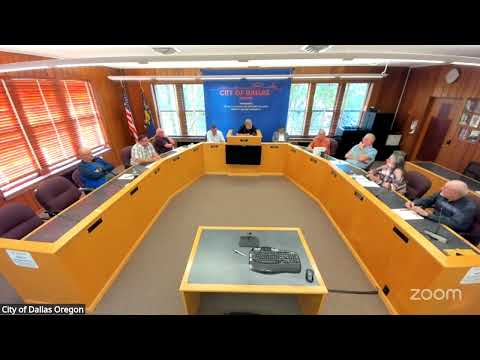
Dallas council adopts Lockrail node master plan over density concerns, 6-1
Summary
The Dallas City Council adopted Ordinance 19-05 to approve the Lockrail node master plan, expanding the plan boundary and rezoning land for mixed-use development while several councilors raised questions about housing density, taxpayer-subsidized housing language and infrastructure capacity.
The Dallas City Council on May 5 adopted Ordinance 19-05, the Lockrail node master plan, by a 6-1 roll call after a prolonged discussion about housing density, the amount of land set aside for commercial use and language in the comprehensive plan referring to "taxpayer funded housing." Councilor Kim Fitzgerald voted no; six other councilors voted yes.
The ordinance updates the Dallas Comprehensive Plan to change allowed land uses, transportation networks and standards within the Lockrail mixed-use node and expands the node boundary. Supporters said the plan adds roughly 90–95 acres of commercial land to address a shortfall identified in the city’s economic opportunities analysis; opponents warned it could accelerate high-density housing before commercial development arrives.
Councilor Kim Fitzgerald said the proposal raised a risk to the city’s character and services. "Does that preserve our small town feel?" she asked, and later added, "the more I read about the potential impact on current Dallas residents, schools, and infrastructure, the more I think we should work on a few things before we vote on this final reading." Fitzgerald said the draft appeared to reserve nearly 130 acres for high- and medium-density housing out of roughly 200 acres in the plan area.
City Manager Camara Slack placed the plan in the context of the city’s prior studies. "The housing needs analysis demonstrated that we had an adequate supply of residential land, the city of Dallas' urban growth boundary for 20 years of growth," Slack said, and summarized specific findings: "We had a 300 acre surplus of low density residential, a 20 acre deficit of medium density, and a 1 acre deficit of high density." Slack added that the economic opportunities analysis showed "about a 90 plus acre deficit of commercial land" over a 20-year horizon and that the master plan would add commercial acreage to address that gap.
Other councilors pushed back on how the rezoning would affect property owners and development sequencing. One councilor warned that rezoning large areas for high-density housing could mean that multifamily construction appears before commercial projects. Staff and supporters responded that much of the residentially planned land is currently outside the city limits and would require annexation to be developed under city rules, which adds steps and time that could slow residential development relative to commercial opportunities inside the city.
Council members also asked for clarification about height limits and mixed-use zoning standards. Planning staff and a city planner identified that residential zones generally limit heights to three stories or about 35 feet, and that higher buildings are typically allowed only in the Central Business District; the council will review specific mixed-use zone standards in subsequent code work.
Council discussion touched on a phrase in the comprehensive plan referencing the city "planning to accommodate its fair share of taxpayer funded housing." Staff told the council there is no fixed statutory metric embedded in that language; it appears in the existing comprehensive plan policies and was included in the packet for context. "I don't know if there's an actual number behind that or if it's just kind of a, hey, do we feel that we've met our fair share?" Camara Slack said.
The council approved the ordinance on second reading with a roll-call vote: Councilor Kim Fitzgerald voted no; Councilor Jantz (yes), Councilor Schilling (yes), Councilor Shane (yes), Councilor David Spivey (yes), Council President Briggs (yes), and Councilor Blosser (yes).
Opponents asked staff to return with clarified language or future amendments addressing concerns about taxpayer-subsidized housing references and infrastructure impacts; staff said comprehensive plan language can be revisited in a later amendment process. The ordinance will guide future rezoning and design of the Lockrail area while the council and staff continue work on zone standards and implementation steps.
AI generated
The text on this page is AI generated. Summaries, highlights, analysis, and video transcripts are all produced from the original source material.
AI can make mistakes, so if you spot one, and we will fix it for everyone.
Note: the source content is unaltered by us. Any content source we link to, be it a video, an audio recording, or a document, is presented exactly as its publisher released it. That publisher is usually a government body, sometimes an individual official or another organisation.