Get email alerts on the Community Development Report topic
No spam. Unsubscribe anytime.
Community development annual report highlights planning wins, code enforcement workload
Summary
City staff presented the community development department's annual report (part 1), highlighting designation of a national historic district, the mill site master plan nearing completion, growth in land‑use applications, code enforcement priorities (vegetation and vehicle issues), and staffing vacancies.
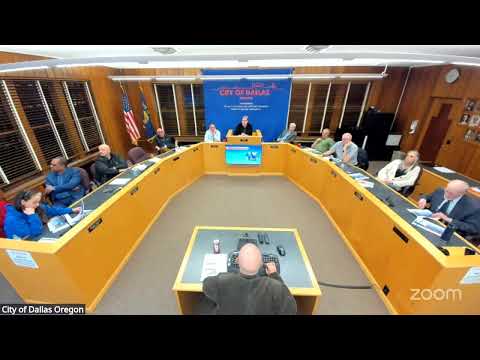
The Dallas Community Development Department presented its annual report (part 1) at the Jan. 21 work session, summarizing planning, code services and historic‑preservation activity during 2024 and outlining projects and staffing needs for 2025.
Charlie Mitchell, economic and community development director, told councilors the department’s notable achievements included the downtown designation as a National Historic District, launch of a voluntary business inventory and a business retention and expansion program, and near completion of the mill site master plan and the Lockrail master plan. Mitchell said the city is advancing design work for the 791 Main Street project (the former Bank of America site) and has begun an update to the transportation system plan, which has not been updated in more than 10 years.
Mitchell reviewed planning‑division activity: 97 new subdivision lots were received as applications in 2024, two multifamily site‑design reviews covered about 100 units, and the department processed about 106 land‑use applications overall. He said the city has two vacant department positions—a planner I and a building inspector—and anticipates filling them when space and recruitment allow.
On code services, Mitchell described common enforcement categories and operational constraints: the department is mostly reactive to citizen complaints (staff typically responds within 24–48 hours if capacity allows), and the largest categories of violations were vegetation, vehicle storage/repair, abandoned vehicles and obstructing sidewalks. Mitchell said roughly 63% of code violations involved vehicles and that the city towed 26 vehicles from public streets in 2024; abandoned recreational vehicles are costly to remove and sometimes require disposal at city expense.
Mitchell also outlined coordination with other departments—public works, police, finance and the courts—for abatement, towing and lien processing, and described recent code‑enforcement examples that required multi‑department response. On historic preservation, he noted the downtown national historic district designation as a major milestone and said staff will pursue monuments and grant funding for preservation projects, including a proposed monument at the first courthouse site.
Mitchell closed by flagging upcoming priorities: completing the mill site master plan and securing funding for implementation (including an Ash Creek daylighting concept), finishing the transportation plan update, advancing design and developer selection for the 791 Main Street site, and addressing staffing transitions in building and code services. Councilors asked about how residents should report code issues; staff directed residents to the city website “Report a Concern” form and said complainants may remain anonymous but providing an address helps the department respond and close the loop.
No formal council action was taken on the report; it was received as informational and a second part of the annual report (economic development, building, and urban renewal) was scheduled for February.
AI generated
The text on this page is AI generated. Summaries, highlights, analysis, and video transcripts are all produced from the original source material.
AI can make mistakes, so if you spot one, and we will fix it for everyone.
Note: the source content is unaltered by us. Any content source we link to, be it a video, an audio recording, or a document, is presented exactly as its publisher released it. That publisher is usually a government body, sometimes an individual official or another organisation.