Get Full Government Meeting Transcripts, Videos, & Alerts Forever!
Get email alerts on the Strategic Planning topic
No spam. Unsubscribe anytime.
LiveWell Kingston commissioners set out to clarify 2025 priorities amid capacity and funding concerns
Summary
At a LiveWell Kingston commission meeting, members used a circle-format discussion to identify five priority areas for 2025 — sensemaking, fundraising, measurement/storytelling, governance, and community engagement — and flagged limited staff capacity and city rules on solicitation as constraints to take into account.
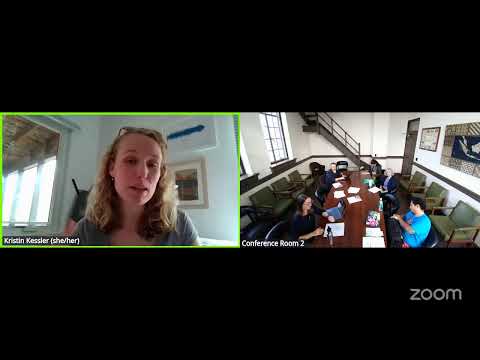
Commissioners and staff of the LiveWell Kingston commission used a circle-format meeting to work toward clearer priorities for 2025, stressing the need to match ambition to limited staff capacity and current funding uncertainty.
The conversation focused on five broad areas commissioners said should guide the commission’s work: sensemaking (data, partner mapping and federal policy implications), diversifying funding (beyond currently uncertain federal streams), measurement and storytelling to show impact, governance (roles and responsibilities for commissioners and focus teams), and deeper community engagement.
Meeting organizers ran a timed “circle” so each of the six participants present had a short, structured turn to respond to prompts about 2025 goals, commitments and barriers. Commissioners agreed to continue the conversation by circulating the questions to absent members and collecting emailed responses to broaden participation.
Several commissioners said they want clearer, written statements of responsibilities and priorities before recruiting new members or expanding commitments. One commissioner urged a short list of outstanding questions and a single document that captures them so the group can avoid repeating the same conversations and move more quickly toward decisions.
Commissioners and staff repeatedly flagged limited capacity. Staff described the practical limits on what paid municipal personnel can do: city employees can apply for grants but are restricted from directly soliciting donations or engaging in lobbying. The meeting noted that the city’s grants office is actively monitoring federal funding streams and that recent federal budget actions have removed or delayed some previously anticipated awards, increasing the urgency for the commission to clarify priorities and funding approaches.
The commission discussed the 2024–25 health assessment and agreed the assessment contains data that could guide prioritization, but some members said the assessment is lengthy and will need focused review. Anita, who reviewed the assessment material in advance, told the group, “I thought I was gonna report on it today, but it's gonna take a lot more time. It's really long.” Commissioners asked that staff circulate a short summary and the assessment’s executive summary to help identify one or two focus areas that align with existing focus-team work.
Kristen, a staff member who described upcoming attendance at a national anti-hunger conference and planned outreach to the office of Representative Pat Ryan, flagged federal policy changes as a likely driver of local needs: “I will not be lobbying, but we'll use the opportunity to reach out to Pat Ryan's office,” she said, noting the importance of monitoring policy shifts that affect food access and other services.
There were no formal decisions to adopt a new mission or to reconfigure focus teams during the meeting. The only procedural action recorded on the agenda was a motion and second to approve the February meeting minutes; the transcript records a motion and a second but does not record a named mover/second or a final vote tally.
Next steps agreed in the meeting: staff will compile outstanding questions raised during the discussion and prepare a short synthesis of the five priority buckets for review; commissioners will be invited to respond by email if they missed the meeting; and the commission will reconvene next month to prioritize actions and assign follow-up tasks. The meeting host said a subsequent meeting would present a short “health check” on the focus teams so commissioners can see where additional support is needed.
The meeting emphasized practical constraints (staff capacity, city rules on fundraising and lobbying, and federal funding volatility) as the primary limits the commission must factor into any 2025 plan. Commissioners said they want a realistic set of goals tied to measurable outputs or clear qualitative milestones so the commission can demonstrate impact when seeking future support.