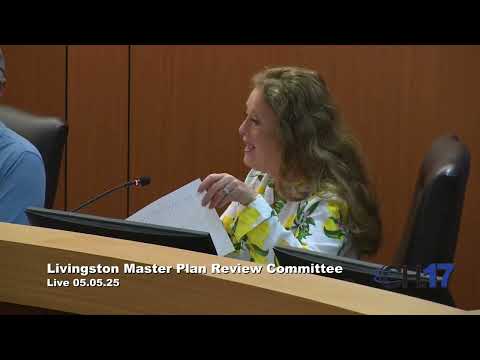
Master plan committee backs codified process for legacy drainage problems
Summary
The Livingston Parish Master Plan Review Committee voted to recommend a codified process for handling legacy drainage issues and to ask that the drainage master plan incorporate specific remediation steps for older subdivisions with problematic detention ponds and unclear ownership.
The Livingston Parish Master Plan Review Committee on May 5 voted to recommend that the parish adopt a codified process for handling legacy drainage problems and that the work be incorporated into the drainage master plan being developed alongside the comprehensive master plan.
Committee members said the proposal is intended to create a consistent set of steps for responding when older neighborhoods — many built before current ordinances — experience flooding, rather than handling each case differently. During the discussion committee members repeatedly cited neighborhoods such as Collins Place and College Place as examples where detention ponds lack clear ownership and streets flood after modest rain.
The committee’s recommendation asks planning and zoning and the parish’s drainage contractors to draft a step-by-step remediation plan (a “punch list”) that would be applied consistently across similar legacy neighborhoods. The committee noted that consistent application of such a process would help the parish defend its decisions if the parish is later sued.
“Many neighborhoods were built prior to current ordinances … The recommendation was to come up with a codified plan to deal with legacy drainage issue,” a committee member said during the discussion, describing the proposed punch-list approach. The member added that, by following the same steps “we can defend our actions in court.”
Committee members discussed likely elements of the process: identifying whether a drainage feature is private or public, confirming ownership, checking whether a gravity drainage district exists, and determining whether parish Department of Public Works (DPW) or a drainage district has maintenance responsibility. Members also discussed options when ownership cannot be identified: asking homeowners’ associations (HOAs) to assume control, creating community development or assessment districts, or, only as a last resort, using eminent domain.
Members gave several quantitative and contextual examples during the discussion: they said 70–80% of the parish lies in unfunded gravity drainage districts; they described situations where one inch of rain can produce three to four feet of standing water in a low street; and they noted culverts and galvanized pipes installed decades ago that have corroded in the area’s acid soils.
Action and next steps: the committee moved to forward the codified-plan recommendation to the planning commission and to ask that the drainage master plan contractor include specific remediation steps. The motion was seconded and approved by voice vote.
What’s next: The committee asked planning and zoning staff and the firm working on the drainage master plan to draft specific remedial steps (the “1 through 16” punch-list discussed in the meeting) and to return drafts through the planning commission process so the council may consider them as part of the comprehensive master plan and any implementing ordinances. Committee members emphasized that funding for repairs was not resolved; adopting a process would not by itself provide money to fix existing ponds and systems.
Community impact: committee members said the recommendation would affect homeowners in older subdivisions with undocumented detention ponds and areas served by multiple drainage authorities. The recommendation will now move to the planning commission for formal review and to the parish administration for coordination with DPW and gravity drainage districts.
AI generated
The text on this page is AI generated. Summaries, highlights, analysis, and video transcripts are all produced from the original source material.
AI can make mistakes, so if you spot one, and we will fix it for everyone.
Note: the source content is unaltered by us. Any content source we link to, be it a video, an audio recording, or a document, is presented exactly as its publisher released it. That publisher is usually a government body, sometimes an individual official or another organisation.