Get Full Government Meeting Transcripts, Videos, & Alerts Forever!
Get email alerts on the Infrastructure Water topic
No spam. Unsubscribe anytime.
Water utilities director reports budget, aging‑infrastructure work, lead inventory and conservation programs
Summary
Director Alex Whiteway presented the Water Utilities end‑of‑year report, detailing a $207 million budget, infrastructure miles, hydrant counts, investments at Pierce Birch water treatment plant, a lead service line inventory and conservation outreach including an education program and a leak‑detection dog in training.
Alex Whiteway, director of Arlington Water Utilities, gave the council an end‑of‑year report that outlined the utility’s 2025 budget, infrastructure condition and programs to reduce water loss and improve system resilience.
Whiteway said the utility’s overall budget is about $207 million, including roughly $22 million in personnel costs, $155 million in operating costs and about $1.4 million for capital outlay. He reported the utility maintains about 1,469 miles of water main and 1,260 miles of sewer main and is responsible for 10,323 public fire hydrants; another 1,689 hydrants are private and maintained by property owners.
Why it matters: The report covers investments in drinking‑water treatment, system maintenance and conservation programs that affect service reliability, regulatory compliance and longer‑term operating costs.
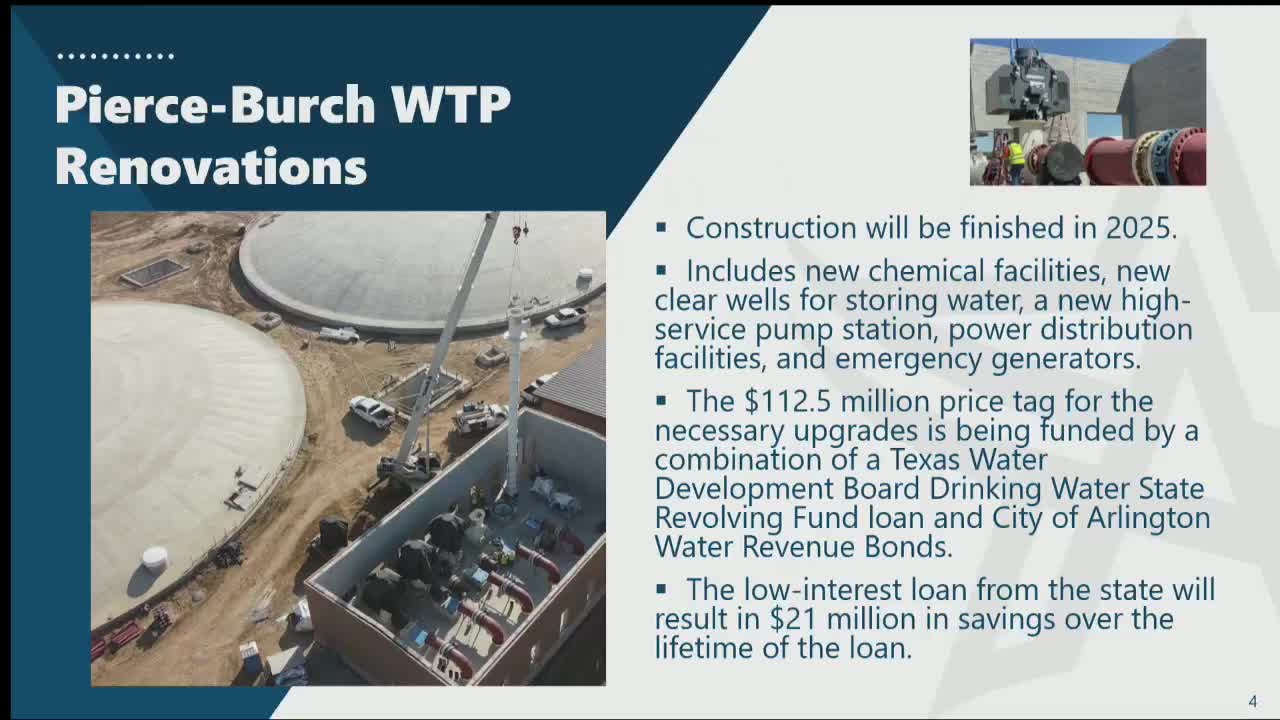
Key operational and capital items Whiteway reported: - Hydrant and valve maintenance: the fire department flows every hydrant annually and provides repair reports to utilities; the city maintains nearly 24,000 water valves and runs a valve‑exercise program to limit outage areas during main breaks. - In‑house crews and equipment: the utility operates a five‑person pipe‑bursting crew and a three‑person directional‑drilling crew, which Whiteway said yields roughly 30–40% savings compared with contracting those jobs. - Advanced metering: 11,613 remote meters (AMI) are installed; Whiteway said about 7,200 meters remain to reach full AMI coverage, and the utility is replacing some older AMI meters as it continues deployment. - Treatment plant and resiliency work: upgrades at the Pierce Birch Water Treatment Plant — a previously approved roughly $112 million project — added three 2,500‑kW generators to meet post‑winter‑storm power requirements and other upgrades; Whiteway said the city used a Texas Water Development Board loan that will save about $21 million over the loan life compared with market alternatives. - Water loss and leak detection: the utility’s water loss is about 9–9.5% with a management goal of 6%; the system is piloting satellite scans and a canine leak‑detection program (a dog named Splash is training) to help pinpoint underground leaks that do not surface visibly. - Lead service line inventory: under the EPA’s lead and copper rule revisions, Arlington cataloged roughly 14,000 service lines and flagged 89 services as possibly containing lead or galvanized pipe that could be lead‑bearing; the city must act on those by 2037 and is developing an approach to verify and/or replace services. - Laboratory capacity and sampling: the new lab at the JK Water Treatment Plant processed roughly 6,877 samples last year across many parameters and supports required monthly sampling and reporting to TCEQ.
Whiteway also outlined customer‑facing programs: an award‑winning conservation program with 1,149 free irrigation evaluations through Tarrant Regional Water District (TRWD), a minor plumbing repairs program that helped 23 residents with repairs up to $1,500, and school outreach (778 fifth graders participated in a conservation curriculum).
Council members asked about water quality awards, water loss drivers, and timeline details for capital projects. Whiteway reiterated efforts to reduce water loss, link leak detection to capital planning and use new technology (drones, satellite scans, a K‑9 unit) to increase efficiency.
No council action was taken during the report; staff said the utility will return with budget and project details through the regular capital‑improvement process.