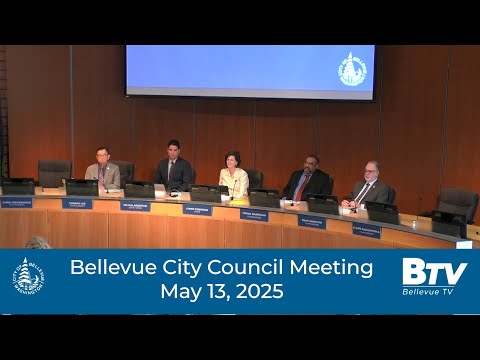
Bellevue council studies land-use code changes to allow middle housing under new state law
Summary
Bellevue city officials and planning commissioners presented a draft land‑use code amendment on May 13 aimed at complying with state laws that require cities to expand ‘middle housing’ options.
Bellevue city officials and planning commissioners presented a draft land-use code amendment on May 13 aimed at complying with state laws that require cities to expand ‘middle housing’ options. City staff, planning commissioners and dozens of residents discussed where to allow additional units, how to count accessory dwelling units and dimensional rules such as floor‑area ratio and height.
The planning commission recommendation would permit up to four dwelling units per residential lot citywide, exempt attached accessory dwelling units (ADUs) from the unit cap while counting detached ADUs, allow up to six units by right where two units are provided as affordable units or within expanded walking-distance buffers around transit stations and designated growth centers, and use floor area ratio (FAR) limits to shape cottage‑style developments.
The proposal matters because it interprets the requirements of House Bill 1110 and House Bill 1337—state law passed in 2023—and translates them into Bellevue’s zoning rules. City staff said the recommended changes aim to both meet the state deadline for local adoption and reflect Bellevue’s larger goals from its recently updated comprehensive plan, including concentrating growth near transit and employment centers.
City staff from Development Services outlined the draft’s main points: four units per lot as the baseline, an option to reach six units when two are affordable or where lots lie within the recommended transit and center buffers, a decision to count detached ADUs toward unit caps and FAR but not attached ADUs, FAR tables scaled to local lot sizes, a parking minimum of one space per unit with exemptions near major transit stops, and proposed height increases from 30–35 feet to a 38‑foot maximum to improve feasibility for certain building types.
Planning Commission members said they reviewed public testimony over several meetings and recommended modest expansions beyond the state minimum in a few locations: increasing the transit buffer to a half‑mile and allowing six units within a quarter‑mile of regional and countywide growth centers. Commissioners also recommended offering a fee‑in‑lieu for projects that do not deliver the two affordable units tied to the six‑unit allowance.
More than a dozen residents addressed the council during oral communications. Speakers who opposed elements of the draft warned of traffic, infrastructure strain and loss of neighborhood character if density is expanded beyond state requirements; those supporting the draft said middle housing could bring family‑sized, lower‑cost options and help stabilize school enrollment. Speakers gave examples: concerns about expanding buffers from a quarter mile to a half mile, neighborhood impacts from increased vehicle trips, and arguments that middle housing could produce townhouses marketable to families at prices lower than current single‑family averages.
Council members responded with a mix of support for the planning commission and requests for additional work. Several members praised staff and the commission for a thorough public engagement process but asked for follow‑up detail on several topics before adoption: how detached ADUs are counted (and why attached ADUs were treated differently), the FAR tables and the way FAR incentives translate to family‑sized units, protections for tree canopy and open space, clearer definitions for “cottage” housing so that cottage typologies remain lower‑scale, and mechanisms to monitor infrastructure and traffic impacts if broader buffers are adopted. Multiple council members suggested a staged approach: adopt the state‑required baseline now and return later to consider expansions after monitoring performance or after additional study.
Staff said the draft is intended to meet the June 30, 2025 state deadline for local adoption but that a further study session is scheduled and staff will return with options that respond to the council’s questions. No formal action or adoption vote occurred at the May 13 study session; staff left with direction to prepare supplemental analyses and to present alternatives on the key issues raised by council members and the public.
Council members and staff said they will continue outreach before any final vote, and will aim to ensure the land‑use code amendment reflects both the state statute and Bellevue’s local policy objectives.
AI generated
The text on this page is AI generated. Summaries, highlights, analysis, and video transcripts are all produced from the original source material.
AI can make mistakes, so if you spot one, and we will fix it for everyone.
Note: the source content is unaltered by us. Any content source we link to, be it a video, an audio recording, or a document, is presented exactly as its publisher released it. That publisher is usually a government body, sometimes an individual official or another organisation.