Get AI Briefings, Transcripts & Alerts on Local & National Government Meetings — Forever.
Senate panel hears opponents, utilities clash over HB 3306 indemnity changes for electric infrastructure contracts
Loading...
Summary
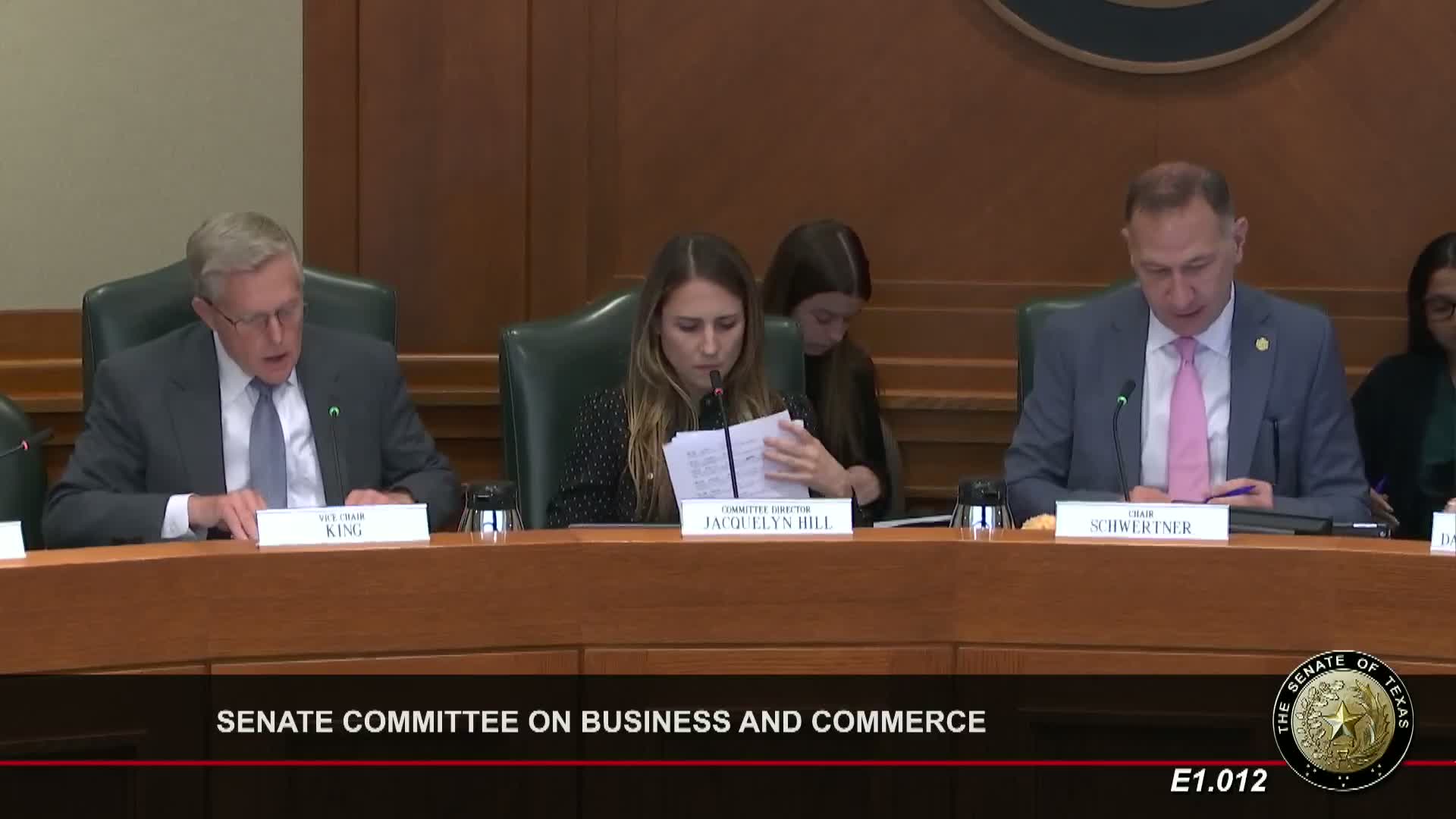
The Senate Committee on Business & Commerce heard divided testimony on HB 3306, a bill that would allow broader indemnity language for construction contracts tied to electric utility infrastructure, maintenance and vegetation management.
The Senate Committee on Business & Commerce on an unspecified date heard testimony on House Bill 3306, which would add construction contracts for electric infrastructure, maintenance and vegetation management to statutory exceptions that allow broader indemnity provisions.
The measure’s sponsor described the bill as a refinement of the insurance code to treat certain electric infrastructure work like public works. “This bill, HB 3,306, by Chairman Dean, would add to those exceptions a provision in a construction contract related to electric infrastructure construction maintenance, or vegetation management, for an electric utility or a transmission and distribution utility,” the sponsor said.
The bill drew sharply different testimony. Fred Wilshus, general counsel for the Texas Construction Association, opposed the bill. “What would happen if 3,306 was adopted? With regard to the utilities, they could be 100% at fault and the subcontractor who was not at fault would have to pay all the damages,” Wilshus said. He told the committee that Texas replaced broad-form indemnity in 2011 to require a fair allocation of fault, and argued HB 3306 would recreate contracts of adhesion that place outsized liability on subcontractors.
Scott Seemster, associate general counsel for Texas New Mexico Power, testified in support. He said utilities “are dealing with sophisticated parties” and that the work on transmission and distribution — poles, wires and substations rather than large building projects — functions more like public infrastructure. “This would allow us to have the contractor stand up,” Seemster said, arguing the change would let utilities manage liability and, he said, ultimately protect ratepayers from unexpected costs. He also said Texas New Mexico Power serves about 275,000 customers.
Jennifer Fagan, also representing the Texas Construction Association, told the committee the bill’s language is broader than developers’ examples and said it could shift large liability to small contractors. “You're having the largest amount of liability pushed down to the smallest company,” Fagan said, noting many vegetation-management contractors are small sole proprietorships.
Committee members asked for clarifications about the scope of projects covered. Senator questions and back-and-forth during public testimony focused on how current limited indemnity rules operate, master service agreements, and how plaintiffs target “deep pockets” in civil suits. Witnesses disagreed on how frequently and in what ways the proposed change would shift exposure down the contracting chain.
Public testimony concluded with the committee leaving the bill pending. No committee vote on the bill’s language occurred during the hearing.
The committee’s record shows the item was laid out for hearing and public testimony was taken; the bill was left pending subject to the call of the chair.
Details to watch: proponents say the bill aligns utility projects with public-works exceptions and helps utilities manage insurance and litigation costs; opponents say it revives broad-form indemnity and risks exposing small subcontractors to large liabilities.