Get Full Government Meeting Transcripts, Videos, & Alerts Forever!
Get email alerts on the Private Streets topic
No spam. Unsubscribe anytime.
Sequim planning commissioners lean toward public streets in comp plan update
Summary
After a multi-hour discussion Jan. 7, the Sequim Planning Commission signaled support for prioritizing public streets in the cityupdated comprehensive plan, while directing staff to provide an inventory of potentially landlocked parcels and to draft possible exceptions for limited situations.
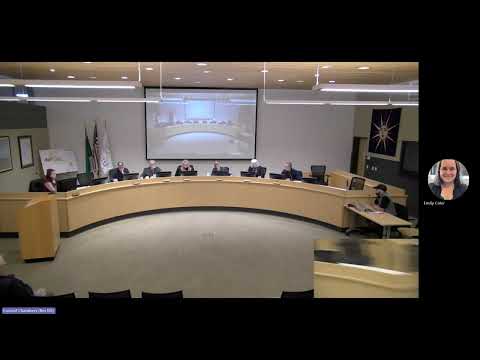
The Sequim Planning Commission on Jan. 7, 2025, signaled it will move the citytoward a public-streets-first policy in its upcoming comprehensive plan update, emphasizing connectivity and emergency access but stopping short of a formal vote.
Commissioners spent roughly an hour discussing proposed amendments that would clarify how the city treats private streets in new development, and asked staff to return with a cleaned-up inventory of parcels that appear landlocked and with draft language describing limited, measurable exceptions if the commission chooses to allow private streets in narrowly defined cases.
Travis, a planning department staff member who presented background material, said the topic dates to the cityplanner: "Back in 2021 during our last annual docket session for comprehensive plan updates, there was a proposal to make changes to our transportation element of the comp plan... so that's kind of why we're here."
Commissioners repeatedly framed the question as whether the city should continue to "prefer public streets" in the transportation element, allow private streets only by exception, or allow private streets more broadly. Several commissioners argued that public streets support a connected grid, multimodal travel and emergency access; others asked staff to identify concrete, objective circumstances for exceptions.
An email read into the record from Alex Fane, who was absent, said: "I prefer all new streets being public except for those in gated communities with man gate or electric locking gate and connecting all new developments as much as possible to existing streets and paths." The commission discussed gating as a specific concern because commissioners said gates and private networks can reduce pedestrian and bicycle connectivity and create barriers for emergency responders.
Staff noted recent local code work has already narrowed differences between private and public street construction. Commissioners and staff referenced the citynoted code changes require private streets built after the code change to meet the same technical standards as public streets (pavement, width, right-of-way dedication as needed). The commission also discussed a recent Sequim Municipal Code provision, SMC 12.11, which establishes a process for converting private streets to public streets; staff said that provision was adopted in 2024 and requires the road meet city standards and generally 100% agreement of affected property owners before conversion.
Commissioners cited other technical constraints from past plans and the citytransporation planning, including a historical finding that about 40% of some street segments were private as of a 2015 inventory, and a change in local access standards that now requires two points of access for developments once they exceed 15 dwelling units (the previous threshold had been 30 units). Those two-access rules and conversion requirements shaped commissioners' concerns about landlocked parcels and future development options.
Several commissioners spoke strongly in favor of prioritizing public streets. Commissioner Larry said a private-street pattern had created emergency-access and snow-removal problems in neighborhoods where older residents live, calling it a public-safety and livability issue. Commissioner Jeff said the commissionfavored a public-streets-first approach but remained open to staff-proposed objective exceptions.
Travis told commissioners he and other staff have a draft GIS-based inventory of parcels that appear landlocked or dependent on private access and said staff could refine and distribute that draft to commissioners for review. Commissioners asked staff to refine the inventory to the city limits (some drafts included the urban growth area) and to work with the cityattorney/consultants (SCJ and others) on language that could be used in the transportation element and later in development code if the commission wants exceptions.
No formal motion was made to amend the comprehensive plan at the Jan. 7 meeting. Instead the commission reached a clear working direction: staff should return with a cleaned-up parcel inventory, examples of measurable exceptions for limited circumstances (for example, physical/environmental constraints or a specified distance from a public street), and proposed language for the comprehensive plan and code cleanups. A public hearing and formal ordinance or comp-plan amendment would follow any staff recommendations.
Next steps: staff will email the draft parcel inventory to commissioners, consult town consultants about language in the transportation chapter and possible exceptions, and schedule follow-up work before any public hearing.