Get Full Government Meeting Transcripts, Videos, & Alerts Forever!
Get email alerts on the Budget topic
No spam. Unsubscribe anytime.
Dubuque City Council receives recommended FY2026 budget; proposes $10.06 tax rate and major capital projects
Summary
The Dubuque City Council on March 31 voted 7-0 to receive and file the City Manager's recommended fiscal year 2026 budget, which proposes a $29,861,901 levy and a $10.06 tax rate and details major capital projects and planned new debt.
DUBUQUE — The Dubuque City Council on March 31 voted 7-0 to receive and file the City Manager's recommended fiscal year 2026 budget, a presentation that lays out proposed property tax and rate increases, major capital projects and a multi‑year debt plan.
Jennifer Larson, the city’s chief financial officer, presented the budget overview. Larson said the recommendation centers on the five‑year capital improvement program (CIP), public safety and streets and noted the budget process began with council goal‑setting in August. "The theme of this budget recommendation centers around major capital improvement program projects, public safety, and streets," Larson said.
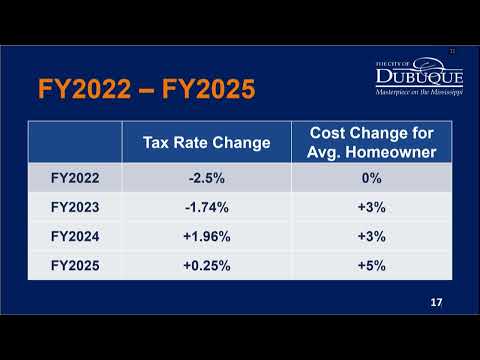
The recommended levy is $29,861,901, a 5.77% increase over fiscal 2025, and the recommended tax rate is $10.06 (a 1.38% increase). Larson told the council the residential impact would average $33.88 for the typical homeowner; commercial and industrial average city shares were shown as $74.26 and $85.68, respectively. The presentation also described state tax changes that affect local revenue, including the residential rollback factor rising from 46.3428% to 47.4316% and the ongoing loss of revenue tied to the 2017 multi‑residential property classification change, which Larson said costs the city about $5,630,000 annually and was not backfilled by the state.
Larson outlined enterprise fund rate recommendations: a 9% water increase (about $3.60 per month), a 9% sanitary sewer increase (about $4.92 per month), a 5% curbside collection increase (about $0.86 per month) and a 5% stormwater increase (about $0.53 per month). She reminded the council that "by Iowa state code, enterprise funds are required to charge enough fees to cover their expenses" and that enterprise funds "must be self supporting by state law."
On capital planning and debt, Larson said the five‑year CIP includes roughly $131 million for sanitary sewer work and detailed major projects and funding sources: Catfish Creek sanitary interceptor and lift station work, water PFAS mitigation, replacement of up to 500 lead water service lines, Fourteenth Street overpass improvements (a large project with federal and regional grant support), Central Avenue corridor improvements and renovation work at the Five Flags Center. The presentation projected issuing $152,147,710 in new debt over the five‑year CIP while retiring $139,519,604, a net increase in planned debt of roughly $12.6 million; use of the statutory debt limit was projected at about 33.5% in fiscal 2026.
Larson also reviewed labor and operating costs built into the recommendation: previously approved bargaining agreements reflected a 5% increase for the police bargaining unit and 3.5% for the fire bargaining unit and operating engineers, plus a recommended 3% cost‑of‑living increase for non‑bargaining employees and implementation of a compensation and classification study. She said the estimated general fund cost of wage and benefit changes in 2026 is just over $2 million.
Councilmembers offered responses and asked for follow‑up. Councilmember Roussell said, "It's always just amazing to see all that goes into the budget," and praised the level of detail; Councilmember Sprank argued for investment over deferred maintenance, noting, "deferred maintenance is debt." Councilmember Murphy asked Larson to explain retirement and new debt issuance; Larson said the city issues long‑term general obligation bonds (typically 20 years) and plans debt service in the budget so future annual payments are set aside from identified funding sources.
Larson closed by reminding the council and residents that the city will host multiple public meetings and department presentations in April and that a public hearing on adoption is scheduled for April 28, with online budget comment forms and council contacts available on the city website.
The council’s formal action was a motion to "receive and file and view the presentation" (moved by Councilmember Roussell and seconded by Councilmember Jones). City Clerk Adrienne Anne Breitfelder called the roll; the motion passed 7‑0. No public input was accepted at the special session because of the meeting format; Larson and council members reiterated that public comment opportunities are scheduled during the department presentation nights.
Looking ahead, the budget as presented would raise the city tax levy, recommend enterprise fee increases to cover utility costs, plan a significant borrowing program to fund infrastructure, and rely on federal, state and local grant resources where available. Councilmembers repeatedly emphasized continued review and additional hearings in April before any final adoption.