Get Full Government Meeting Transcripts, Videos, & Alerts Forever!
Get email alerts on the Zoning topic
No spam. Unsubscribe anytime.
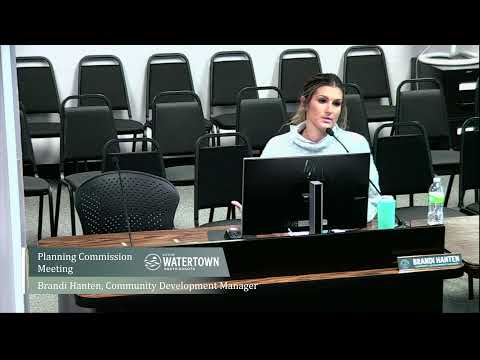
Watertown planning commission approves Ordinance 25-02 to create Commercial Lake District for Lake Compaska
Summary
The City of Watertown Planning Commission voted unanimously to approve Ordinance 25-02, establishing a revised Commercial Lake (CL) zoning framework for Lake Compaska that closes the existing CL district, creates two new CL districts and a discretionary overlay for higher-impact uses.
The City of Watertown Planning Commission voted unanimously on Feb. 20 to approve Ordinance 25-02, revising the city’s Commercial Lake zoning for Lake Compaska. The measure closes the existing CL (Commercial Lake) district for future applications, preserves the three properties currently zoned CL, and establishes two new districts (referred to in the ordinance as CL 1 and CL 2) plus a discretionary overlay labeled CLX to govern higher-impact uses.
The ordinance aims to allow limited lake-oriented commercial activity while protecting Lake Compaska’s largely residential character. Planning staff told commissioners the lake area is roughly 93 percent single-family residential and that the new districts and design standards are intended to enable “cohesive and complementary” commercial uses near the water while limiting impacts on adjacent neighborhoods.
Under the adopted framework, CL 1 (lake-adjacent) and CL 2 (lake-proximity) define where new commercial rezoning requests may be considered; a map presented by staff shows areas within approximately a half-mile of the shoreline where each district would apply. The existing CL properties retain their current zoning and are not subject to the new restrictions. Staff said properties beyond the city limits would require action by the county–city Joint Jurisdiction Board for commercial uses.
Permitted and special-permitted uses in the new districts are narrower than the previous CL rules. Allowed uses listed for the districts include lake-focused retail and service establishments, restaurants subject to special-permitted-use standards, recreational uses (public and private), religious institutions and mixed-use structures that place residential units above ground-floor commercial space. The commission and staff clarified that standalone multifamily housing or apartments are treated as residential and would follow the city’s R-3 rules rather than the CL regulations.
Design standards were folded into the draft from existing overlay regulations (the Gateway and Downtown overlay districts were cited as sources) to preserve neighborhood aesthetics. Specific protections and limits adopted in the ordinance include: outdoor seating prohibited within required side-yard setbacks of the primary structure; permitted outdoor seating hours set from 10 a.m. to 12 a.m.; outdoor music events limited to four per calendar year per property unless additional events are approved by the Board of Adjustment; and events must conclude by midnight. Staff also said the ordinance creates an administrative “lake use special event permit” (not currently on the books) that will be required for outdoor music events and similar activities.
To address uses commissioners and committee members identified as potentially intrusive — specifically bars/taverns and hotels/motels — the commission approved a discretionary CLX overlay. The overlay can be applied for at the same time as rezoning to CL 1 or CL 2; if requested later, application of the CLX overlay would return to the planning commission and then to city council with public notice and adjacent-owner notifications. The overlay is intended to provide transparency to the public and permit additional public hearings rather than allowing higher-impact uses by right.
The ordinance also addresses signage and electronic message centers. Staff said signage would be handled similarly to institutional uses (for example, churches or schools within residential districts). Committee members did not adopt an outright prohibition on electronic message centers; instead staff said on-premise electronic signage would be permitted under the same constraints used for other institutional signage.
Commissioners and staff credited a 10-month committee process that drafted the ordinance. Staff members named as contributors included Brandy (staff member) and Carla (committee manager); committee participants referenced in the meeting included Todd Kayes, Lynn Jerns (committee chair), Bonnie Aletsky, Blake Dolley, Kyle Peters and Mike Danforth. In discussion, commissioners noted communications with lake stakeholders about water-quality and conservation concerns but said those topics would be addressed in broader, follow-up regional or interagency processes involving the county and the corps rather than in the zoning ordinance itself.
A public hearing was opened and closed with no public speakers. Commissioner Case moved to approve Ordinance 25-02 with staff adjustments for typos and clarifications and with the renaming to CL 1 and CL 2; Commissioner Dolly seconded. A roll-call vote recorded “yes” from Collin, Speier, Kaccek, Case, Albie, Dully and Tate; the motion passed unanimously. Staff noted the city will likely need a future amendment to the comprehensive land-use plan to align the plan with the new regulatory scheme.
Implementation steps identified during the meeting include creating the administrative lake use special event permit; incorporating the ordinance’s boundary map into future rezoning reviews; and, at a later time, updating the comprehensive land-use plan. The planning commission and staff emphasized that the new structure is intentionally more limited than the former CL district to create clearer, predictable public notice and review for potential commercial uses along Lake Compaska.
Votes at a glance: Ordinance 25-02 (Commercial Lake District) — Motion to approve with staff corrections and renaming to CL 1/CL 2. Mover: Case. Second: Dolly. Vote: unanimous (Collin, Speier, Kaccek, Case, Albie, Dully, Tate — all “yes”). Outcome: approved.