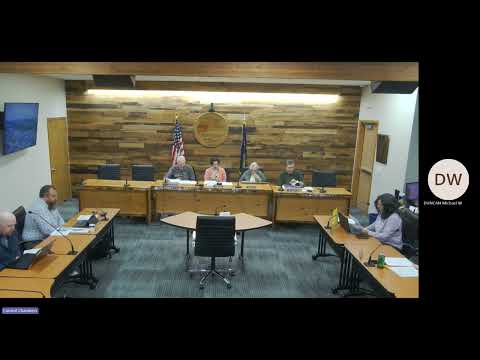
Planning staff outlines code updates, subdivision process changes and development activity
Summary
Planning staff briefed the commission on near-term code updates, several active land-division matters, and new middle-housing permissions allowing partitions of duplexes; staff said subdivisions may become Type 2 administrative decisions under recent state changes
Planning staff provided a set of administrative and code updates during the meeting, reporting active projects, pending code work and recent state-driven changes to housing laws.
Angela (planning staff member) told the commission that four land partitions are currently under staff review and that the Culture Subdivision (previously approved) is beginning contractor procurement and may require sewer work near 43rd Avenue. She said the Duck Howell Subdivision remains in redesign while applicants address wetlands and coordinate with the Department of State Lands and a homeowners association.
On code updates, Angela said the city will begin a larger code amendment process that will incorporate new state housing requirements. She said some provisions added in the city's last amendment may be removed to comply with incoming state law; staff will submit required materials to the Department of Land Conservation and Development (DLCD) and expects to bring a draft back to the commission in late spring or early summer.
Angela described a specific procedural change affecting subdivisions: "subdivisions are now going to be a type 2 decision, which are administrative. They won't come to you," she said, adding that staff may recommend routing specific applications directly to a Type 3 process (a noticed hearing before the commission) if public interest or appeal risk warrants it.
Staff also described recent uptake of a middle-housing provision referenced in the meeting as "Senate Bill 458," which allows developers to divide a duplex and sell each side as separate units. Angela explained the practical workflow: a duplex must first comply with applicable zoning and building standards on the parent lot, builders typically obtain the building permit and Certificate of Occupancy (C of O), and then the applicant completes the partition lot-line process so the two units can be sold separately. "I have 4 partitions that I am reviewing right now," Angela said, and noted several applicants have used the process since the law changed.
Angela provided an implementation note: although permit and partition processes can be initiated concurrently to save time, staff cannot finalize a partition decision until the building has received its C of O and the parent lot is verified to meet standards. Staff said some additional requirements (separate utilities, fire separation, and half-street improvements) have been applied to some projects to ensure compliance.
On schedule, Angela said staff intends to submit the code amendment package to DLCD and aims to present a draft to the commission by late spring or early summer for formal review and public hearings.
No formal actions were taken on these updates at the meeting.
AI generated
The text on this page is AI generated. Summaries, highlights, analysis, and video transcripts are all produced from the original source material.
AI can make mistakes, so if you spot one, and we will fix it for everyone.
Note: the source content is unaltered by us. Any content source we link to, be it a video, an audio recording, or a document, is presented exactly as its publisher released it. That publisher is usually a government body, sometimes an individual official or another organisation.