Lifetime Citizen Portal Access — AI Briefings, Alerts & Unlimited Follows
Secretary of State, vendor outline Cal Access replacement system, target public launch November 2026
Loading...
Summary
Secretary of State staff and prime vendor CGI briefed the Fair Political Practices Commission on the Cal Access Replacement System (CARS), describing stakeholder engagement, a phased development schedule and a public go‑live target of Nov. 26, 2026.
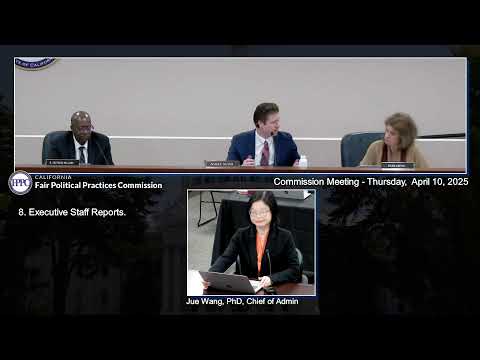
The California Secretary of State’s office and prime vendor CGI told the Fair Political Practices Commission on April 10 that the Cal Access Replacement System (CARS) is under active development and is scheduled for public rollout on Nov. 26, 2026.
The presentation explained why the project is being undertaken and how the Secretary of State (SOS), the California Department of Technology (CDT), independent verification and validation consultants, and the vendor are working together to build a cloud-based system to replace the legacy Cal Access application.
The project team said the objective is to move the state’s campaign and lobbying filings from a mix of paper and legacy online forms to a single, data-driven, online platform that validates entries, improves public access, and reduces manual processing. “Cal Access is the public’s window into the filings that are received by the secretary of state,” said Kiara Rasmussen, Political Reform Division assistant chief, California Secretary of State. Rasmussen said the team is focused on automation, stronger data validation and easier public access.
John Heinlein, SOS assistant project director for CARS, described an emphasis on stakeholder engagement. He said the project has regular biweekly and monthly meetings with a broad set of users, including campaign treasurers, third‑party filing software vendors, county and city filing officers, and watchdog groups. “One of the guiding objectives when we started planning this project was stakeholder engagement,” Heinlein said, noting the project used industry best practices to involve users in design, demonstrations and user acceptance testing.
Denise Tower, CGI project manager, reviewed the build plan and current schedule. She said the project completed kickoff and planning deliverables last year and is in phase 2 development with four planned program increments. Increment 1 is focused on filer registration and disclosure; the team reported they are in the early development sprints (8 of 40 completed at the time of the briefing) and beginning to deliver working software for stakeholder review. Tower said the project has set up development, test and user acceptance environments in the Microsoft Azure Government cloud and is converting legacy data into the new schema.
Officials described the migration need as significant: the legacy system dates to work begun after the Online Disclosure Act of 1997 and contains roughly 20–30 years of filings. Tower said the project team is implementing data governance and conversion processes to preserve data integrity during migration. Heinlein said the system will support interfaces with third‑party electronic filing vendors and that a proof of concept for those interfaces is planned for mid‑May during Sprint 11.
Commissioners and staff asked about training and user experience. Rasmussen and Tower described a mix of instructor‑led, webinar and self‑paced training and said the system is being designed to be “wizard driven” so screens adapt to users’ answers and reduce training needs. Commissioner Wilson asked about artificial intelligence; the team said they have discussed AI conceptually and are tracking options but had not finalized any AI features.
The presenters asked for ongoing, timely feedback from the commission and FPPC staff, who are regular participants in the project’s biweekly meetings. Executive Director West and FPPC staff — including Dave Bainbridge, Chloe Hackert and Lindsay Nakano — were listed by the SOS team as active, standing partners on the project.
The team reiterated the public go‑live target for the full public portal: Nov. 26, 2026, timed to give filers and third‑party vendors runway before the 2026 general election.
The commission did not take any formal action on CARS during the meeting. The presentation materials and ongoing stakeholder meetings will continue; FPPC staff and SOS will coordinate on testing and training schedules.
Ending: The commission thanked the SOS and vendor teams for the briefing and for regular coordination; staff noted FPPC participation will continue through stakeholder reviews and user acceptance testing.