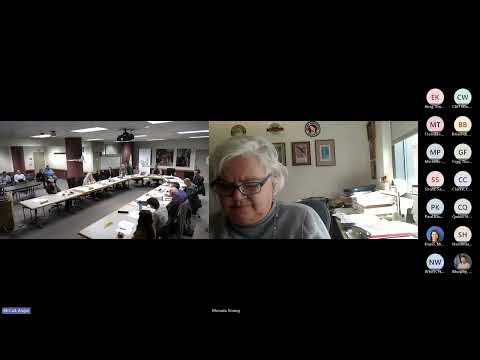
City drafts Complete Streets ordinance update to add ADA reference, standards and plan-based triggers
Summary
City transportation leadership presented a redline draft April 9 updating the Complete Streets policy (Chapter 17) to reference an ADA transition plan, add national/design standards (AASHTO, NACTO), incorporate a safe-systems safety approach, and clarify when exceptions apply; staff said the update aims to improve grant competitiveness and better
City transportation leadership presented a draft update on April 9 to the city’s Complete Streets ordinance (Chapter 17 of the Plan Spokane policy code), proposing changes that explicitly reference disability-access planning, national design standards and a ‘‘plan‑based’’ approach to applying complete‑street elements.
"The Complete Streets ordinance has not been updated since it passed in 2011," said John Schneider, director of Transportation and Sustainability, who introduced the draft and described the rationale: state statute and grant programs have evolved, community expectations for multimodal streets have increased, and an updated ordinance could improve the city's competitiveness for state grants.
Key changes in the draft ordinance included: - A new reference to an ADA transition plan: staff noted the city does not yet have an adopted ADA transition plan and the draft ordinance references the plan to signal intent to compile ADA assessment and transition priorities. - Explicit references to standards and guidance: the draft names AASHTO and NACTO as design references and adds the "safe systems" framework as an element to guide project design and safety outcomes. - Clarified exception language: the draft adds regional‑equivalence language (allowing parallel routes to carry certain elements) and explains when development should be required to provide frontage or other improvements instead of the city constructing them. - Performance measures and reporting: a new clause directs staff to consider measurable performance metrics to support grant applications and track outcomes. - Emphasis on plan‑based triggers: the ordinance update keeps a plan-based approach so that complete‑street elements are required where plan documents (for example, bicycle master plans or pedestrian master plans) call for them; staff told commissioners this approach creates flexibility to tailor treatments by context.
Commissioners and attendees asked clarifying questions about how the ordinance will treat different contexts. One commissioner asked whether the plan‑based approach allows different Complete Streets treatments in industrial areas versus dense residential corridors; Schneider said that is the intent — the ordinance relies on area plans and the bicycle/pedestrian master plans to provide context‑sensitive direction and that keeping those plans current is essential to triggering the desired elements.
Several commissioners flagged specific wording that they said should be clarified: one asked that the ordinance retain an explicit multimodal definition in the Complete Streets definition text (so the concept of multi‑modal use is obvious at the top of the ordinance); another asked that when the city relies on development to build frontage improvements there be a reasonable time limit or interim treatment so underinvested neighborhoods are not left without safe connections for decades.
Schneider said the draft will go to the Transportation Commission for a recommendation in May and then to the Plan Commission and City Council. He invited written comments and suggested staff email ([email protected]) as the route for formal feedback for the May review. He also noted staff will coordinate with regional partners, including WSDOT, when truck‑route or corridor responsibilities overlap.
Ending: Schneider asked for commissioner input in the next two weeks and said staff will bring a refined draft to the Transportation Commission’s May meeting, then to the Plan Commission as part of the Plan Spokane process.
AI generated
The text on this page is AI generated. Summaries, highlights, analysis, and video transcripts are all produced from the original source material.
AI can make mistakes, so if you spot one, and we will fix it for everyone.
Note: the source content is unaltered by us. Any content source we link to, be it a video, an audio recording, or a document, is presented exactly as its publisher released it. That publisher is usually a government body, sometimes an individual official or another organisation.