Get Full Government Meeting Transcripts, Videos, & Alerts Forever!
Get email alerts on the Civic Discourse topic
No spam. Unsubscribe anytime.
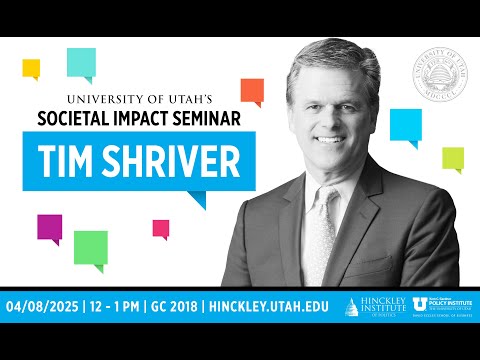
Tim Shriver presents Dignity Index at University of Utah forum, urges students to treat opponents with dignity
Summary
At a Hinckley Forum at the University of Utah, Tim Shriver, CEO of Unite and chairman of Special Olympics International, described an 8‑point Dignity Index and urged students to adopt skills to reduce political contempt and polarization.
Tim Shriver, CEO of Project Unite and chairman of Special Olympics International, presented the Dignity Index and urged students at the Hinckley Forum at the University of Utah to treat people with dignity even when they disagree.
Shriver, introduced by a student host, said the nonprofit he co‑founded in 2018 developed the Dignity Index in partnership with the Hinckley Institute as “an 8 point scale that measures how people talk to each other when they disagree.” He described the effort as a response to rising contempt in political and social life and said the index is intended to make contempt visible and teach skills to move toward more civil exchange.
The Dignity Index assigns low scores to language that dehumanizes or advocates exclusion, and higher scores to language that shows curiosity and humility toward those with different views. Shriver described examples used in the program—including sportsmanship remarks by Simone Biles and a scene from the television show Ted Lasso—to illustrate how statements are scored and to show how ordinary interactions can be shifted toward dignity.
Shriver traced part of the problem to what he called an “outrage industrial complex,” a cycle of algorithmic amplification, partisan media, and political incentives that rewards contempt. “If your argument for or against the wall is full of hatred and anger and hostility and contempt and dehumanization of people who don’t agree with you, you’re getting your information from this web,” Shriver said. He cited research and public polling in the presentation—attributing figures to outside sources—to argue the country faces deteriorating trust and increased interpersonal conflict.
Drawing on his experience with the Special Olympics, Shriver offered an anecdote in which athletes used single‑use cameras backwards; the story aimed to show how distorted lenses of judgment lead to mistaken assumptions about others’ competence or intent. He said the Special Olympics work taught him that shifting identity (for example, seeing someone as an athlete rather than by other labels) can change how people perceive one another.
Shriver said the Dignity Index is practical and teachable: “All we’re asking people to do is be aware of how they characterize someone when they disagree.” He described simple skills the program teaches, including a breathing/self‑regulation technique (“turtle”), self‑awareness exercises, and starter questions—such as “Tell me more” or “What outcomes are you trying to achieve?”—to move conversations upward on the index. He said second graders can learn the basics and that the approach is intentionally nonpartisan.
He also outlined calls to action aimed at campus audiences: he encouraged students to join a Students for Dignity chapter on campus, to use social media to model civil engagement, and to sign up on Unite’s website. As a light fundraising prompt he suggested a $1 contribution to support the work.
During a brief question‑and‑answer period, Shriver said the index cannot always capture tone or satire from text alone but that scores are more reliable when context is available. Asked whether showing dignity toward openly abusive or violent actors risks empowering them, Shriver said dignity does not mean tolerating criminal behavior or abandoning accountability: “I would say for life” for someone who committed capital crimes, he said, and added that dignity can help separate a person from their deeds while preserving accountability. He cited Martin Luther King Jr. as a model of forceful moral critique that did not descend into personal dehumanization.
The forum was presented as part of the University of Utah’s Societal Impact Seminar Series in partnership with the Kem C. Gardner Policy Institute. The event included short audience participation during scoring exercises and two audience questions during the Q&A.
Shriver’s presentation summarized the Dignity Index, offered classroom‑style scoring practice, and closed with a recruitment pitch for student involvement and a website for more information.