Lifetime Citizen Portal Access — AI Briefings, Alerts & Unlimited Follows
Pinal County Water Augmentation Authority outlines regional work, stresses century‑scale planning
Loading...
Summary
At a Casa Grande City Council study session, Joe Singleton, executive director of the Pinal County Water Augmentation Authority, reviewed the authority’s recent technical work, litigation‑threatened programs that affect subdivisions in the Pinal AMA, and regional projects including a Bartlett Dam feasibility study and a cloud‑seeding pilot.
Joe Singleton, executive director of the Pinal County Water Augmentation Authority, briefed the Casa Grande City Council on the authority’s recent technical reviews and policy work, and urged long‑range planning for groundwater in the Pinal Active Management Area.
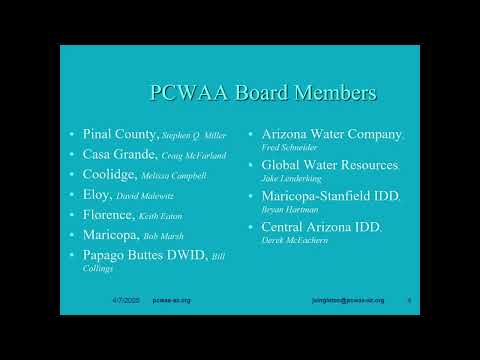
The authority, enfranchised under Title 45 and working to support sustainable water management in the Pinal AMA (including the Eloy Sub‑Basin and the Maricopa‑Stanfield area), has pursued technical reviews, legislative fixes and regional projects intended to shore up water supplies for communities and agriculture, Singleton said.
Singleton said the authority hired Matrix New World to review the Arizona Department of Water Resources’ 2019 groundwater model, submitted recommended corrections and proposed changes to how assured‑water‑supply assumptions are made. He said the authority supported technical work from a Pinal stakeholder group and has submitted a package of recommended changes to DWR. "We're talking about math that goes out a hundred years," he said, summarizing the long time horizon that state water planning requires.
Why it matters: The authority’s work affects whether developers can obtain assured‑water‑supply approvals for new subdivisions in the Pinal AMA and shapes how groundwater is accounted for across municipal, agricultural and private utility users.
Key points from Singleton’s briefing: - Groundwater modelling and assured‑water‑supply rules: The authority supported outside review of DWR’s 2019 AMA model and submitted suggested corrections; the authority also proposed changes to the Assured Water Supply program’s administrative approach. - ADOS and litigation: Singleton described ADOS (an alternative pathway to designation of assured water supply) as a program passed about a year ago that has been sued twice and, if implemented and sustained, could allow new subdivision plats to proceed by accounting for additional replenishment and previously uncounted groundwater use. He said Arizona Department of Water Resources is reviewing applications related to ADOS and that legal challenges remain "not specified" in outcome and timing. - Ag‑to‑Urban concept: The authority is exploring an Ag‑to‑Urban credit that would give physical‑availability credit toward subdivision requirements in exchange for relinquishing agricultural water rights that meet irrigation‑history criteria. Singleton said the legislative and administrative tracks are not yet aligned and are "still pretty far apart." The Senate group considering the matter was scheduled to meet again shortly after the briefing. - Bonding and regional projects: The authority is updating bonding language from its 1993 statute; Singleton said a revised bill recently "passed out of a House committee" and could become an important financing tool, particularly if modified Bartlett Dam work yields new surface water supplies. The authority is a steering‑committee member and cost‑share partner on a Bartlett Dam modification feasibility study that would raise reservoir capacity rather than dredge capacity at Horseshoe Dam, he said. - Cloud seeding study: A regional cloud‑seeding study reported roughly 23 potentially seeding‑suitable summer days in the area and suggested the program could produce additional water at reasonable cost. Singleton said the typical seeding agent under consideration would be a calcium‑chloride type salt; he noted at least one tribal stakeholder has raised concerns, and that consultants were preparing cost proposals for a salt‑agent program.
Council members asked about reuse of effluent, local advocacy and CAP (Central Arizona Project) cuts. Singleton emphasized the long planning horizon and sought to reassure residents: "You're in pretty much no danger of going home tonight, turning on your tap, and have it spit sand at you. You're fine that way," he said, while noting policy choices made now affect water availability for future generations.
The presentation did not include formal council actions or votes. Singleton and members of the authority, including a local representative from Casa Grande, said they will continue to update the city as the authority pursues rule changes, federal project reviews and potential pilot programs.
The council and staff did not take formal votes during this briefing; the authority’s proposals and legislative items remain subject to external agency decisions and litigation.
Ending: Singleton offered to answer detailed technical questions and flagged continuing engagement with DWR and with regional partners as the authority awaits final responses to submitted technical packages and as litigation and legislative processes proceed.