Get Full Government Meeting Transcripts, Videos, & Alerts Forever!
Get email alerts on the Supplemental Pay topic
No spam. Unsubscribe anytime.
Subcommittee backs staffing, legislative changes and audits to clarify state supplemental pay
Summary
A House subcommittee on supplemental pay voted to request funding for DPS staff, ask audits of fire departments, and pursue statutory clarifications after testimony from DPS, firefighters and oversight officials.
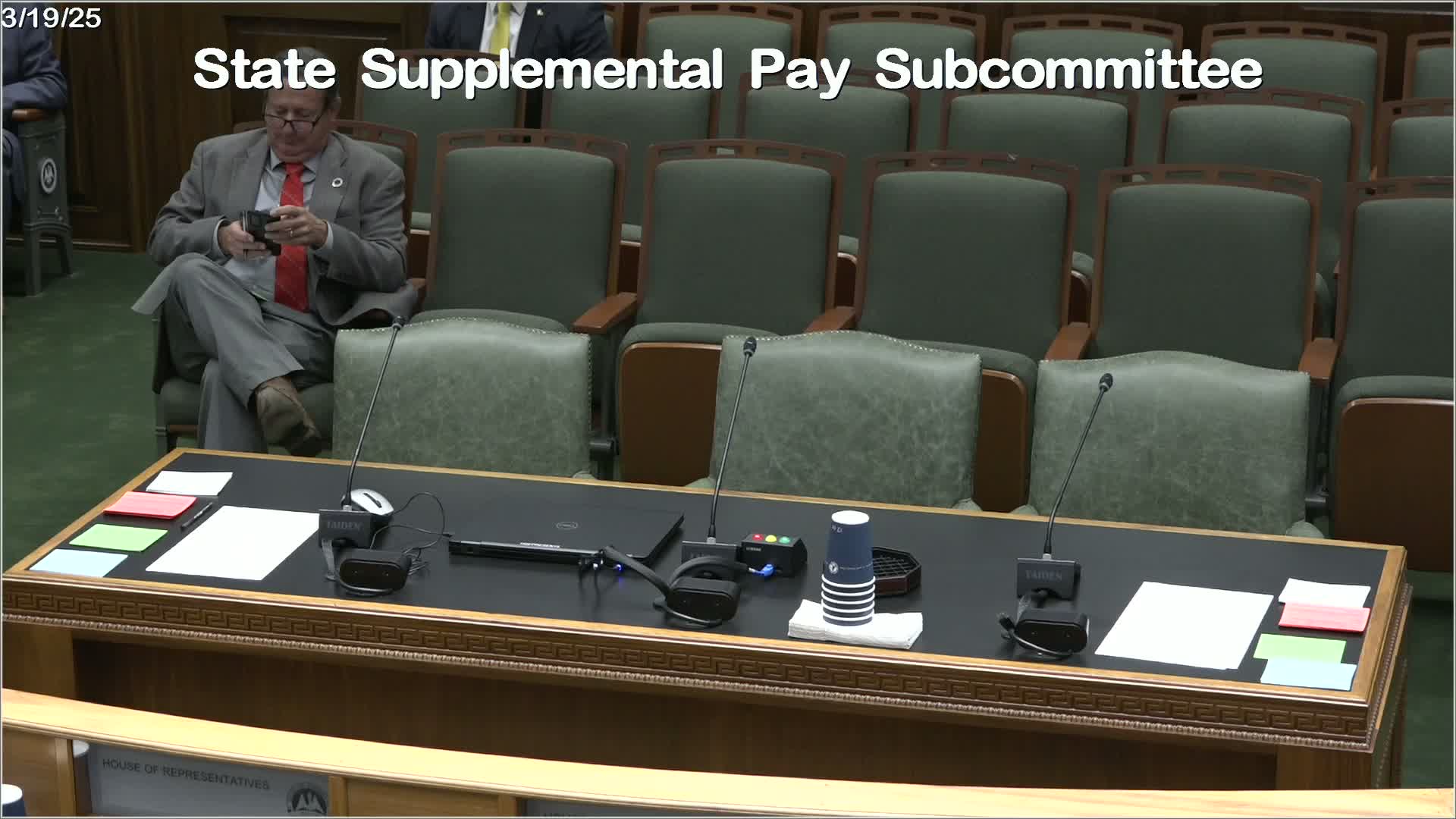
The Subcommittee on Supplemental Pay voted to include several requests and study items in a report to the House Committee on Appropriations and the Senate Committee on Finance after testimony from Department of Public Safety (DPS) staff, firefighters, municipal and university police representatives and state oversight officials.
The subcommittee moved, without recorded objections, to ask Appropriations and Senate Finance to fund additional DPS positions to administer state supplemental pay; to submit a summary of recommendations from supplemental pay boards and state agencies; to consider legislation creating a deputy sheriff supplemental pay statute; to ask the legislative auditor to audit fire departments’ supplemental pay rosters; and to further study and clarify definitions of eligible classes (law enforcement and firefighters).
Those items follow multiple presentations and recommendations. Lieutenant Colonel Robert Burns of the DPS State Police told the panel his office supports clearer statutory language on eligibility and appeals and requested additional staffing to administer the program. He said the department would like an amendment to HB 1 to add personnel and associated costs for the upcoming session and described administrative challenges: “We currently use our financial services department to process supplemental pay issues and payments… they are having to do multiple duties. We don't have a dedicated staff,” Burns said. He told members the department created a dedicated telephone line and expanded email coverage and directed staff to respond to inquiries within three business days.
Representing firefighters, Shane Spillman summarized recommendations developed with the Fire Chiefs Association and the Louisiana Firemen's Association. They proposed delaying a new member’s first supplemental pay payment until the thirteenth month rather than the twelfth, and they asked that members who qualify continue to receive supplemental pay throughout their employment unless they fail to maintain required certifications. “Firefighting… is about 10 to 15% of our job now. Everything else is the medical and all the other calls that we make,” Spillman said, arguing that eligibility language should reflect modern fire-service duties beyond classic firefighting.
State Treasurer’s Office representative Lindsay Schexnider and Adrienne Bordelon, state examiner for the Municipal Fire and Police Civil Service System, recommended clarifying statutory definitions of eligible duties. Schexnider noted that the statute refers to a majority of law-enforcement duties rather than specific job titles, and she said boards currently must interpret duties when reviewing applications. Bordelon described how recent changes expanded eligibility to some university police: “UNO and SUNO came to the state supplemental pay and asked to have their classified state police officers added… the attorney general opined that they would be eligible provided they met certain criteria.” She flagged potential conflicts in law when state-classified employees receive supplemental pay that statute otherwise appears to exclude.
Jim Craft, executive director of the Louisiana Commission on Law Enforcement and a supplemental-pay board member, told the subcommittee the program is valuable in many jurisdictions and defended retaining benefits for officers who earned them through service and training. “If they're certified police officers and went out and got the training… that $600 a month is a godsend for them,” Craft said.
Committee members and witnesses pressed three recurring policy issues: 1) ambiguity in Title 40 and related statutes about who is eligible (job title vs. job duties), 2) administrative capacity at DPS to process applications and payments promptly, and 3) whether recent legislative additions allowing university police to receive supplemental pay create a legal conflict or open a path for other state-classified employees to seek the benefit. DPS recommended clarifying Act 110 payment language (now read to cap a single payment at $10,000) and suggested setting a 6-month window for departments to submit applications once eligibility is recognized to reduce large retroactive balances.
The subcommittee moved a set of report recommendations and study items by voice vote with no recorded objections. Members also requested a resolution directing the legislative auditor to audit fire departments’ supplemental-pay recipient lists and counts so the legislature can see how many employees at each department currently receive payments. The panel asked staff to prepare a report that would list recommended statutory clarifications, the DPS staffing request for inclusion in HB 1, and the audit request for the legislative auditor.
The subcommittee adjourned after approving the report items and study directives.