Lifetime Citizen Portal Access — AI Briefings, Alerts & Unlimited Follows
‘College in the High School’ enrollment surges while reimbursement rules strain colleges
Loading...
Summary
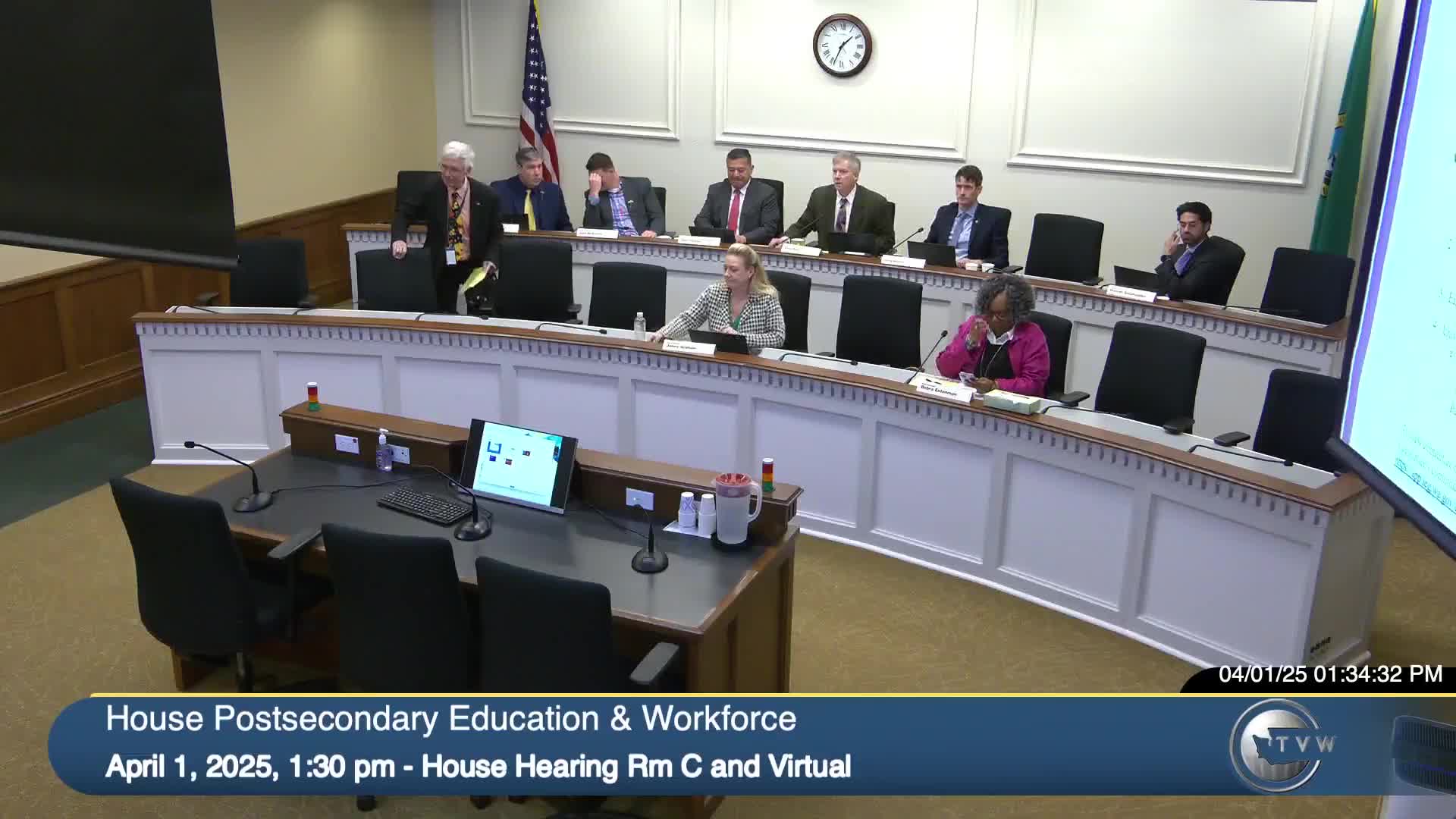
At a work session of the Postsecondary Education & Workforce Committee on April 1, state and university officials said enrollment in the state’s college-in-the-high-school dual-credit programs has increased sharply since the Legislature eliminated student fees, but the reimbursement model created by that law is not covering program costs for many colleges.
At a work session of the Postsecondary Education & Workforce Committee on April 1, state and university officials said enrollment in the state’s college-in-the-high-school dual-credit programs has increased sharply since the Legislature eliminated student fees, but the reimbursement model created by that law is not covering program costs for many colleges.
Jamie Trogot, director of student services and K‑12 alignment at the State Board for Community and Technical Colleges, told the committee that the Legislature’s change in 2023 made college-in-the-high-school “free for students” and that participation has risen roughly 53% since 2018. “Our success rates right now for college in the high school is 96%,” Trogot said, adding that students of color now represent about 47% of participants.
The growth has not eliminated financial pressure on providers. Trogot described the program’s reimbursement process: colleges submit course information and are paid afterward, typically in the fall. For community and technical colleges the system currently reimburses “$3,500 per course, or it could be $300 per student per course,” she said. That latter per‑student figure applies when section size is small and has reduced the effective revenue some institutions receive.
Officials from multiple institutions described the consequences. Dr. Patrick Blaine, dean for humanities, arts and social sciences at Whatcom Community College, said Whatcom decided in January to pause its college-in-high-school offerings because the college’s direct costs for 2024–25 were “approximately $30,000 in salaries and stipends,” while the 2023–24 fee allocation the college received was $13,333. “The crux of this is that our costs for providing the programming outweigh what we received in reimbursement,” Blaine said, adding that indirect costs—administration, HR, enrollment and student services—raise the breakeven point further. Whatcom officials said they remain interested in the model and are working with local K‑12 partners to transfer sections to other providers.
Steve DuPont of Central Washington University and Dr. Kyle Kerrigan, CWU’s director of concurrent enrollment, described CWU’s statewide delivery and credited Senate Bill 5048 (2023) for expanding access. CWU said it partners with more than 220 high schools and is NACEP‑accredited. Kerrigan said the program aims to “create an integrated and seamless pipeline for students from middle school to high school and into postsecondary education.”
Jens Larsen of Eastern Washington University said EWU is the fastest‑growing provider and highlighted scale and operational costs as a tension point: EWU staff said once a course reaches a certain enrollment threshold the institution receives no additional revenue for additional students, so very small and very large sections both create financial pressure.
Tim Stetter, director of the University of Washington’s UW in the High School program, explained how the current statutory funding design applies differently to universities and community colleges. He said the statutory course‑based funding level is $6,150 per course (with annual adjustments), but the law’s per‑student $300 rule for small courses and the post‑performance reimbursement structure mean many institutions actually receive less funding than before fee waivers. “We are actually receiving a little bit less in funding than we were 5 years ago,” Stetter told the committee, even as registrations have doubled at some institutions.
Speakers identified implementation costs that accreditation and quality requirements impose. Participants noted that NACEP (National Alliance for Concurrent Enrollment Partnerships) accreditation requires faculty mentoring, professional development, student support services and administrative staffing. Trogot said roughly half of Washington’s community and technical colleges are NACEP‑accredited and colleges not yet accredited undergo a state review process every two years intended to help prepare them for national accreditation.
Panelists described several program closures and scale‑backs that they attribute to the funding model. Trogot listed Clark College as having closed its program in 2024, Everett Community College as having scaled down sections, and Whatcom as pausing its program for the coming year. Central and other institutions said they are working to absorb or reassign some sections so students can still take courses.
Legislators on the committee asked staff and presenters for more granular cost data. Rep. Rhett McIntyre asked whether the fee waiver had shifted costs to other students or changed the system’s bottom line; Trogot replied that the board would provide more detail. Rep. Reid asked for a systemwide accounting of college costs and whether states with different funding models offer lessons; Trogot said Washington is participating in a national dual‑credit cohort to study those questions. The committee asked SBCTC staff to supply a breakdown of college costs and the reimbursement history for committee review during the interim.
Officials and lawmakers framed possible responses without endorsing a single solution: options discussed included targeted state funding to cover accreditation and staffing, shared services among colleges, or changes to the per‑course/per‑student split to better support small and rural sections.
The work session closed with committee leadership asking members to consider interim priorities and potential policy options for the short session next year, including follow‑up analysis of program costs and possible statutory or budget fixes.
Ending: Committee staff will compile the requested cost and reimbursement data for further review; colleges and universities said they will continue to collaborate on shared solutions and that the state’s dual‑credit system remains a high priority for improving postsecondary access.