Get Full Government Meeting Transcripts, Videos, & Alerts Forever!
Get email alerts on the Senate Floor Votes 2025 03 31 topic
No spam. Unsubscribe anytime.
Idaho Senate advances budgets, public-safety and education measures; child-advocacy, parental-rights and DEI bills move forward
Summary
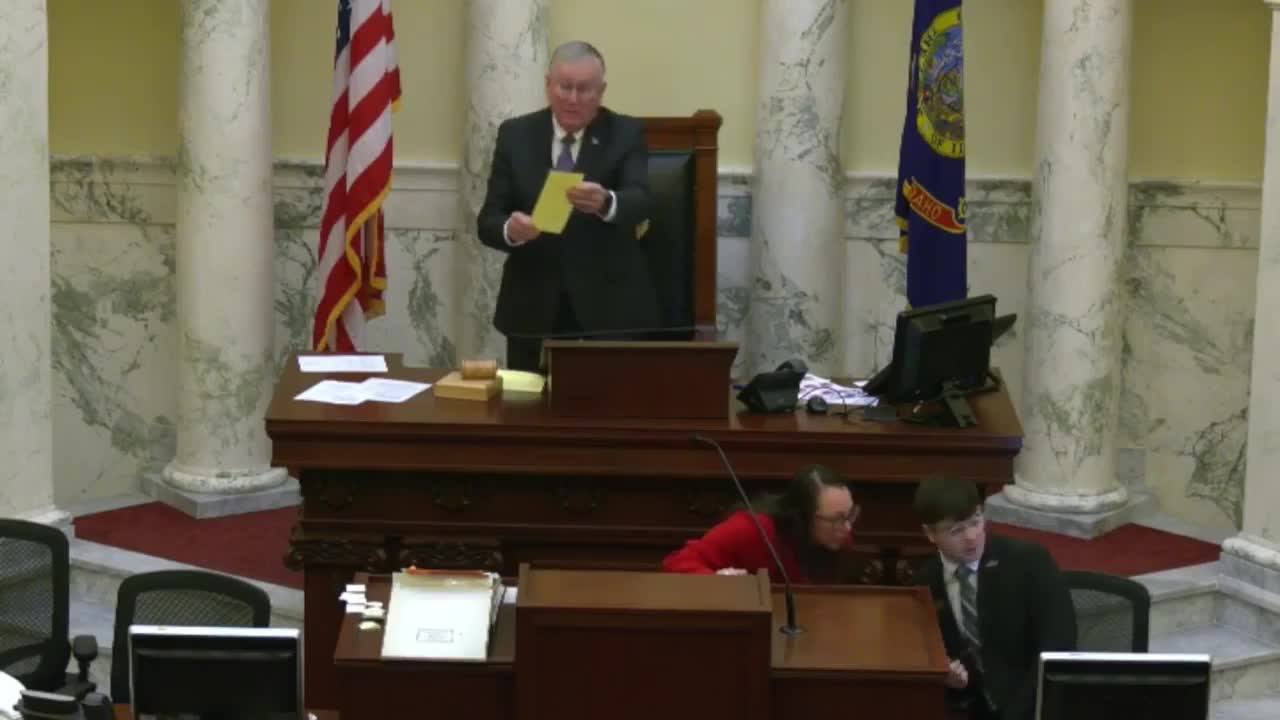
The Idaho Senate spent March 31, 2025 debating an array of budget and policy measures, approving appropriations for Medicaid, the Idaho State Patrol, public health services, libraries and education programs, while also advancing one-time funding for children—s advocacy centers and passing amendments to the Idaho Parental Rights Act and a prohibition on DEI offices at taxpayer-funded institutions.
The Idaho Senate spent its March 31, 2025 floor session considering a mix of appropriation and policy bills, approving a number of departmental enhancement packages and sending several policy measures back to the House. Major budget items approved included funding increases for Medicaid, the Idaho State Patrol, the Idaho Commission for Libraries, public health services, and multiple K-12 education line items. The Senate also approved a one-time appropriation to Children's Advocacy Centers and passed amendments to the Idaho Parental Rights Act and a measure restricting diversity, equity and inclusion (DEI) offices at taxpayer-funded institutions.
Why it matters: Several of the votes implement or respond to policy decisions made earlier this session and in past years — notably the state—s transition of public defense from counties to a state office and work to update Medicaid forecasting and managed-care contracts. The measures affect state spending priorities for public safety, health and education and, in the case of DEI and parental-rights legislation, set new limits on how state-funded institutions may structure programs and training.
What the Senate did (high-level) - Passed multiple departmental enhancement appropriations to fund agency maintenance and program changes, including supplemental costs and one-time investments. Key approvals included the Medicaid maintenance/enhancement bill, funding for the Idaho State Patrol, Department of Health & Welfare public-health programs, and appropriations for the Idaho Commission for Libraries. - Approved one-time funding for children—s advocacy centers statewide to support forensic interviews, medical exams and related services used in child-abuse investigations. - Amended and approved the Idaho Parental Rights Act to clarify exceptions and add a two-year statute of limitation for civil claims; sponsors said the changes were intended to prevent the law from being applied in ways that block routine, nonemergency care or create administrative confusion. - Passed legislation restricting DEI offices, DEI-required trainings, and bias-reporting systems at taxpayer-funded institutions; sponsors characterized the bill as a protection of academic freedom and a curtailing of identity-based administrative programs.
Major budget and policy items (details and next steps) - Medicaid (Senate Bill 12-01): The Senate approved the Medicaid maintenance/enhancement appropriation, which included an updated population forecast and funding for implementation measures tied to managed care direction adopted by the Legislature this session. Sponsors described the bill as funding legally-required services and forecasted enrollments; critics warned about the program—s growth. Vote: passed (Yes: 22; No: 13; 1 absent). The bill will be transmitted to the House.
- Office of the State Public Defender (Senate Bill 12-02): The Senate approved supplemental and ongoing funding to align the new state-run public defender system—s budget with service levels and contract conversion needs, plus rates for contract attorneys. Sponsors said the transition from county-based defense work revealed significant underestimates in earlier fiscal data. Vote: passed (Yes: 23; No: 12). The bill will be transmitted to the House.
- Idaho State Patrol (Senate Bill 11-97): The Senate passed an appropriation bill that included funds for vehicle backlogs, forensic staff, a targeted salary increase for commissioned officers and replacement items (patrol vehicles, body armor and IT modernization). Sponsors said vacancies and pay compression are driving the request. Vote: passed (Yes: 28; No: 6; 1 absent). The bill will be transmitted to the House.
- Medicaid- and health-related measures (multiple): The Senate approved the Department of Health & Welfare public-health enhancement bill (Senate Bill 11-94) and a separate Medicaid supplemental/maintenance bill (Senate Bill 12-01). The public-health bill restored or shifted funding for suicide prevention, overdose prevention, WIC, immunization and other programs and moved several items between ongoing and one-time status as the Senate reviewed ARPA and other federal funds. Vote on SB11-94: passed (Yes: 22; No: 13). The bills move to the House.
- Libraries and digital-access funding (Senate Bill 11-96): The Senate approved funding to support the Idaho Commission for Libraries, including ongoing reimbursements for public-library services (content filtering, mobile hotspots and equipment) and a one-time digital-access grant program to buy devices for Idahoans. The bill included reporting and affidavit language about certain spending categories. Vote: passed (Yes: 24; No: 11). The bill will be transmitted to the House.
- Children—s Advocacy Centers (Senate Bill 12-03): The Senate approved a one-time general fund appropriation of $3,000,000 to support accredited and associate Children—s Advocacy Centers statewide. Senators described CACs as trauma-informed, multidisciplinary facilities that conduct forensic interviews, coordinate medical and mental-health services, and support criminal prosecutions of child-abuse cases. Sponsors and several law-enforcement letters cited improved conviction rates when CAC procedures are used. Vote: passed (Yes: 27; No: 8). The bill will be transmitted to the House.
- Idaho State Historical Society (Senate Bill 1200): The Senate approved enhancements for staffing and collections work at the Idaho State Historical Society, including requests contingent on a federal grant and multi-year moving costs for state artifacts and records. Vote: passed (Yes: 20; No: 13; 2 absent). The bill will be transmitted to the House.
- Department of Lands and wildfire funding (House Bill 4-44): The Senate passed the Department of Lands enhancement bill, which included requested positions, fire-detection cameras, fire equipment and a partial payment toward last year—s statewide firefighting costs. Sponsors noted a request to pay $40 million from the budget and use fund balance for the remainder of about $60 million in prior-year wildland fire invoices. Vote: passed (Yes: 24; No: 11). The bill will be returned to the House.
- Education and K-12 measures (multiple House bills): The Senate approved several education-related enhancement bills on third reading: charter facilities and lottery adjustments (House Bill 4-53, passed 33-1-1), the Idaho Digital Learning Academy funding increase tied to enrollment (House Bill 4-52, passed 27-8), the School for the Deaf and the Blind enhancements (House Bill 4-51, passed 27-8), and several statewide public-school career-ladder and benefits calculations (House Bill 4-54, passed 33-1-1). The Senate also approved facility and other appropriations. Each bill will be returned to the House.
- Fish & Game appropriation (House Bill 4-50): The Senate did not pass the Department of Fish and Game enhancement package; the measure failed on final passage. Vote: failed (Yes: 16; No: 19). The bill will be returned to the House.
- Parental Rights (Senate Bill 11-99, as amended): The Senate approved amendments to last year—s Idaho Parental Rights Act to clarify exceptions for emergency care and specific circumstances (for example, when a minor parent seeks care for their own child, suspected drug-exposed newborns, reporting of sexual assault, and imminent suicide threats), and it added a two-year statute of limitation for related civil claims. Sponsors said the changes respond to reported misapplication of last year—s law and are intended to protect children and preserve parental decision-making in nonemergency, routine situations. Vote: passed (Yes: 26; No: 9). The bill will be transmitted to the House.
- DEI restrictions at taxpayer-funded institutions (Senate Bill 11-98): After floor debate, the Senate passed a measure that defines "DEI" broadly to include specific concepts and then prohibits DEI offices, mandatory DEI trainings and bias-reporting systems at publicly funded institutions; it also creates enforcement mechanisms and a private injunctive right (no monetary damages). Sponsors framed the bill as protecting academic freedom and preventing identity-based administrative programs paid by taxpayers; opponents argued it redefines common terms, chills speech and could inject legal uncertainty into campus operations. Vote: passed (Yes: 27; No: 8). The bill will be transmitted to the House.
Votes at a glance (key roll-call results; errors or missing details are listed as "not specified"): - House Bill 4-27 (transfer of EMS to Military Division; FY2026 appropriation): passed (Yes 25, No 10). Evidence: bill read and passed on March 31, 2025. - Senate Bill 11-96 (Idaho Commission for Libraries appropriation): passed (Yes 24, No 11). - Senate Bill 11-97 (Idaho State Patrol appropriation/enhancements): passed (Yes 28, No 6; 1 absent). - Senate Bill 1200 (Idaho State Historical Society appropriation): passed (Yes 20, No 13; 2 absent). - Senate Bill 12-02 (Office of the State Public Defender appropriation/enhancements): passed (Yes 23, No 12). - Senate Bill 11-94 (Department of Health & Welfare, Division of Public Health appropriation): passed (Yes 22, No 13). - Senate Bill 12-01 (Medicaid maintenance/enhancement; forecast updates and waivers): passed (Yes 22, No 13). - House Bill 4-44 (Department of Lands appropriations and wildfire payments): passed (Yes 24, No 11). - House Bill 4-48 (Department of Finance appropriations for cybersecurity/examiners): passed (Yes 23, No 12). - House Bill 4-50 (Department of Fish & Game appropriations): failed (Yes 16, No 19). - House Bill 4-51 (School for the Deaf & Blind appropriations and staffing): passed (Yes 27, No 8). - House Bill 4-52 (Idaho Digital Learning Academy enrollment funding): passed (Yes 27, No 8). - House Bill 4-53 (charter facilities and lottery distribution adjustments): passed (Yes 33, No 1, 1 absent). - House Bill 4-54 (public schools career ladder and related adjustments): passed (Yes 33, No 1, 1 absent). - House Bill 6 (city/county officers; AG jurisdiction changes): passed (Yes 28, No 5, 2 absent). - House Bill 3-39 (elections and voter-registration maintenance provisions): passed (Yes 27, No 7, 1 absent). - Senate Bill 11-98 (DEI restrictions at publicly funded institutions): passed (Yes 27, No 8). - Senate Bill 11-99 (Idaho Parental Rights Act amendments): passed (Yes 26, No 9). - Senate Bill 12-03 (Children—s Advocacy Centers funding, one-time $3,000,000): passed (Yes 27, No 8). - Senate Bill 12-04 (executive office enhancements, including celebration funding): passed (Yes 25, No 10).
What to watch next: Most of these bills will return to the House for concurrence, transmittal to the governor, or implementation steps. Several appropriations included one-time funding or federal-fund shifts that Senate members flagged as temporary and requiring future monitoring. The Parental Rights and DEI measures create new compliance and enforcement duties that will likely prompt administrative rulemaking, reporting and possibly litigation.
Speakers and testimony: Senate debate involved multiple senators and sponsors across committees: Senator Sarah Bierke (appropriations lead on health items), Senator Curt McGinnis and clerks for message transmission, Senator Taves and Senator Toews on multiple amendments, Senator Cook (library appropriations), Senator Woodward (finance items), Senator Hart (Fish & Game and other appropriations), Senator Galloway (education items) and others. The floor record contains extended floor statements from sponsors and multiple questions from members on funding sources and program details.
Ending: The Senate adjourned its March 31 session after the votes and recessed to resume work the following day. The bills approved by the Senate will proceed per legislative process (to the House or to the governor as applicable). For documents, fiscal notes and the full roll-call text, consult the Idaho Legislature—s official journals and fiscal packet materials.