Lifetime Citizen Portal Access — AI Briefings, Alerts & Unlimited Follows
Missoula mayor outlines FY26 priorities on government responsiveness, cost of living and housing
Loading...
Summary
At a March 26 Committee of the Whole meeting, Missoula’s mayor presented three top priorities for fiscal year 2026: improving city responsiveness and customer service, addressing rising costs of living including advocacy on property tax reform, and expanding housing choice and affordability.
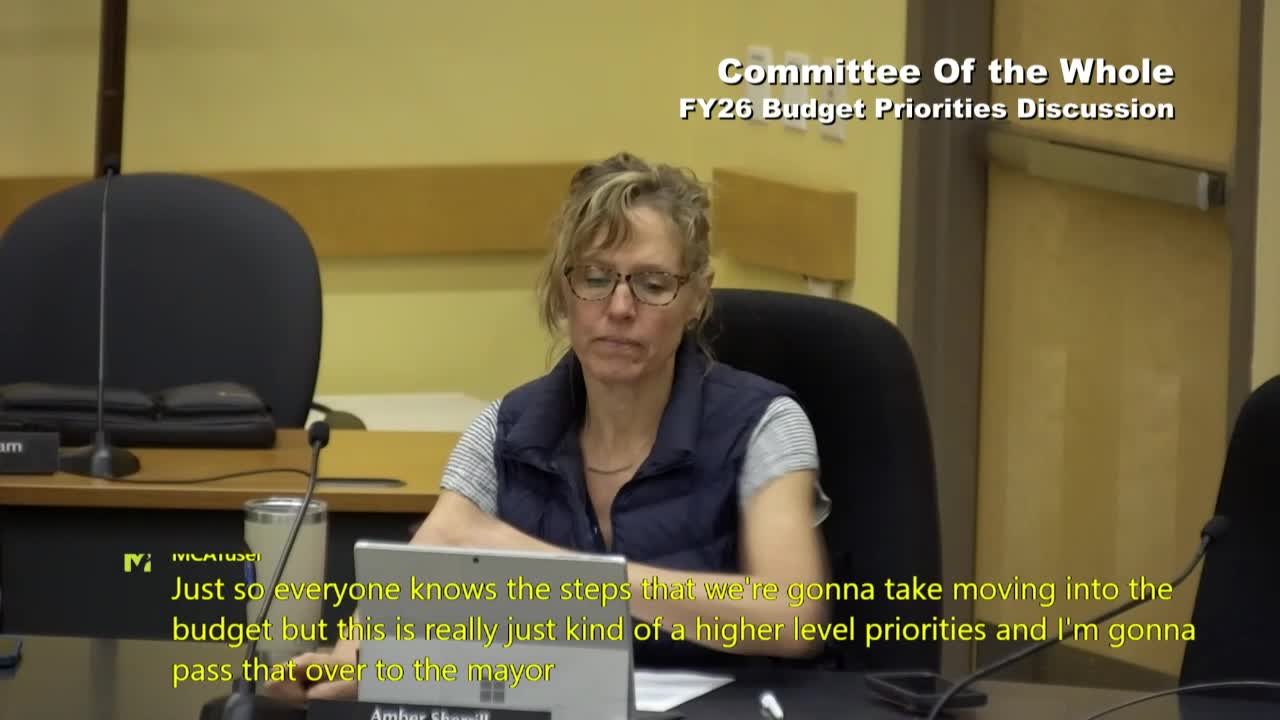
Mayor (name not specified) told the Missoula City Council Committee of the Whole on March 26 that the administration’s top priorities for fiscal year 2026 are improving city responsiveness, addressing the rising cost of living and expanding housing choice.
The mayor said these priorities — framed through the city’s lenses of housing, equity and climate — are intended to focus staff time and budget work ahead of the formal budget process, which the administration said will begin in mid-May.
Mayor (name not specified) said a responsive, efficient and transparent government “strengthens trust, and it improves services and enhances our community well-being,” and listed specific actions under that priority: a new city website with resident-service portals, formalized constituent-service policies across departments, centralized communications and a social-media strategy for real-time updates, and continued work on data-driven performance management (described in the meeting as a “we work certification” methodology).
On infrastructure, the mayor said the city is prioritizing water-main replacements and other utility projects and is coordinating with the county and the Montana Department of Transportation to secure federal infrastructure grants. She said the state has “over $400,000,000 of federal awards that are pending,” and that the city and its partners are working with the federal delegation to protect those awards.
The mayor described the city’s ongoing water-main replacement program and noted residents remain responsible for service lines. The administration said it has arranged low-interest financing options for homeowners to replace service lines; the mayor said the work reduces system leakage and supports the city’s climate goals by lowering pump-related electricity use.
As a second priority, the mayor outlined steps to address the rising cost of living and to strengthen the local economy. She said the city is advocating at the state level for property-tax reform and is exploring a local-option sales tax; she cited results from the city’s national community survey showing that 76% of respondents “were very interested and very supportive of a local option sales tax that would offset property taxes.”
The mayor also described the city’s shift toward priority- and performance-based budgeting, noting last year’s budget changes reduced general-fund expenses by $1.5 million through changes including a more cost-effective workers’ compensation program and other expense reductions.
On economic development, the mayor said the city partners with the Missoula Economic Partnership and uses the Missoula Redevelopment Agency as a principal tool for development work. She said a prior program called “Good Cities, Great Jobs” is no longer in effect and that the city will continue efforts to connect nontraditional workers with trades and manufacturing and to support a clean-energy economy.
The third priority focused on housing choice and affordability. The mayor said the city is advancing development on city-owned land, including work tied to the Midtown master plan, and named two projects: Scott Street Rivara, which she said will deliver 89 homes for purchase aimed at moderate-wage earners, and Southgate Crossing. She said the city currently owns about 45 acres it is evaluating for activation.
The mayor described additional housing actions: legislative advocacy to secure funding and remove barriers to development, implementing the newly adopted land use plan and finishing the Unified Development Code to promote “missing middle” housing, incentives for private-sector affordable projects (tax credits, grants), and continuing housing-first initiatives with supportive services for people experiencing houselessness.
Council members asked clarifying questions. Council Member Kristen Jordan confirmed that the administration intends to measure program outcomes and “put metrics on our programs to track them” under a performance- or priority-based budgeting approach; the mayor confirmed the city is moving to that approach (and clarified she did not say the city is using zero-based budgeting). Council Member Daniel Carlino asked whether the police union contract changes would fit in the coming budget; the mayor said the contract included a negotiated wage opener that the Missoula Police Officers Association has placed into arbitration and that arbitration likely will occur this summer because of limited arbitrator availability.
No formal votes or motions were taken during the March 26 Committee of the Whole discussion; the mayor framed the presentation as an overview of priorities to guide the upcoming budget process.
The council adjourned after the brief Q&A; the administration said more details on communications centralization, budget metrics and project-level funding will be provided during the formal budget process beginning in mid-May.