Get email alerts on the School Safety Speed Cameras topic
No spam. Unsubscribe anytime.
Palm Bay council debates school‑zone camera program after rollout errors; refunds issued
Summary
After a problematic rollout that produced erroneous notices, the Palm Bay City Council discussed its automated school‑zone camera program. City staff and police say hundreds of warnings and nearly 900 paid citations were generated; some payments are being refunded. Council discussion ended without action to remove the cameras.
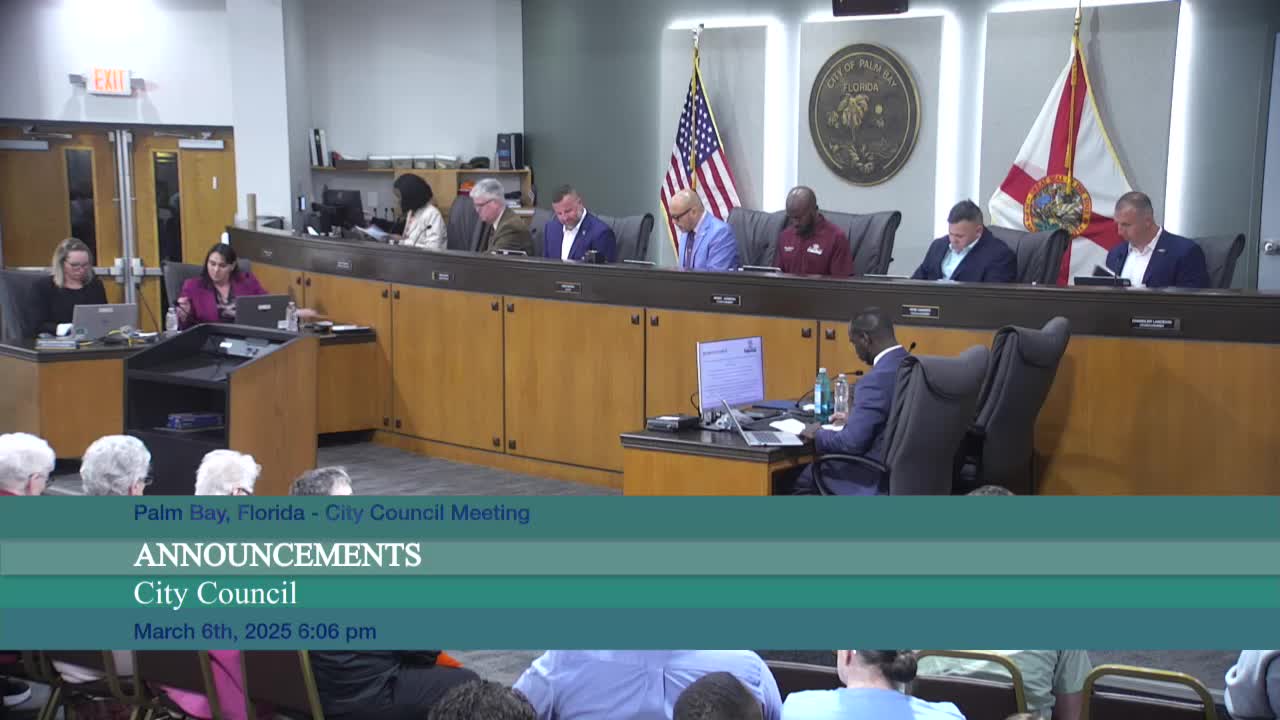
Palm Bay City Council members and residents pressed police and the vendor on Thursday over the city’s newly installed automated school‑zone camera system after the program issued erroneous notices and prompted refunds.
The council debate began after Councilman Derek Langevin asked that the school‑zone speed enforcement camera system be added to the agenda. Council members, the police department and the camera vendor discussed how the system operates, how many warnings and citations were generated, and who pays the fines.
The matter mattered to residents because the cameras issue citations when a vehicle exceeds the posted school‑zone speed by at least 11 mph during the zone’s active times. “There was an error,” Deputy Chief (Palm Bay Police Department) said of an early installation problem, “They immediately paused all live cameras … They turned the switch off so there was nothing being recorded and activated.” He told the council that, to date, the city had recorded about 3,970 warnings and that 898 people had paid citations; 86 people who had already paid were being refunded.
Why this matters: the cameras are designed to deter dangerous speeding near schools by imposing fines, but residents and some council members said the rollout produced inaccurate citations and disproportionately harms working households. “It’s relatively new in Palm Bay, but this company and the issues are not new,” Councilman Langevin said, citing other jurisdictions where similar installations produced problems and refunds. Resident Lance Fisher, a former deputy chief, told the council, “safety was never mentioned 1 time” in early procurement meetings and said revenue — not safety — had been emphasized.
How the system works: the vendor gathers photographic and speed data and presents it to Palm Bay police for review. “We’re not issuing a ticket,” Greg Parks, senior vice president for Redspeed, told the council. “It’s your police department that issues [citations]… We’re simply gathering evidence and presenting it to Palm Bay Police.” The city’s commander overseeing the project described the statutory fee split for each paid citation: $60 goes to the municipality (of which $39 stays with the city and $30.9 is attributed to the police), $20 goes to the state general fund, $12 goes to the local school district, and smaller amounts go to a school crossing guard program and state law enforcement training funds.
Council reaction and next steps: members pressed for more data on when warnings and paid citations occurred, whether cameras recorded only during school‑zone times, and how quickly vendor and staff corrected the cross‑connection that caused some erroneous citations. Several residents urged removing the cameras; Councilman Langevin moved to remove them from service, but the motion failed for lack of a second. No formal policy change or termination of the contract occurred. Council members asked staff to produce more detailed usage and error data and to compile the status of refunds and appeals ahead of the next meeting.
What remains unsettled: the council did not take formal action to suspend or end the camera program. A number of residents said they plan to challenge citations at the local administrative hearings; police said about 20 citizens had filed to contest citations and that the first hearing is scheduled in April. City staff and the vendor said they will continue to process refunds for erroneous citations and will supply requested operational data to the council.
The discussion left the cameras in place while staff compiles a fuller record of system performance, refunds and appeals. Council members said they wanted to see whether the program is changing driver behavior near schools, and whether the balance of safety benefit and community cost warrants keeping the program in its current form.
AI generated
The text on this page is AI generated. Summaries, highlights, analysis, and video transcripts are all produced from the original source material.
AI can make mistakes, so if you spot one, and we will fix it for everyone.
Note: the source content is unaltered by us. Any content source we link to, be it a video, an audio recording, or a document, is presented exactly as its publisher released it. That publisher is usually a government body, sometimes an individual official or another organisation.