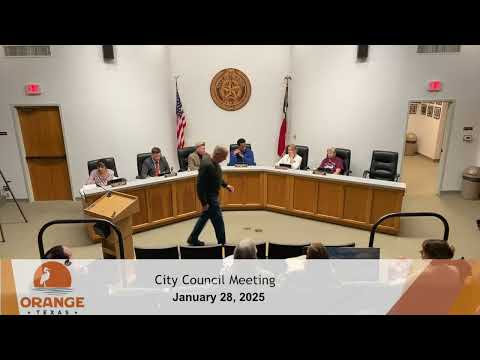
Council approves ASPCA grant as residents urge trap‑neuter‑return program
Summary
Residents urged the City of Orange to adopt trap‑neuter‑return (TNR) policies during public comment; council approved an ASPCA National Shelter Initiative grant of $46,200 to create an outdoor play/interaction area at the city animal shelter.
Orange, Texas — The City Council on Jan. 28 approved a $46,200 grant application to the American Society for the Prevention of Cruelty to Animals (ASPCA) to build an outdoor play and interaction area at the municipal animal shelter, after residents spoke in favor of expanding trap‑neuter‑return services and broader no‑kill efforts.
Residents and animal welfare volunteers addressed the council during the public comment period urging adoption of a formal trap‑neuter‑return (TNR) ordinance so animal control officers can sterilize and return community cats instead of impoundment and euthanasia. Veterinarian Kelly Kayes said TNR gives animal control officers “a happy outcome” because they can “trap, ... make sure they’re healthy, spay them, neuter them, stop the problem, vaccinate, and then I can turn them loose.” Maryann Fidgeon, executive director of Saving 9 Lives, said TNR is “effective in reducing the population” and humane compared with trap‑and‑kill approaches.
City animal services staff described the ASPCA 2024 National Shelter Initiative grant application to council members. The resolution authorizes submission of the grant application “at no cost to the city” and designates the city manager as the authorized representative for grant matters. The grant amount presented to council was $46,200 and council voted to approve the resolution; the motion passed unanimously.
Council members also noted the city’s recent declaration as a no‑kill city and tied the grant request to continuing those efforts. City staff said the planned use of grant funds is an outdoor, enclosed area where staff and potential adopters can take dogs out of kennels to evaluate temperament and facilitate adoptions. Council recorded no request for a property tax exemption or other city funding for the project; the resolution recorded the grant as “no cost to the city.”
Votes at the meeting show unanimous approval by council members present (McKenna, Salter, Hennigan, Chandler and Birch). The resolution also authorized the city manager to represent the city in matters related to the grant.
The public comments and the approved grant application together signal continued city support for animal welfare initiatives and for expanding nonlethal population control efforts, subject to eventual ordinance changes and operational planning by animal services staff.
AI generated
The text on this page is AI generated. Summaries, highlights, analysis, and video transcripts are all produced from the original source material.
AI can make mistakes, so if you spot one, and we will fix it for everyone.
Note: the source content is unaltered by us. Any content source we link to, be it a video, an audio recording, or a document, is presented exactly as its publisher released it. That publisher is usually a government body, sometimes an individual official or another organisation.