Lifetime Citizen Portal Access — AI Briefings, Alerts & Unlimited Follows
Commerce, Life Science Washington and local CEOs outline cluster growth, funding and AI convergence
Loading...
Summary
State Commerce, Life Science Washington and biotech leaders briefed the committee on Washington’s life‑sciences cluster, state funds and mentoring programs, workforce gaps, and the emergence of AI-driven protein design centered in Seattle.
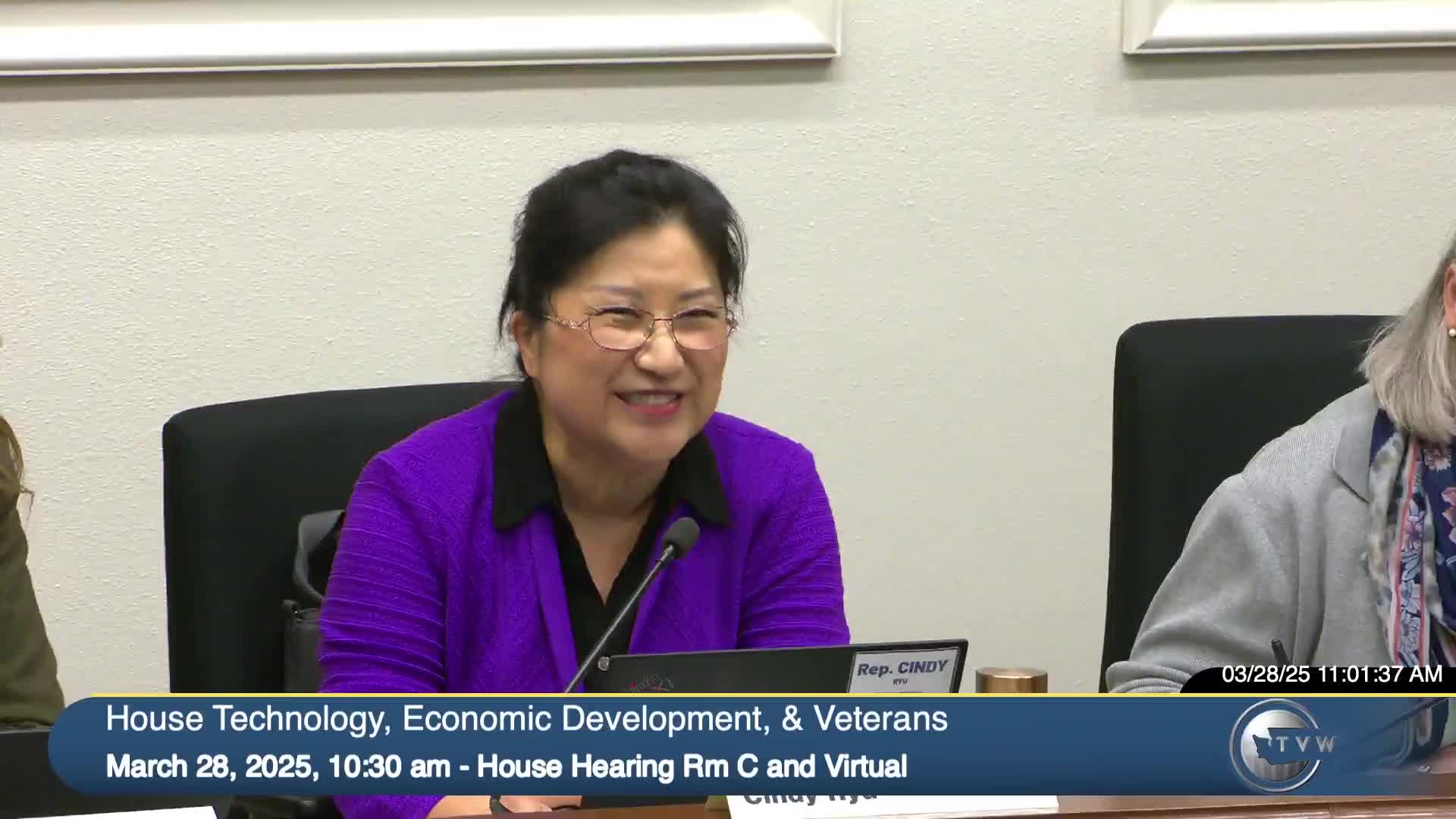
Lisonbee Beeson, sector lead for Life Sciences and Global Health at the Washington State Department of Commerce, Mark Cummings, president and CEO of Life Science Washington, and Lucas Nivaughn, CEO of Cyrus Biotechnology, told the House Technology, Economic Development, and Veterans Committee on March 28 that Washington’s life‑sciences cluster has matured into a nationally significant industry and is at the forefront of the convergence of artificial intelligence and biologics.
Beeson summarized Commerce’s recent investments and priorities, emphasizing diversification of the sector and geographic reach beyond Puget Sound: “I call commerce the Swiss army knife of everything,” she said, and highlighted efforts to expand entrepreneurship, mentorship and regional capacity. She described state-funded programs used to support the sector, including the Life Science Discovery Fund and the Andy Hill Care Fund, and said Commerce has directed returned investment dollars toward mentorship and small grants targeted to rural, women-led and underserved entrepreneurs.
Cummings positioned Washington as “one of the top 10 life science clusters in The United States,” and described long timelines for industry returns: building companies and securing FDA approvals can take a decade or more. He said the industry supplies roughly 46,000 direct jobs and a larger statewide economic impact (he cited “about $38,000,000,000 in total economic impact”). Cummings described an entrepreneurship mentoring program that pairs early-stage founders with experienced former CEOs and executives; he said roughly 43 graduated companies from the program have raised about $3.2 billion in private capital.
Nivaughn focused on the emerging role of AI in drug discovery, protein design and biologics. He said Seattle-based tools and research (including the Institute for Protein Design/C. David Baker’s work and open-source projects like OpenFold and Rosetta) place the region near the global lead in “biotech AI.” He described in-silico workflows (target identification, in-silico protein design and antibody optimization) and stressed that AI outputs in biotech typically must be validated in wet labs and follow existing FDA regulatory pathways for preclinical and clinical studies.
Committee members raised regulatory and workforce concerns. Lawmakers pressed speakers on whether responsible‑AI principles have been adopted by government entities; Nivaughn and Cummings said work is ongoing and that existing responsible‑AI or “Responsible Biodesign” working groups are early-stage, largely academic and industry-driven and have not yet produced enforceable government regulation. Beeson and Cummings said Washington has invested state funds in mentorship, startup grants and cluster programs and that Commerce is focused on expanding opportunities in Eastern Washington and among underrepresented groups.
Speakers listed implementation gaps: capital for later-stage commercialization remains heavily sourced from out of state, experienced C‑suite executives with multiple exits are scarce locally, and manufacturing competitiveness may require policy attention if other states or countries offer large incentives. On policy, Cummings recommended targeted investments in cancer research funds, workforce programs and entrepreneurship support rather than broad tax incentives. Nivaughn urged care in any regulation so it does not concentrate control of advanced AI models in a small number of large tech firms.
No formal actions or votes were taken by the committee during this panel; speakers and lawmakers concluded the session with offers to continue engagement and follow‑up on workforce, infrastructure, and responsible‑AI issues.