Get Full Government Meeting Transcripts, Videos, & Alerts Forever!
Get email alerts on the Economic Mobility topic
No spam. Unsubscribe anytime.
Raj Chetty: Neighborhoods, social ties and schools drive economic mobility; Seattle voucher trial, Hope VI, college access show measurable gains
Summary
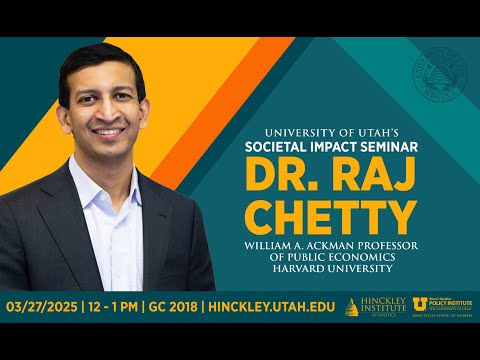
Raj Chetty, the William A. Ackman Professor of Public Economics at Harvard University and director of Opportunity Insights, told a Hinckley Institute forum that neighborhood conditions, social ties and schools — not just statewide policy — largely determine children’s chances to earn more than their parents.
Raj Chetty, the William A. Ackman Professor of Public Economics at Harvard University and director of Opportunity Insights, told a Hinckley Institute of Politics forum that where a child grows up strongly shapes that child’s economic outcomes and that targeted interventions can raise long‑term earnings.
Chetty opened by showing long‑term trends in intergenerational income mobility. “We estimate that 92 percent of children born in 1940 went on to earn more than their parents did,” he said, and added that for children born in the 1980s the chance of earning more than their parents has fallen to roughly one‑in‑two. He stressed the geographic scale of the variation: “It’s not about differences in state level policies or differences across cities. It’s about what’s happening in one neighborhood versus another neighborhood.”
Using anonymized tax records, Opportunity Insights maps upward mobility across metro and rural areas and down to census tracts. Chetty highlighted Salt Lake City as one of the nation’s stronger metros for mobility: children from families at roughly the 25th percentile of income (about $27,000 a year, he said) in Salt Lake City earn on average about $37,000 in adulthood — a larger intergenerational gain than in many U.S. metros.
Chetty summarized four robust, cross‑place predictors of higher mobility: lower neighborhood poverty and mixed‑income communities; greater family stability (for example, higher shares of two‑parent households); better K–12 schools and access to higher education; and greater social capital — measured as cross‑class social connections.
On social capital, Chetty described a partnership with Facebook researchers that produced a nationwide measure of “economic connectedness”: the share of a low‑income person’s friends who are high income. He said the social‑network map closely mirrors the mobility map and that Utah is among the states with strong cross‑class connections. “The places which have the highest levels of cross class connection are exactly the places where you have the best chances of rising out of poverty,” he said.
Chetty turned to policy experiments. He described a randomized trial in Seattle and King County that tested whether providing housing‑search assistance to voucher recipients changed where families moved. Of 1,000 families entering the voucher program, 500 received standard vouchers and 500 received extra help: a navigator who showed listings in higher‑opportunity neighborhoods, coached families through landlord interactions and helped with application fees or security deposits. In the control group 14 percent of families moved into higher‑opportunity neighborhoods; in the treatment group 54 percent did. Chetty said the added service cost about $2,500 per family and estimated that the average child who grows up in a higher‑opportunity area because of the move will earn about $200,000 more over a lifetime.
Chetty also reviewed analyses of the federal HOPE VI neighborhood revitalization program (which invested, he said, roughly $17 billion across 261 high‑poverty public‑housing projects). Comparing children who grew up in those developments before and after revitalization, Opportunity Insights finds average annual earnings gains on the order of $4,000 for children raised in the same places after redevelopment, a long‑run improvement Chetty linked to increased interaction across neighborhoods and greater social capital.
On higher education, Chetty presented two dimensions that determine a college’s contribution to mobility: the outcomes of low‑income students who attend, and the share of students a college enrolls who come from low‑income families. He showed that many selective colleges produce strong outcomes for the low‑income students they enroll but that those colleges enroll relatively few low‑income students. Conversely, many community colleges enroll many low‑income students but produce weaker long‑run earnings outcomes. Chetty argued there are two policy levers: raise outcomes at colleges that already enroll many low‑income students (for example with stronger employer links and internships) and increase low‑income access at colleges with strong outcomes.
As an example of an effective workforce model he described a randomized evaluation in which participants in a one‑year vocational program with employer internships experienced earnings increases of roughly $9,000 per year relative to controls.
Chetty repeatedly emphasized that many of these findings are “hyper local”: differences in mobility can exist within one city block and that each additional year a child spends in a higher‑opportunity environment produces incremental benefits. He closed by noting that Utah currently ranks highly on mobility metrics but that demographic and social changes make continued attention necessary: “I think that will require deliberate efforts going forward to make sure that remains the case,” he said.
During the audience Q&A Chetty said the Opportunity Atlas data are public and downloadable, and encouraged local researchers and policymakers to apply the maps and microdata to understand neighborhood‑specific mechanisms. He also acknowledged persistent racial disparities in mobility and said that, conditional on parental income, Black boys in particular are less likely to rise than white boys — an inequality he linked to differences in exposure, schools and social connections and called for investments beginning in early childhood.
Ending: Chetty framed the research agenda as both equity‑motivated and growth‑oriented: improving mobility expands opportunity for families and increases the supply of innovators and entrepreneurs. He invited students and researchers to continue studying these interventions and their mechanisms.