Get Full Government Meeting Transcripts, Videos, & Alerts Forever!
Get email alerts on the Allens Creek Reservoir topic
No spam. Unsubscribe anytime.
Brazos River Authority approves $9.8 million contract to advance Allens Creek Reservoir permitting and design
Summary
The Brazos River Authority board authorized a professional services contract with Gannett Fleming for permitting and preliminary design tasks for the Allens Creek Reservoir in Austin County and approved a FY2025 budget amendment to cover timing differences. The board voted 14–0 with one abstention.
The Brazos River Authority on [date not specified] authorized its general manager/CEO to negotiate and execute a professional services contract with Gannett Fleming Inc. not to exceed $9,803,826 to carry out permitting and preliminary design activities for the Allens Creek Reservoir project in Austin County.
Board members said the work is intended to move a long-term reservoir project into detailed site investigation and the Army Corps permitting process. The resolution also included a fiscal-year 2025 budget amendment increasing the project capital improvement budget from $500,000 to $7,230,000 to cover timing differences in project delivery.
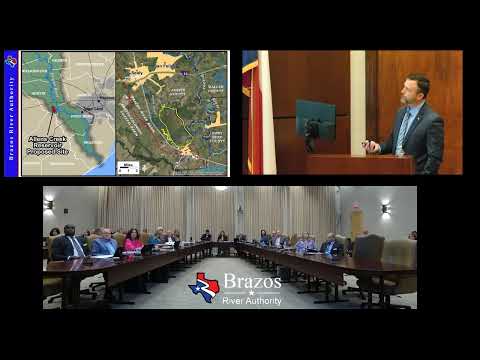
Board members and Gannett Fleming staff described Allens Creek as a “legacy” regional water-supply project sited in Austin County just south of Sealy and roughly west of Houston. The authority owns about 9,500 acres of the project site and holds a Texas Commission on Environmental Quality (TCEQ) water-right permit to impound up to 145,000 acre-feet, with an anticipated average yield “just under 100,000 acre-feet,” presenters said. The contract scope focuses on four parallel task groups: a comprehensive site survey and utility desktop study; a river geomorphology (sediment-transport) study; preliminary cultural and environmental studies; and a preliminary geotechnical investigation, including borings and laboratory testing.
Project manager John King (identified in the meeting as the agenda presenter for Allens Creek) and Gannett Fleming’s deputy geotechnical practice lead, Scott Birch, told the board the work will establish a baseline for alternatives analysis and inform a U.S. Army Corps of Engineers Section 404 permit application. Birch said the team will perform field borings approximately every 2,500 feet during this preliminary phase (the Corps’ final-design recommendation is denser sampling), cone-penetration testing, aquifer performance/pumping tests, and laboratory testing. The team estimated the field and analytical work for these tasks will extend roughly one year, with laboratory testing and reporting for geotechnical items possibly running to 12–18 months.
Board members asked about fatal-flaw risk, contract gating, staffing, and lifecycle costs. Director Lattimore asked whether prior work showed the project was feasible; presenters said existing studies from previous owners (including Texas Genco/H.L. & P. referenced in earlier materials) and BRA’s internal work show no current indication of a fatal flaw but that the new studies are intended to identify any issues that could require abandoning or significantly redesigning the project. Directors asked whether the contract includes a contractual “off-ramp” if a fatal flaw emerges; BRA staff said the contract includes an option to off-ramp at a gate if a critical, unmitigable issue arises.
On geomorphology, Gannett Fleming explained the river in the project area is actively meandering and that intake/pump-station siting must account for possible future cutoff events. Engineers said siting the intake closer to the reservoir lowers pumping energy costs but can increase risk if the river meanders away; siting further from the reservoir may require more land and higher pumping energy but may be more stable. The team identified tradeoffs in lifecycle cost and said the geomorphic and sediment-transport analyses will be critical to that evaluation.
Presenters estimated the immediate team of engineers and scientists working on the contract will be about 30 people overall, with an additional 30–40 drilling and survey personnel supplied by contractors during peak mobilization; at the project’s peak the team could total roughly 60 people onsite or engaged concurrently for drilling and surveying activities. Gannett Fleming and partner firms named in the presentation included HDR, Rifeline, Northwest Hydraulic Consultants, and Fugro for drilling. The Brazos River Authority noted it owns the project parcels in full following a prior purchase and will incorporate prior data into the new studies.
The board approved the resolution on a voice roll call. The motion was made by Director Krone and seconded by Director Lattimore; the recorded vote was 14 yes, 0 no, 1 abstain (Director Embro). The board-approved contract amount not to exceed $9,803,826 does not include a separate contingency line within the contract scope, according to staff, and the FY2025 budget amendment is intended to accommodate timing differences, not to increase the overall capital appropriation for the project.
Board members and consultants said the permitting and design work will support a future Corps record of decision that, if favorable, would allow BRA to move to final design and construction. Presenters cautioned that reservoir projects are long-term endeavors and estimated a multi‑decade timeframe from permitting to a full fill: as a high-level estimate several speakers noted it could be 10–20 years before the project is filled with water, depending on studies, permitting, and construction timelines.
The resolution text authorized the general manager/CEO to negotiate and execute the Gannett Fleming professional services agreement and to implement the FY2025 budget amendment. The project team said the immediate deliverables are an accurate site survey (including utilities), geomorphic and hydraulic modeling for the Brazos River reach near the intake locations, early cultural and endangered-species assessments (building on prior mussel and species work), geotechnical borings and laboratory testing, and an alternatives analysis to inform the Corps 404 permit package.