Lifetime Citizen Portal Access — AI Briefings, Alerts & Unlimited Follows
Team Alaska officials tell lawmakers Arctic Winter Games boosts rural youth, preview 2026 Whitehorse host
Loading...
Summary
Team Alaska leaders briefed Alaska legislators in Juneau on the history, scope and youth-development goals of the Arctic Winter Games, described volunteer and fundraising needs, and previewed the 2026 Games in Whitehorse, Yukon.
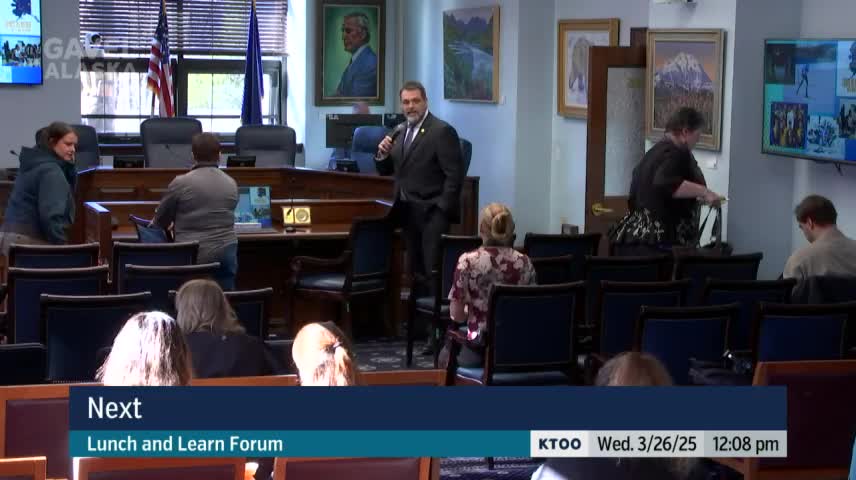
Team Alaska leaders told legislators at a Juneau legislative "lunch and learn" that the Arctic Winter Games serve as an athletic and cultural exchange for northern communities, with organizers emphasizing outreach to rural Alaska and previewing the next Games in Whitehorse, Yukon, in 2026.
The Arctic Winter Games were founded in 1970 as a northern counterpart to the Canada Games, organizers said. Sarah Frampton, executive director of Team Alaska Arctic Winter Games, told legislators the Games combine sport and cultural programming and now include contingents from northern Canada, Greenland and parts of Scandinavia as well as Alaska. "It's like our mini Olympics," Frampton said, adding that Team Alaska fields athletes across the full event slate when possible.
Frampton said Team Alaska brings a contingent that organizers estimate at about 355 people and that a fuller count including staff and volunteers is closer to 400. She described the program as largely volunteer-driven: she is the only paid, part-time staff member for Team Alaska and the organization depends on volunteer coaches, board members and other helpers to recruit athletes and coordinate travel. "Coordinating all that travel, and getting all those kids to where they need to be at any given moment takes a village," Frampton said.
Nicole Johnson, president of Team Alaska's board and a longtime Games participant from Nome, told the Legislature she has focused on increasing rural participation. Johnson said rural representation rose to 66 athletes at the most recent Games and that the organization hopes to recruit about 100 athletes from across the state in future years. "We have grown our rural athletes from anywhere from 10 to 20 athletes to last year, 66 athletes from rural Alaska," Johnson said.
Organizers described the Games' dual athletic and cultural mission. Frampton listed 21 sport and cultural events currently on the program, including alpine/downhill skiing, archery, arctic sports (Inuit games), badminton, basketball, biathlon (ski and snowshoe), cross-country ski, curling, figure skating, futsal, gymnastics, hockey, snowboarding, snowshoeing, speed skating, table tennis, volleyball and wrestling, plus dedicated cultural performances. She said Team Alaska fields some teams that other contingents may not be able to support, such as curling.
Reggie Jewell, an Arctic Winter Games alumnus and longtime coach/officiant, recounted early demonstrations of Indigenous games in the 1970s and urged continued state support for the program. "When you're young ... you end up with some awesome adults," Jewell said, describing lifelong relationships formed through the Games.
Presenters told the Legislature that the state of Alaska is listed in the Arctic Winter Games charter as a partner and that the program historically has received state appropriations as well as private fundraising. Frampton said fund-raising remains essential and that organizers sometimes cover travel costs for village athletes who otherwise could not afford to attend.
On logistics and competition rules, presenters noted the Games emphasize developing athletes rather than established club competitors; Johnson said Team Alaska frequently draws younger athletes (seventh through ninth graders) in basketball and mix-age rosters in other sports, and that the maximum athlete age is 19. Frampton described the cultural contingent that travels with the team and highlighted the "fair play" awards that recognize sportsmanship.
Looking ahead, organizers said Whitehorse, Yukon, will host the 2026 Arctic Winter Games and that many venues there — including the Canada Games Centre and downhill ski areas — are prepared to stage events the Mat-Su host supplied in 2024. "They're very excited to get back and showcase what they have been preparing for," Frampton said.
Organizers took a few questions from legislators before concluding the presentation and asked lawmakers to continue state support while Team Alaska pursues private fundraising. The presenters did not request or announce any specific new state appropriation or legislative action during the session.
Questions and follow-up from legislators included requests for the full event list and clarification that the cultural programming was distinct from the athletic events. Frampton said a clip of an interview involving Arctic Winter Games athletes was later posted to YouTube and that the organizers had been contacted by representatives of Buckingham Palace about an interview.
The presentation closed with organizers thanking Senator Kronk for sponsoring the lunch-and-learn and inviting further engagement as Team Alaska prepares for the 2026 Games.