Get Full Government Meeting Transcripts, Videos, & Alerts Forever!
Get email alerts on the Health Care topic
No spam. Unsubscribe anytime.
Connecticut rare-disease advocates push for expanded waivers, emergency protocols and orphan-drug protections
Summary
Speakers at an RDAC meeting outlined legislative priorities including authority to solicit funds (SB562), expansion of Katie Beckett and compassionate waivers (SB801, SB802), emergency-protocol bill HB6920, protections for orphan drugs, and a request that the Department of Public Health pursue a sickle-cell gene-therapy site.
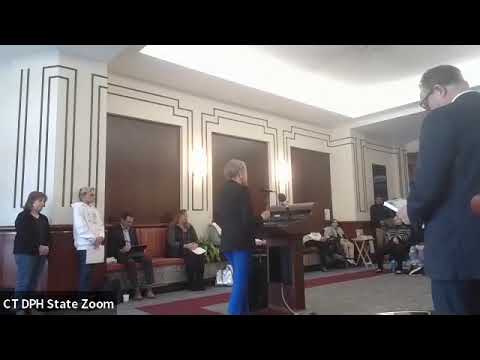
Michelle Spencer Manson, co-chair of the RDAC and a medical geneticist at Yale, and other rare-disease advocates outlined a slate of Connecticut legislative priorities they said would improve care access, emergency treatment and research for patients with rare conditions.
"Our first priority here is for funding SB562," Spencer Manson said, describing a proposed change to allow the group to solicit outside funds for research and public education materials. She said the authority would let the RDAC create a website and educational resources without increasing state appropriation costs.
The group urged expansion of state Medicaid waivers to serve children with rare conditions, naming two bills: SB801 to expand the Katie Beckett waiver and SB802 to create a compassionate waiver for critically ill children. "We have lots of patients who are waiting for this and waiting for a very long time," Spencer Manson said, adding that some rare diseases can cause intellectual disability to develop over time.
Speakers asked that section 4 of Public Act 23-137 be amended to include RDAC input when the state defines intellectual disability and to modernize criteria used to determine eligibility for developmental services. "We would like to see an amendment to PA 23-137 section 4 to see expansion of that intellectual disability definition," Spencer Manson said.
The group also urged passage of HB6920, a bill to require emergency personnel to follow rare-disease–specific protocols or to contact a patient’s treating physician in emergencies; Spencer Manson said the bill had a public hearing scheduled for 02/26/2025. "You cannot treat patients with [inborn errors of metabolism] the way you treat regular patients. It will be horrendously detrimental to them," she said.
Advocates proposed that the Department of Public Health submit an application to establish a Connecticut sickle-cell gene-therapy site to expand access to an emerging, potentially curative treatment. They also requested legal protections for orphan drugs, asking for an amendment to Public Act 23-171, section 8, to protect drugs used to treat one rare disease or up to three related rare diseases.
Dana, a physician-scientist who identified herself as a pediatric hematologist and a researcher at the Jackson Laboratory for Genomic Medicine, introduced herself and her research focus on germ cell tumors; other speakers included parents and committee volunteers who described joining awareness and advocacy committees.
None of the items discussed at the meeting were recorded as formal votes; the remarks were presented as legislative priorities and requests for inclusion in pending state actions. The meeting concluded with a motion to end the session and transition to an event program.
The measures the group discussed would require action by the Connecticut legislature, and several items depend on state agencies such as the Department of Public Health for implementation or application to federal programs.