Get Full Government Meeting Transcripts, Videos, & Alerts Forever!
Get email alerts on the Sustainable Farms And Fields Grants topic
No spam. Unsubscribe anytime.
Committee reviews changes to Sustainable Farms and Fields grant program
Summary
Senate Bill 5391 would adjust allowable uses, prioritization criteria and the timing for updating a carbon-equivalency metric for the Sustainable Farms and Fields grant program administered by the State Conservation Commission.
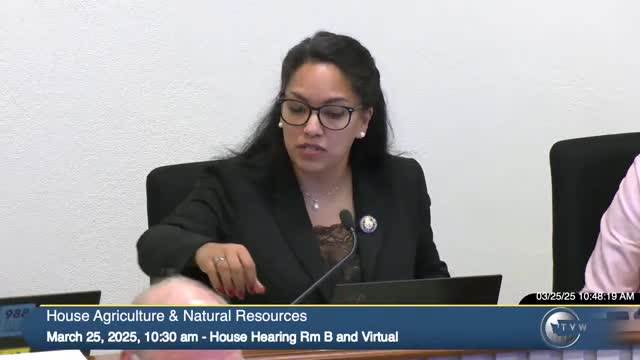
The House Agriculture and Natural Resources Committee held a public hearing Tuesday on Senate Bill 5391, which would revise the Sustainable Farms and Fields grant program by (1) changing allowable uses of grant funds, (2) adding project prioritization for energy- and fuel-use reductions, and (3) delaying the timing for an updated carbon-equivalency metric until just before the program implements upfront carbon-storage payments.
Rebecca Lewis, staff to the committee, summarized the bill’s three main changes and said it removes a narrowly worded provision on compost‑spreading equipment while retaining the ability to fund equipment purchases more generally. “The bill removes from that list a provision specific to financial assistance for the purchase of compost spreading equipment,” she said.
Danny Madrone, legislative director for the State Conservation Commission, testified in support and told the committee the commission endorsed the change to add prioritization for projects that reduce carbon dioxide equivalent emissions through increased energy efficiency or reduced fuel use. Madrone said the commission recommended removing the complicated compost spreader language because it was difficult to interpret and could still fund compost spreaders under an equipment-purchase category.
The nut graf: supporters said the bill refines program administration to focus grant prioritization on measurable greenhouse gas and energy benefits and to avoid spending agency resources on premature metric development until the program is ready to implement upfront carbon payments. Madrone said the commission did not expect upfront carbon payments to be funded “anytime soon” and recommended postponing the metric update until that policy was imminent.
Members asked whether the program could cover specific commodities such as hemp and whether outreach had reached historically underserved farmers. Madrone said the program is not limited to particular commodities and that the commission’s grant guidelines already prioritize projects serving historically underserved farmers, including Black, Indigenous and farmers of color, low‑income farmers, first‑time farmers and veterans; he offered to follow up with details on outreach.
Remote testimony came from Bonnie Jo Peterson, executive director of the Industrial Hemp Association of Washington, who said the program supports climate‑smart practices and that continuing the grant program is important given reductions in federal research and farm funding. Peterson urged the committee to move the bill forward.
Committee staff read into the record that 65 people signed in pro and 34 signed in con on SB 5391. The public hearing closed with committee staff noting the bill will be considered in executive session the following week; the committee asked members to submit amendments to staff by Friday morning if they intend to propose changes.