Lifetime Citizen Portal Access — AI Briefings, Alerts & Unlimited Follows
Senate committee advances bill creating tax credits for short‑line railroads
Loading...
Summary
The Senate Transportation and Infrastructure Committee voted to report Senate Bill 722 to the full Senate with a recommendation that it pass; the bill would create two 50% tax credits to support maintenance and new infrastructure for class 2 and 3 short‑line railroads in West Virginia and carries reporting and fiscal provisions.
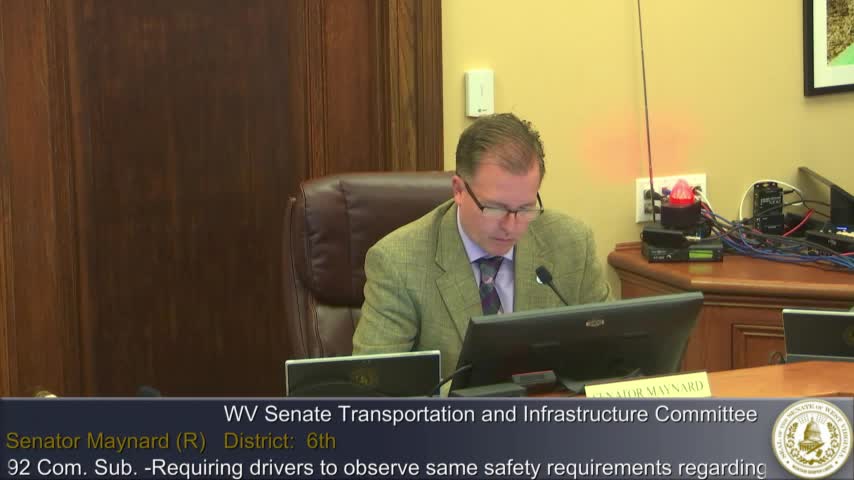
CHARLESTON, W.Va. — The Senate Transportation and Infrastructure Committee voted to report Senate Bill 722 to the full Senate with a recommendation that it pass, sending the measure first to the Committee on Finance for its fiscal review.
Senate Bill 722 would create the West Virginia Short Line Railroad Modernization Act, adding a new article in the state tax code to permit two separate tax credits for eligible short‑line railroads. The first is a credit equal to 50% of qualified short‑line maintenance expenditures, capped at $5,000 per mile of track owned, leased or operated in West Virginia at the end of the calendar year. The second is a credit equal to 50% of qualified new rail infrastructure expenditures; it would be capped at $2 million per individual project and $5 million in the aggregate per year.
The bill allows credits to be used against personal income, business franchise and corporate net income taxes in any order, permits a five‑year carryover, and allows credits to be transferred or sold under conditions set in the bill. The measure requires annual reporting by the Tax Department to the governor, the president of the Senate and the speaker of the House. Committee counsel also noted two fiscal notes accompanying the bill that estimate the cost — depending on assumptions — at roughly $7.4 million annually if short‑line railroads claimed the annual caps.
Mariah, committee counsel, told senators the bill defines an “eligible taxpayer” as a class 2 or class 3 short‑line railroad located wholly or partly in West Virginia and excludes maintenance expenditures that were used to generate a federal tax credit or that were funded by a federal grant. She also pointed the committee to two fiscal notes and background materials from Mickelson and Company provided to members.
Trent Kingsbury, business development associate and financial analyst at Mickelson and Company, testified to the committee that the bill follows an increasingly common model used in other states to keep low‑density branch lines connected to the national freight network. "This legislation is doing is it's a proven model that helps small rural, low density branch lines stay connected to the, national freight network," Kingsbury said. He told senators there are no class 2 railroads currently operating in West Virginia — the state's short lines are class 3 — and described the existing federal qualified railroad track maintenance credit as a 40% credit capped at $3,500 per rail mile. He said inflation and current maintenance costs mean railroads need to spend substantially more per mile today.
Senators who spoke during committee discussion said they supported the bill from an economic development perspective, noting short lines serve as first‑mile/last‑mile connections for rural businesses. The counsel acknowledged two concerns raised in the fiscal note: how the department would interpret ambiguous language about caps and how the department would verify whether specific expenditures had already been used to generate federal credits or were funded by federal grants. Counsel said those questions are likely to receive closer review in Finance.
The committee recorded a motion by the vice chair from Taylor to report SB 722 to the full Senate with the recommendation that it pass, subject to the original double committee reference to the Committee on Finance; the chair declared the motion adopted.
Votes at a glance: The committee approved reporting SB 722 to the full Senate with the recommendation that it do pass and be first referred to the Committee on Finance.