Lifetime Citizen Portal Access — AI Briefings, Alerts & Unlimited Follows
Committee hears bill to allow "warehouse receipt" investments for Montana craft distillers
Loading...
Summary
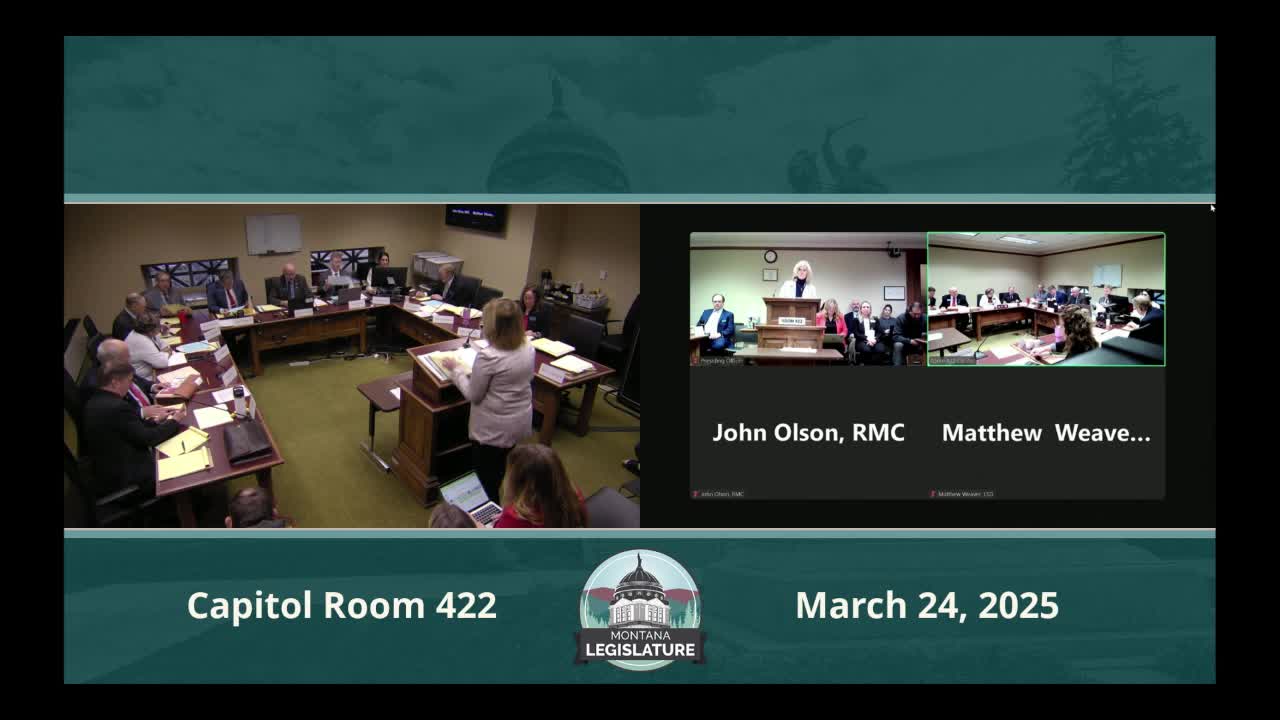
A bill to authorize warehouse-receipt investments for distillers drew support from distillery owners and trade groups at a Senate Business and Labor Committee hearing, and prompted questions from regulators about oversight and how such investments would affect licensing reviews.
Representative Seekins Crow, the sponsor, told the Senate Business and Labor Committee that House Bill 549 would allow Montana distillers to sell "warehouse receipts" that let outside investors fund barrels of aging spirits without transferring ownership of the distillery.
Why it matters: Supporters said the change would give small Montana distilleries new ways to raise operating capital while federal law and other states already allow similar arrangements. State regulators raised questions about whether the Department of Revenue would have enough financial information about licensees if inventory-based investments became common.
Representative Seekins Crow opened the hearing saying the proposal would permit "a type of investment opportunity that is currently available to distillers in other states. And the federal government does allow for this. However, in Montana, our law must also provide for this for us to be able to do it." She described the change as narrowly tailored to let investors buy an interest in a barrel while the product remains in bonded storage.
Jennifer Hensley, counsel for the Montana Distillers Guild, told the committee the change aligns Montana with federal practice and other states and stressed that "No alcohol physically changes hands. And this bill clarifies that an investment indicates absolutely no ownership interest in a distillery license or business." Hensley added that the federal Alcohol and Tobacco Tax and Trade Bureau (TTB) receives annual reports on warehouse receipts, and that under the bill states would not need a separate reporting regime for the receipts.
Distillery owners gave practical examples. Jake Blue, owner of Lakeside Distillery, said the provision would let small operators "buy more grain, fill more barrels" without giving up ownership: "It's me and my wife. We're both federal employees. We're just scraped together every dollar that we could to fill a barrel, put it away, and not look at it for 4 years." Brian Anderson of Whistling Andy Distilling and Nicholas Lee of Glacier Distilling described similar business and export reasons to support the bill.
Michael Lawlor, an attorney who said he drafted an earlier version for a client, explained why the change is needed: "The normal concept of ownership... the Department of Revenue uses in interpreting ownership interests in alcohol license businesses is that ownership in any part of the business, which includes the inventory, constitutes an ownership in the business itself and in the alcohol license. And so that's a problem when you wanna be able to have investment in the inventory." He said HB 549 would make clear that a warehouse receipt is not an ownership interest in the distillery or its license.
Toby Gilchrist, representing Barrel Proof Capital, outlined how investors and distilleries might structure exits: buybacks by the distillery, sales to bottlers, or retail channels. He emphasized that barrels must remain in bonded warehouses and carry investment risk: "It does carry investment risk just like any other investment. In the very worst case scenario, if it is storybound or out of business... it'd be similar to investing in a commodity that would be lost."
Regulators sought clarity about the state's ability to oversee licensees. Becky Schlau, alcoholic beverage control administrator at the Department of Revenue, said the department would not, under the bill as written, receive investor names and that lack of visibility "may put us at a disadvantage as far as understanding their whole ownership" when the agency reviews financials at renewal. She said warehouse receipts would not automatically create an undisclosed ownership interest but could make it harder for the agency to see the licensee's full financial picture.
Committee members also asked how off-site bonded warehouses are inspected. Steve Swanson, who identified himself as an investigator, said distilleries must obtain department approval for bonded premises and that investigators perform suitability checks similar to those for licensed premises. He added that routine reinspection schedules are generally complaint-driven rather than calendar-based.
What the bill does not do: Witnesses repeatedly said HB 549 as written does not grant investors any equity in a distillery or any right to direct where bottled product is sold; it is structured as a transaction about the barrel (the inventory), not the license.
Where it stands: After testimony the sponsor closed and asked the committee to "do concur"; no formal vote was recorded at the hearing.
Ending: Supporters urged the committee to adopt the bill to give Montana distillers the same inventory-financing tools used elsewhere; regulators asked for clarifying language to ensure the state retains visibility into licensee finances.