Get Full Government Meeting Transcripts, Videos, & Alerts Forever!
Get email alerts on the Traffic Calming Bikeway topic
No spam. Unsubscribe anytime.
NDOT unveils speed cushions, bulb-outs and neighborhood ballot for McFerrin Avenue traffic calming; bikeway planning introduced
Summary
Nashville Department of Transportation engineers presented a finalized traffic-calming design for McFerrin Avenue and introduced early plans for a protected bikeway during a neighborhood meeting.
Nashville Department of Transportation engineers presented a finalized traffic-calming design for McFerrin Avenue and introduced early plans for a protected bikeway during a neighborhood meeting. The traffic-calming plan centers on speed cushions and intersection bulb-outs; NDOT said it will mail ballots to properties that abut the street and requires 66% yes votes among returned ballots for the project to enter the construction queue.
NDOT engineer David Greaves, who led the presentation, said the neighborhood street traffic calming (NSTC) program favors “physical solutions to encourage lower speeds” and highlighted the agency’s emphasis on engineering among the program’s “education, enforcement, and engineering” approaches. “We are seeking to help McFerrin experience a better roadway environment with an engineered design rather than only relying on educating people about speeding and driving safety,” Greaves said.
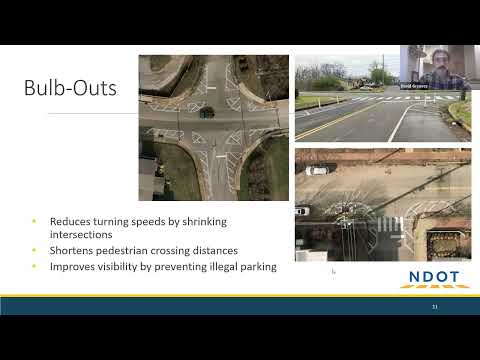
NDOT presented a design that places six locations for speed cushions along McFerrin Avenue and multiple curb bulb-outs at crossings including Maxwell Avenue, Marina Street (near the school), Silverdean Place, Myrtle Street and others. Greaves described the cushions as roughly 3 inches high and about 6 feet wide; for McFerrin NDOT plans to use 10.5-foot-long cushions intended to be driven over at roughly 20–25 mph and to minimize impact on large emergency vehicles by spacing and wheel-path design. In prior NDOT before-and-after studies cited in the meeting, average speeds fell from about 31 mph to 22 mph and the 80th percentile speed fell from about 37 mph to 25 mph after cushions were installed.
Noise and parking were the primary concerns raised by residents. One attendee asked about noise, noting daily traffic volumes; Greaves said the industry expectation is that cushions reduce instances of very loud, high‑engine activity and that overall a traffic-calmed street is often quieter even if individual vehicles make a small sound when traversing a device. Residents also described heavy on-street parking near the school during drop-off and pickup and urged NDOT to study parking trade-offs before finalizing any bikeway design.
On the bikeway, Greaves said McFerrin has been on Nashville’s bike network for years: it was designated as a minor separated bikeway in the Walk and Bike plan (2017) and later shown on the city’s interactive “Choose How You Move” map as a protected bikeway. NDOT described the bikeway work as early-stage: staff will collect traffic and parking data, develop conceptual plans, conduct additional community engagement and produce design drawings if the project advances. Greaves explained that a protected bikeway generally means a marked bike lane with a buffer and physical separators to keep bicycle and vehicle traffic apart, and showed Buchanan Street (a 2021 project) as an example.
NDOT outlined the public ballot process for the traffic-calming project: NDOT will mail a ballot postcard to each eligible property (residences, churches and schools that abut the right-of-way) and open a six-week voting period. Each qualifying parcel receives one ballot; NDOT uses unique ID codes on postcards to validate ballots. If at least 66% of returned ballots are “yes,” the project will be entered into NDOT’s construction queue; Greaves said that, depending on scheduling, a successful project would typically reach construction in about eight to ten months as projects are queued for implementation. NDOT noted that vacant lots are removed from the ballot list and owners of multiple properties receive a single ballot.
Participants agreed the traffic-calming plan generally addressed the neighborhood’s safety concerns and several residents volunteered to alert neighbors once ballots are mailed. “If we know when the ballots go out, then we have an opportunity to make sure we talk to our neighbors,” one resident said; NDOT agreed to notify neighborhood contacts when mailings go out and to provide property lists (without ballot codes) on request.
Greaves emphasized the projects remain subject to further study and design steps. For the bikeway, NDOT said it will perform additional parking analysis and traffic modeling to determine how a protected bike facility could be implemented given existing parking demand and driveway constraints. NDOT also said the project will include additional community engagement before final design.
The meeting was recorded and will be posted on NDOT’s YouTube channel for those unable to attend.